Natural Stone Dry Lay Inspection: What to Check Before Shipment
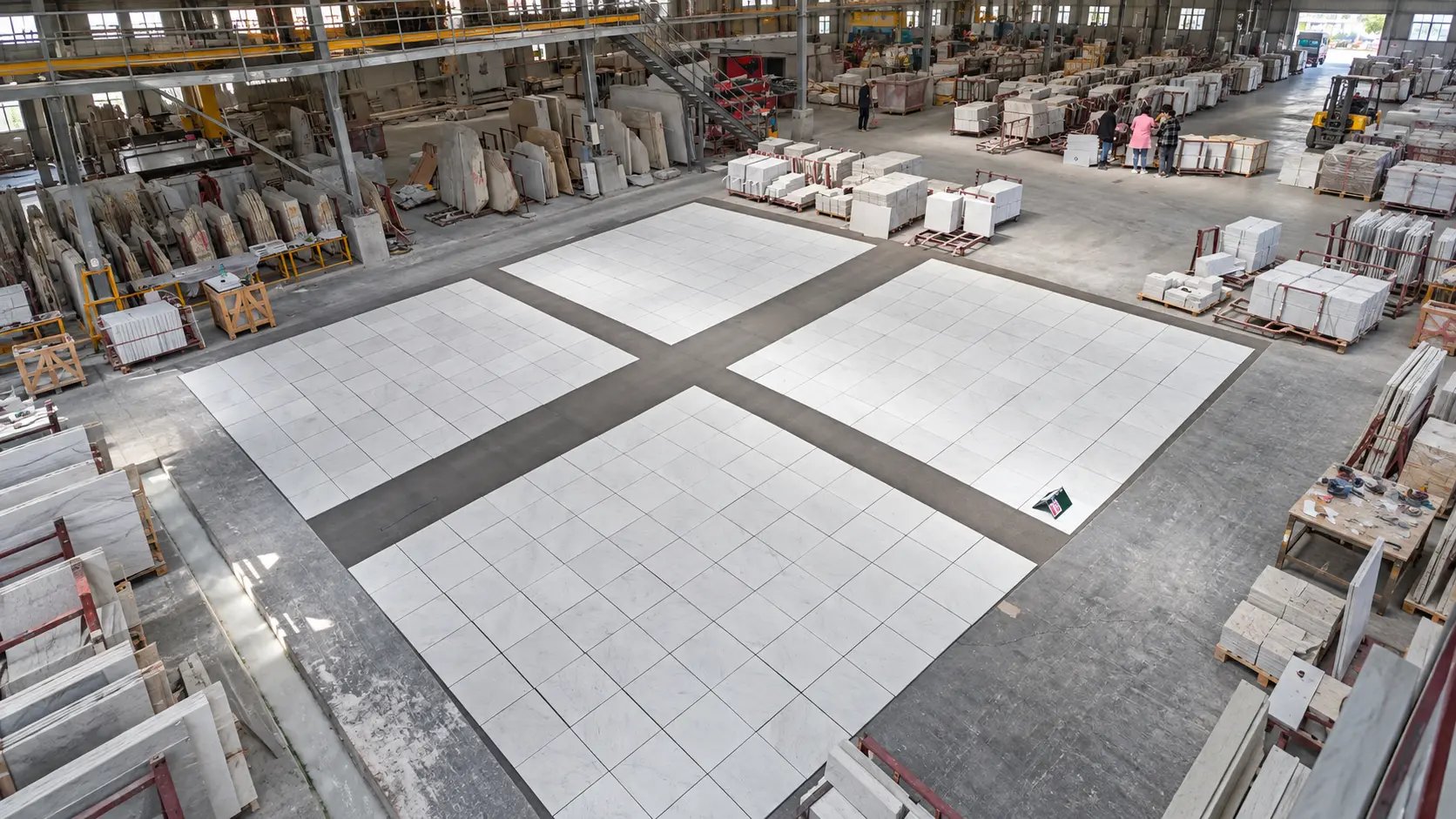
Natural stone dry lay inspection is one of the most useful quality-control stages between fabrication and export packing. Instead of inspecting individual pieces separately, the factory arranges related panels, tiles, treads, vanity components or other cut-to-size pieces in their intended sequence so the overall visual and dimensional result can be reviewed before shipment.
This process is especially important for natural marble, quartzite and travertine because every slab contains variation. Two pieces may both meet the drawing dimensions but still create an unsuitable result if the background colour, vein direction, joint relationship or sequence is wrong.
For international hotel, luxury retail, high-end residential and commercial projects, a natural stone dry lay inspection also gives the buyer an opportunity to review QC photos or video remotely before the material is protected and loaded into export crates.
At Show Stone, dry lay can be coordinated with approved shop drawings, digital slab layouts, piece numbers and packing references so the same information remains traceable from fabrication through inspection and delivery.
Buyer Decision Check
- Visual approval: Decide whether colour range, vein direction and bookmatching should be approved before packing.
- Dimensional control: Confirm which dimensions, joints, openings, edges and mitres need to be checked during dry lay.
- Reference documents: Provide the latest approved drawings and digital layouts for comparison.
- Piece identification: Define the numbering system by room, floor, elevation, stair flight or installation sequence.
- Remote approval: Confirm whether QC photographs, video or both are required before shipment.
- Correction process: Agree that identified issues should be corrected and re-checked where required before final packing.
What Is Natural Stone Dry Lay Inspection?
A natural stone dry lay inspection is a pre-shipment factory process in which fabricated stone pieces are arranged without permanent installation so their relationships can be checked together.
Depending on the project, this may involve laying pieces horizontally on a clean factory floor, positioning wall panels in sequence, assembling fireplace components, arranging stair treads and risers, or setting out custom cut-to-size pieces according to approved numbering.
The purpose is not to simulate every site condition. It is to identify visual, dimensional and sequencing issues that can be checked more efficiently before the stone leaves the factory.
Dry lay is therefore different from on-site installation. Show Stone can carry out factory dry lay, QC, numbering and installation coordination, but does not undertake final on-site installation.
Why Dry Lay Matters Before International Shipment
Once natural stone has been packed into wooden crates and shipped internationally, correcting a fabrication or layout problem becomes significantly more difficult.
A factory inspection can help project teams identify issues while the material, drawings, fabrication equipment and production team are still available in one location.
Dry lay can be used for:
- Wall panels
- Floor tiles
- Large-format cut-to-size panels
- Stair treads and risers
- Vanity tops
- Countertops
- Fireplace surrounds
- Bookmatched marble walls
- Patterned stone flooring
- Custom project components
The process is particularly valuable when individual pieces depend on one another visually or dimensionally.
1. Check the Overall Colour Range
The first dry-lay check should usually be the overall colour balance.
Natural stone is not a uniform manufactured surface. Background tones may change from slab to slab, and even consecutive slabs can contain lighter, darker, warmer or cooler areas.
During natural stone dry lay inspection, review whether:
- One piece appears much lighter or darker than adjacent pieces
- The overall colour transition is acceptable
- Warm and cool areas have been distributed appropriately
- Strong natural variation matches the approved project expectation
Materials such as Sofitel Gold Marble can show warm tonal movement that should be evaluated across the entire visible group rather than one piece at a time.
2. Check Background Colour Consistency
Background colour is different from individual veins. A marble may have attractive veining but still produce an inconsistent wall or floor if the base colour changes abruptly between adjacent pieces.
This is why batch coordination and full-slab selection should happen before cutting, while dry lay serves as a second visual checkpoint after fabrication.
For strongly decorative materials, the objective is not always to make every piece identical. Instead, the goal is to create an intentional and acceptable visual transition.
For guidance on material selection before cutting, see How to Select Natural Stone Slabs.
3. Check Vein Direction
Vein direction is one of the most common reasons for arranging pieces before shipment.
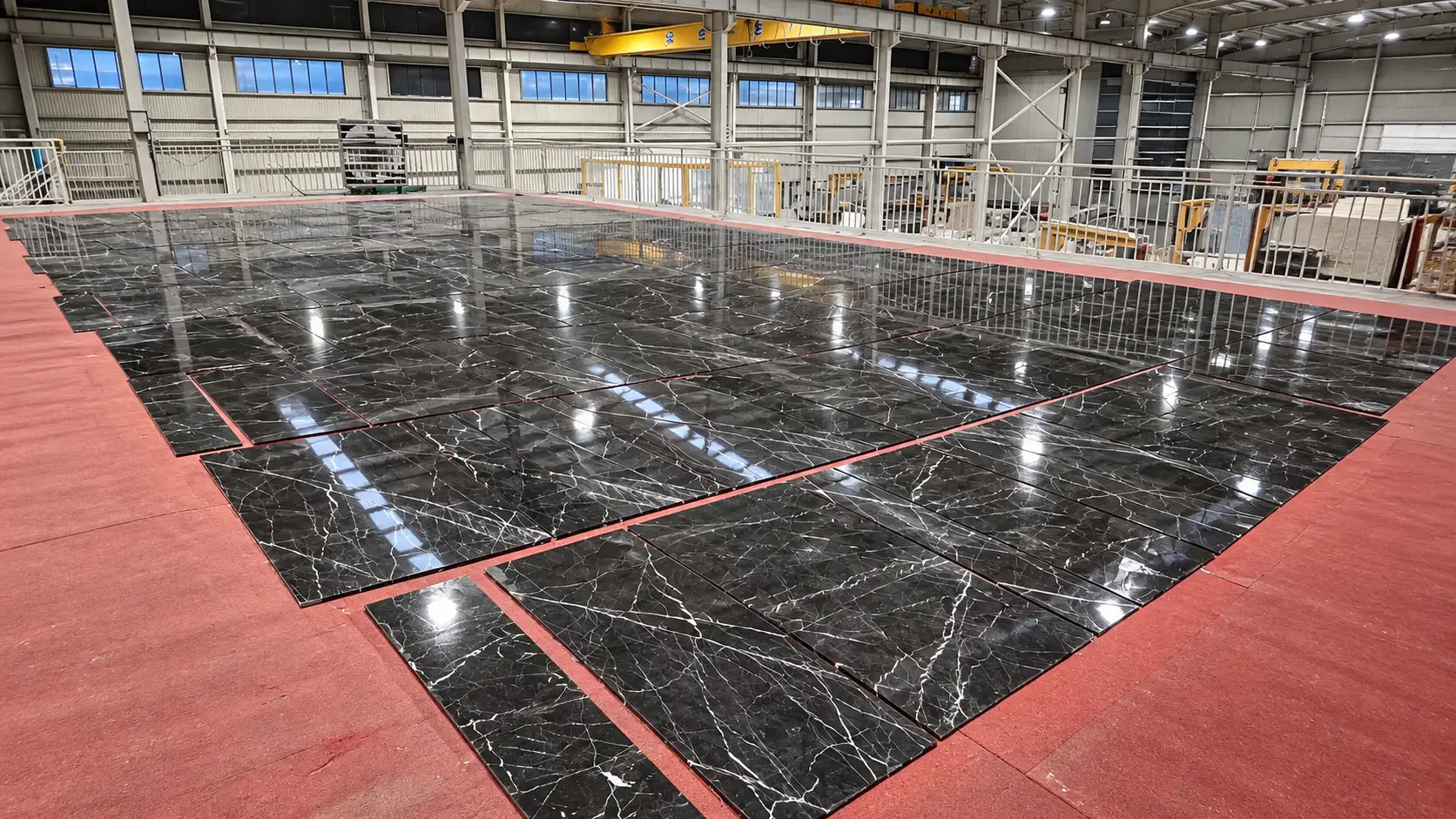
Directional natural stone can appear disorganised if pieces are rotated independently during cutting or packing.
Dry lay allows the QC team to confirm whether the veins:
- Run in the intended direction
- Continue naturally from one piece to the next
- Follow the approved elevation or floor layout
- Create unwanted visual breaks at joints
Materials such as Breccia Violetta Marble can contain strong movement, making the relationship between neighbouring pieces particularly important.
4. Check Bookmatching and Vein Matching
Bookmatched and vein-matched stone layouts require more control than random installation.
For a bookmatched wall, adjacent panels may need to create a mirrored composition. For vein matching, the objective may instead be to continue a vein naturally across several pieces.
During natural stone dry lay inspection, compare the physical arrangement with the approved digital layout and check:
- Correct panel order
- Correct panel orientation
- Mirror relationship
- Vein continuity
- Joint position
- Overall visual balance
Arabescato Marble is an example of a material where expressive veining can make layout planning particularly valuable.
For a deeper explanation, see Bookmatched Marble Walls: Slab Selection, Layout, Fabrication & Installation.
5. Check Fabricated Dimensions
Visual matching is only one part of QC. The fabricated pieces must also match the approved dimensions.
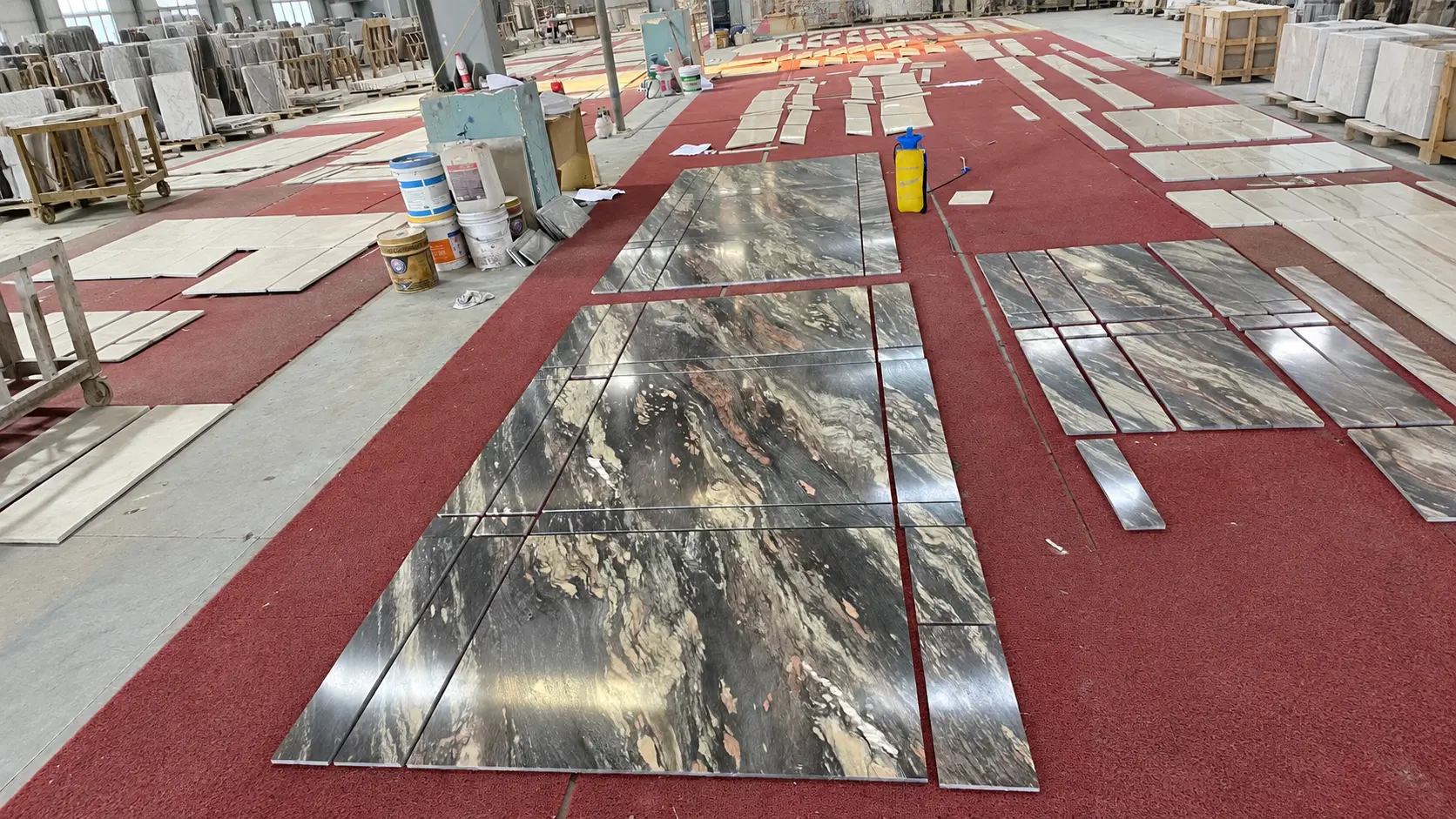
Depending on the project, dimensional inspection may include:
- Length
- Width
- Thickness
- Panel shape
- Opening dimensions
- Cut-out locations
- Edge positions
Complex custom pieces should be compared with the most recent approved drawing rather than an earlier design revision.
6. Check Joint Alignment
Joints that look acceptable on individual pieces may become visibly misaligned once the full assembly is arranged.
During dry lay, check whether:
- Horizontal joints continue correctly
- Vertical joints align with the design
- Pattern lines cross joints appropriately
- Panel sizes correspond to the approved elevation
- Geometric flooring pieces fit the intended pattern
This is particularly important for wall elevations, patterned flooring and installations with strong architectural grids.
7. Check Geometric Floor Patterns
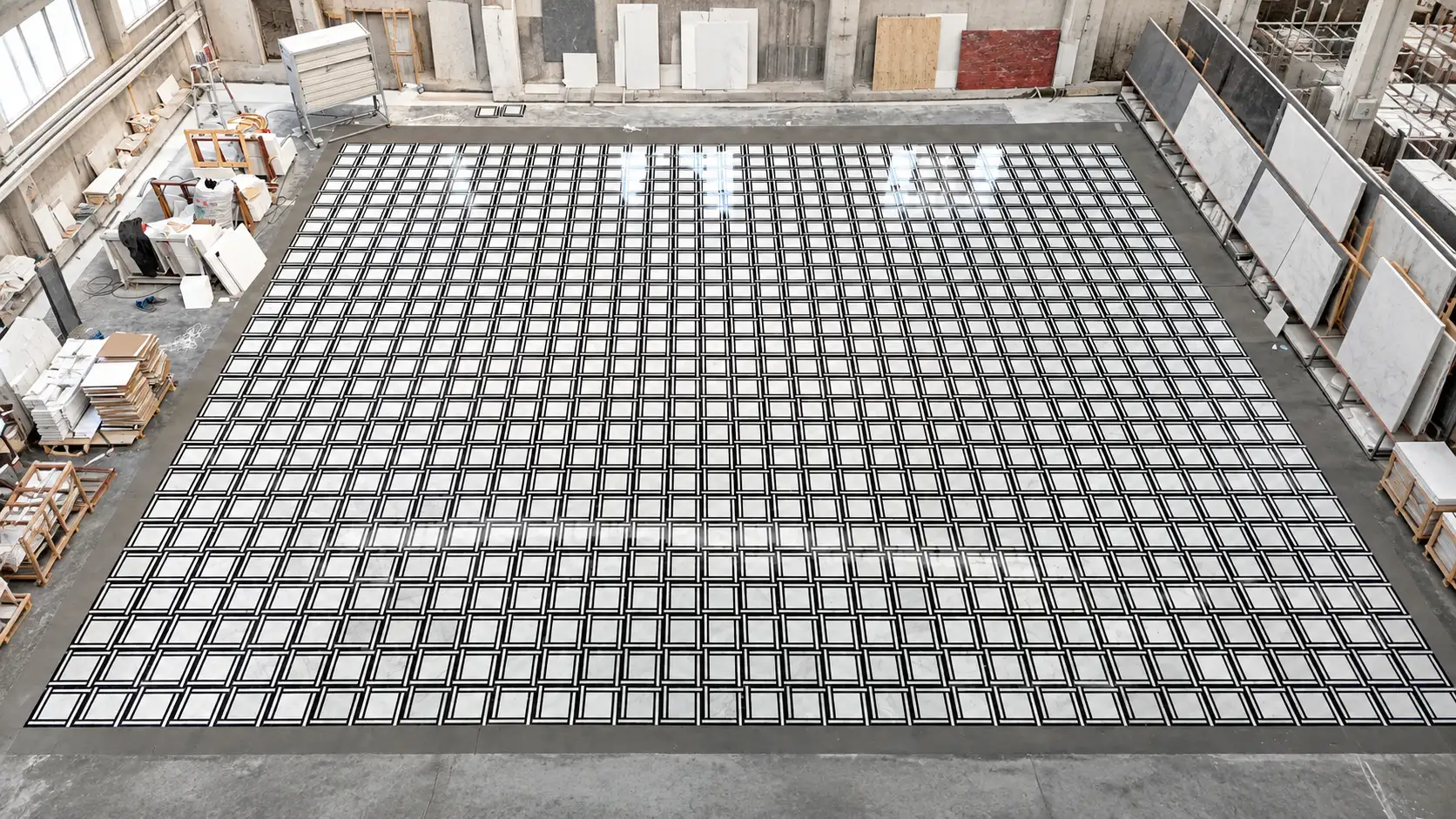
Patterned natural stone flooring can contain repeated shapes, borders, directional pieces and multiple colours.
A natural stone dry lay inspection can help verify:
- Pattern repetition
- Piece orientation
- Border alignment
- Corner conditions
- Joint spacing references
- Colour distribution
- Installation sequence
For materials such as Travertino Classico, dry lay can also help project teams review tonal variation and directional movement across a larger floor area.
8. Check Edge Profiles and Mitres
Edges should be inspected according to the approved fabrication detail.
Typical checks include:
- Mitred edges
- Built-up edges
- Bullnose profiles
- Bevels
- Custom mouldings
- Exposed polished edges
For mitred assemblies, inspect how the two finished surfaces meet and whether the resulting corner aligns with the approved design.
9. Check Cut-Outs and Openings
Cut-outs should be checked before packing because a misplaced sink, tap, electrical or mechanical opening can make an otherwise correctly fabricated piece unusable.
Typical openings may include:
- Sink cut-outs
- Cooktop openings
- Tap holes
- Floor drains
- Electrical openings
- Ventilation openings
- Service access openings
Where relevant, the QC team should compare the location and size with the approved fabrication drawing.
10. Check the Surface Finish
Dry lay also provides an opportunity to inspect whether the finish is visually consistent across related pieces.
This may include checking:
- Polished finish
- Honed finish
- Brushed finish
- Tumbled finish
- Leathered finish
- Other approved project finishes
For polished pieces, inspect reflection and sheen consistency. For honed or textured surfaces, review whether the finish appears uniform across the visible assembly.
11. Check for Visible Fabrication or Material Issues
Natural stone contains natural variation, and some materials may include veins, fissures, mineral areas or reinforced sections. These should not automatically be treated as defects.
However, QC should distinguish expected natural characteristics from problems that require correction or further review.
Visual inspection can include:
- Edge chips
- Unwanted scratches
- Polishing inconsistencies
- Incorrect repairs
- Fabrication damage
- Unexpected visual concentration
Where an issue is identified, it can be reviewed before the material is packed.
12. Compare the Dry Lay With Approved Drawings
A visually attractive arrangement is not enough if it does not match the approved project documentation.
The dry lay should be compared with the relevant:
- Shop drawing
- Elevation
- Floor layout
- Cutting list
- Piece schedule
- Approved digital slab layout
Show Stone develops and coordinates stone-specific fabrication information based on drawings supplied by the client, designer or contractor. Final project design and structural engineering remain with the appointed project professionals.
For more detail, see Natural Stone Shop Drawings Explained: What to Check Before Fabrication.
13. Compare Physical Pieces With the Digital Slab Layout
For strongly patterned materials, digital slab scanning and cutting layouts can be used before fabrication to determine where each finished piece should come from on the slab.
The dry lay provides the physical verification stage.
The QC team can compare:
Actual slab → Digital layout → Finished piece → Dry-lay position → Piece number
This workflow helps maintain continuity between planning and production.
Materials such as Super White Quartzite can benefit from this approach when a project requires controlled pattern distribution across multiple visible panels.
14. Confirm Piece Numbering
Piece numbering should be checked while the full dry lay is visible.
A traceable numbering system may follow:
Project → Building → Floor → Room → Elevation → Piece
For other applications, the sequence may use:
Project → Stair Zone → Flight → Step → Component
or:
Project → Room → Fireplace → Component
The important point is that the same reference should remain consistent across the drawing, physical stone, QC documentation, packing list and crate label.
15. Use QC Photos and Video for Remote Approval
International buyers cannot always visit the factory for every inspection.
QC photographs and video can provide a practical remote review method before shipment.
Useful documentation may include:
- Full dry-lay overview
- Close-up joint photographs
- Vein matching details
- Piece-number photographs
- Edge details
- Cut-out measurements
- Finish details
For larger or more complex assemblies, video can help show the relationship between multiple pieces more clearly than isolated photographs.
16. Correct Issues Before Packing
The main value of natural stone dry lay inspection is that there is still an opportunity to act before shipment.
If an issue is identified, the response may include:
- Re-polishing
- Edge correction
- Re-numbering
- Re-orienting pieces
- Re-cutting where required
- Replacing an unsuitable piece where feasible
- Updating the packing sequence
After correction, selected areas or the complete assembly can be re-checked or re-dry-laid when required.
17. Approve Before Export Packing
Once the dry lay has been reviewed and required corrections have been completed, the finished pieces can move into packing.
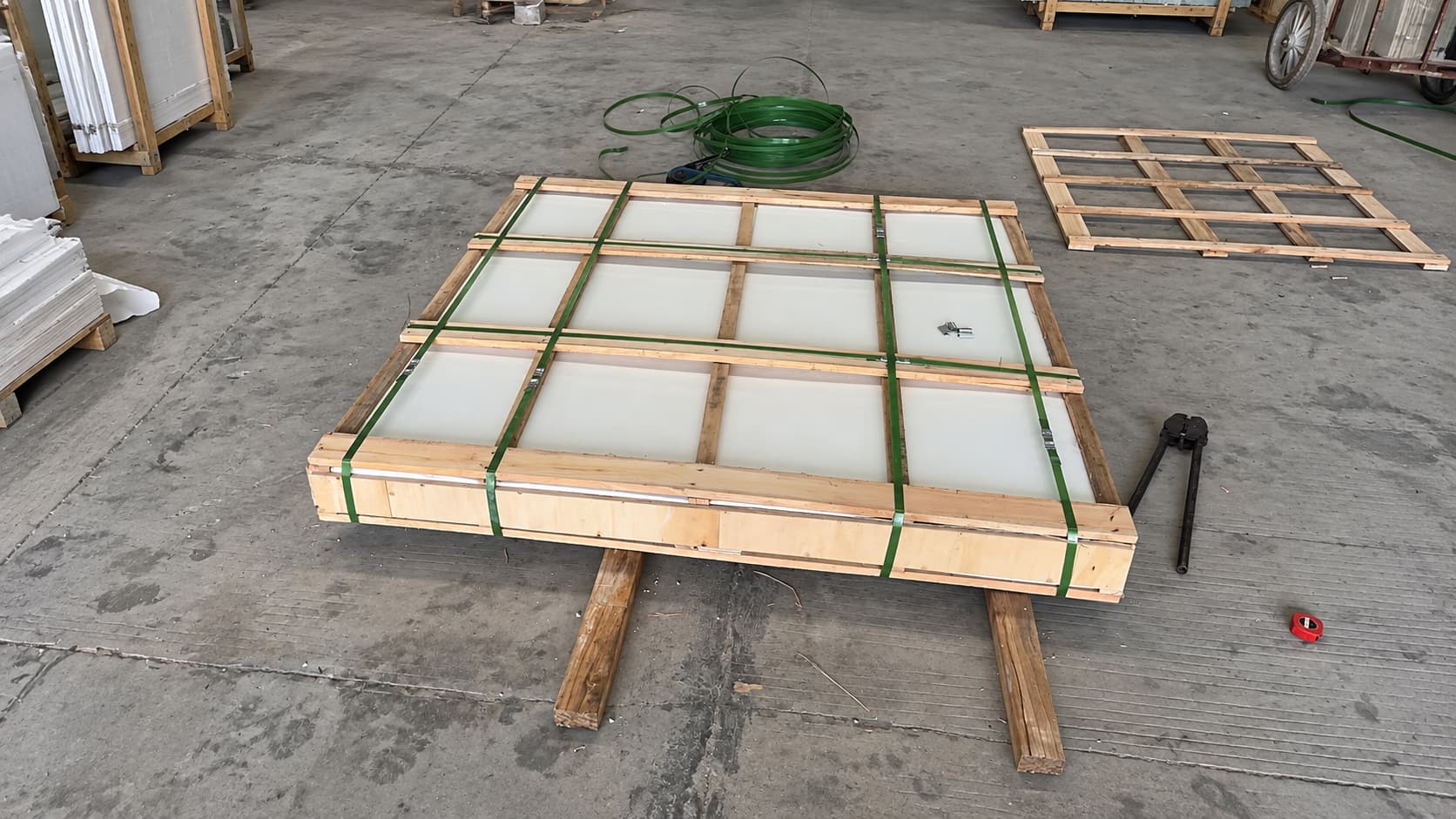
Packing can be coordinated by:
- Room
- Floor
- Elevation
- Stair flight
- Stone package
- Installation sequence
Foam protection and export wooden crates help protect finished pieces during international transportation.
Dry Lay for Wall Panels
Large-format wall panels often require close visual control because multiple pieces are viewed together as one continuous elevation.
Dry lay can help verify:
- Panel sequence
- Bookmatching
- Vein direction
- Joint alignment
- Colour distribution
- Piece numbering
This is especially useful for hotel lobbies, luxury retail interiors, bathroom walls and residential feature walls.
Dry Lay for Staircases
Staircase dry lay is useful because many treads and risers may be visually similar while having different dimensions or positions.
The factory can check:
- Tread-riser relationships
- Step sequence
- Vein direction
- Nosing profiles
- Landing transitions
- Individual step numbers
For more information, see Natural Stone Staircases for Luxury Interiors.
Dry Lay for Fireplace Surrounds
Custom fireplace packages can contain a mantel, legs, jambs, header, hearth, panels and carved profiles.
Full dry lay can help verify that these individual pieces work together before packing.
For a detailed example of this workflow, see Marble Fireplace Surrounds: Stone Selection, Profiles, Fabrication & Installation Guide.
Technical Dry Lay Inspection Checklist
| Inspection Item | What to Check | Reference |
|---|---|---|
| Colour Range | Light/dark variation and overall balance | Approved slabs / sample range |
| Background Colour | Warm/cool variation and panel transitions | Slab approval |
| Vein Direction | Orientation and continuity | Elevation / digital layout |
| Bookmatching | Mirror relationship and sequence | Approved bookmatch layout |
| Dimensions | Length, width, thickness and shape | Approved fabrication drawing |
| Joints | Alignment and panel relationship | Elevation / floor layout |
| Edge Profiles | Mitres, bullnose, bevels and custom details | Section detail |
| Cut-Outs | Size and position | Approved shop drawing |
| Surface Finish | Polish, hone or texture consistency | Approved finish sample |
| Piece Numbering | Correct room, floor, elevation or sequence | Drawing / piece schedule |
| QC Documentation | Photos and video before packing | Buyer approval requirements |
| Packing | Crate sequence and labels | Packing list / installation sequence |
Common Mistakes During Natural Stone Dry Lay Inspection
Checking Only Individual Pieces
Individual pieces may appear acceptable while the complete wall, floor or staircase still has colour or vein inconsistencies.
Reviewing Colour but Ignoring Dimensions
Dry lay should combine visual inspection with dimensional QC rather than focusing on appearance alone.
Using an Outdated Drawing
The factory should compare finished stone with the latest approved drawing revision.
Ignoring Piece Orientation
A correctly sized panel can still be wrong if it has been rotated or positioned in the wrong sequence.
Not Checking Cut-Outs
Cut-outs and openings should be confirmed before the stone is packed and shipped.
Removing Piece Numbers After Inspection
Identification should remain traceable through packing and site delivery.
Packing Before Buyer Approval
Where remote approval is part of the project workflow, QC documentation should be reviewed before final packing.
Treating Dry Lay as Site Installation
Factory dry lay is a pre-shipment quality-control process. Final site conditions, substrates, setting materials, tolerances and installation remain the responsibility of the appointed site team.
Buyer Checklist Before Ordering
- Dry-Lay Scope: Confirm which walls, floors, staircases or custom assemblies require dry lay.
- Approved Drawings: Provide the latest drawing revision before inspection.
- Digital Layout: Confirm whether physical pieces should be compared with the approved slab layout.
- Colour Range: Define any important colour or background-selection requirements.
- Vein Direction: Confirm directional requirements before cutting.
- Bookmatching: Approve panel sequence and mirror arrangement.
- Dimensions: Define critical dimensions and tolerances according to project requirements.
- Joints: Confirm expected joint and panel relationships.
- Edges: Confirm mitres, bullnose, bevels and custom profiles.
- Cut-Outs: Provide final approved positions and dimensions.
- Finish: Confirm polished, honed or other approved surface treatment.
- Numbering: Establish room, floor, elevation or installation-sequence references.
- QC Documentation: Confirm whether photographs, video or both are required.
- Approval: Identify who is authorised to approve the dry lay before packing.
- Corrections: Allow time for correction and re-checking if an issue is found.
- Packing: Coordinate crate references with the installation sequence.
Frequently Asked Questions
What is natural stone dry lay inspection?
Natural stone dry lay inspection is a factory quality-control process in which fabricated stone pieces are arranged in their intended sequence so colour, vein direction, dimensions, joints, edges, cut-outs, finish and piece numbering can be reviewed before packing.
Which stone projects benefit from dry lay?
Dry lay can be used for wall panels, floors, staircases, vanity tops, countertops, fireplace surrounds, bookmatched walls, geometric flooring and other custom cut-to-size stone packages.
Can dry lay be used to check bookmatched marble?
Yes. Bookmatched panels can be arranged in sequence so the mirror relationship, vein position, joint alignment and overall composition can be compared with the approved layout.
Can dimensions be checked during dry lay?
Yes. Finished length, width, thickness, shape, openings and other critical fabrication dimensions can be compared with the approved drawings during factory QC.
Can buyers approve dry lay remotely?
Yes. QC photographs and video can be provided for remote review so buyers and project teams can inspect the arrangement before the finished pieces are packed.
What happens if a problem is found during dry lay?
Where feasible, issues can be corrected before packing. The affected pieces or complete assembly can then be re-checked or re-dry-laid when required.
Are stone pieces numbered after dry lay?
Yes. Pieces can be numbered by project, building, floor, room, elevation, stair flight or other approved sequence so the references remain traceable through packing and delivery.
Does dry lay happen before export packing?
Yes. The normal sequence is fabrication, factory QC and dry lay, approval or correction where required, piece numbering and then protective export packing.
Is factory dry lay the same as on-site installation?
No. Factory dry lay is a pre-shipment inspection process. It does not reproduce all site conditions and does not replace final installation by the appointed contractor or specialist stone installer.
Does Show Stone perform on-site installation?
No. Show Stone provides fabrication support, factory dry lay, QC documentation, piece numbering, packing and installation coordination, while final on-site installation is carried out by the client or appointed contractor.
Why Project Buyers Work With Show Stone
Show Stone supports architects, designers, contractors, hotel groups, retailers and international project buyers with a workflow that connects slab selection, digital layout, fabrication, natural stone dry lay inspection, numbering and export packing.
Our project QC support can include:
- Full-slab photography and video approval
- Batch and colour coordination
- Digital slab scanning
- Digital cutting layouts
- Bookmatching and vein matching
- Custom cut-to-size fabrication
- Wall panel dry lay
- Floor tile dry lay
- Staircase dry lay
- Vanity and countertop dry lay
- Fireplace dry lay
- Colour and background inspection
- Vein-direction inspection
- Dimension and thickness inspection
- Joint-alignment inspection
- Edge and mitre inspection
- Cut-out and opening inspection
- Polished and honed finish inspection
- Visual QC
- Comparison with approved drawings
- Comparison with digital slab layouts
- Piece numbering
- Room, floor and elevation references
- QC photographs and video
- Remote buyer approval
- Correction and re-checking where required
- Packing by installation sequence
- Foam protection and export wooden crates
- International shipment coordination
Show Stone does not undertake final on-site installation. The appointed contractor or specialist installer remains responsible for site conditions, substrates, installation tolerances and final installation.
Project teams can review materials such as Travertino Classico, Sofitel Gold Marble, Breccia Violetta Marble, Arabescato Marble and Super White Quartzite.
To understand how dry lay fits into the wider production workflow, see Natural Stone Fabrication Process for Hotel and Retail Projects.
For independent natural-stone design and specification resources, project teams can also review the Natural Stone Institute resources for design professionals.
Final Recommendation
Natural stone dry lay inspection should be treated as a controlled pre-shipment quality-control stage rather than a simple photo opportunity. A useful inspection reviews the complete stone package against the approved design, including colour range, background tone, vein direction, bookmatching, dimensions, joints, edge profiles, mitres, openings, finish and piece sequence.
For high-value hotel, luxury retail, residential and commercial projects, combining dry lay with digital slab layouts, QC photographs or video, clear piece numbering and installation-sequence packing can provide better traceability from factory production to site delivery.
To discuss dry lay requirements for a natural stone project, please contact Show Stone with your material selection, approved drawings, quantity, dry-lay scope, QC requirements and delivery destination.