Natural Stone Reception Desks for Luxury Hotels: Materials, Design & Fabrication
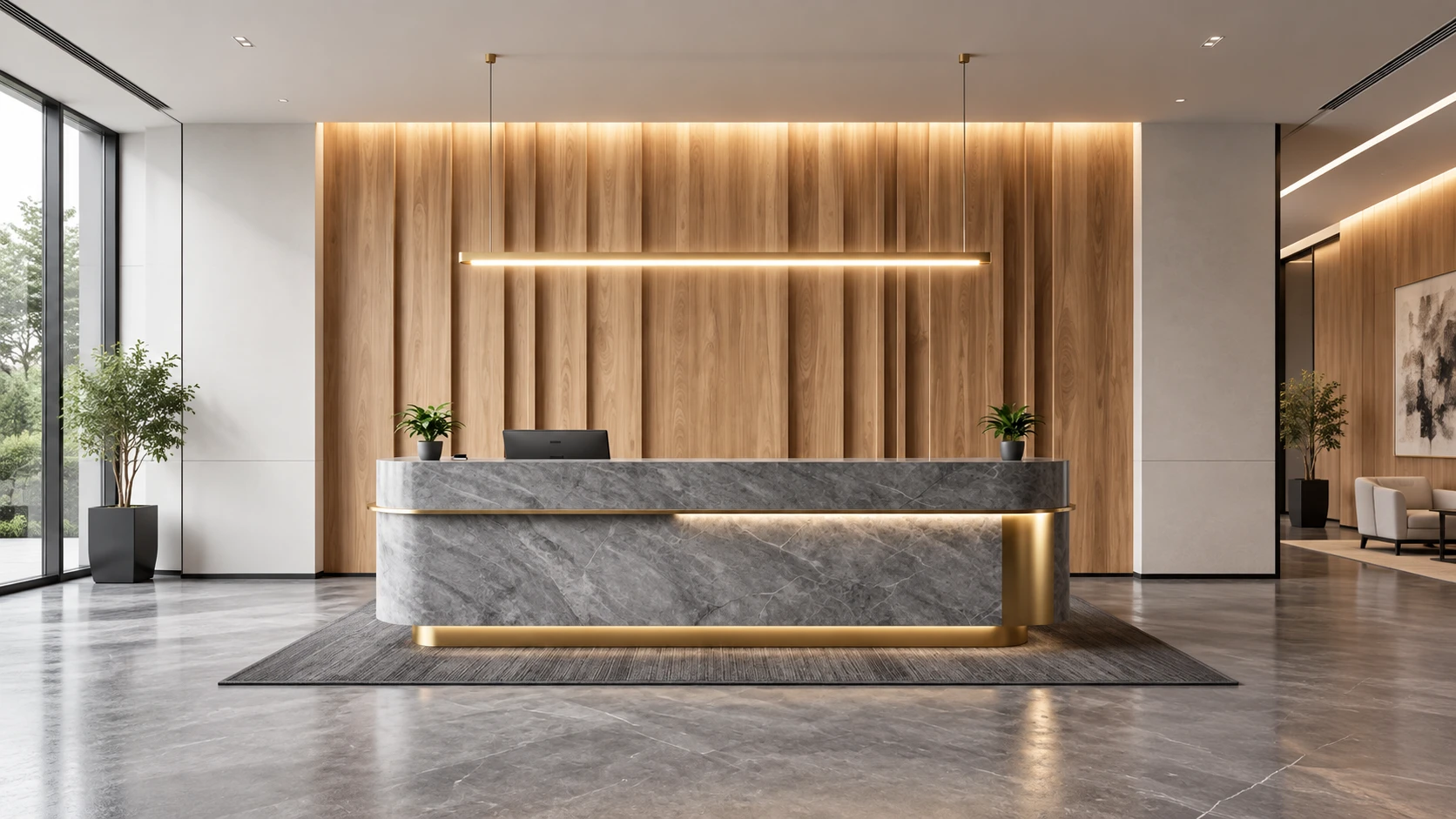
Natural stone reception desks are often one of the first architectural elements guests see when entering a luxury hotel. The reception counter must perform as a working front desk, but it also contributes strongly to the visual identity of the lobby.
Marble, quartzite, onyx and travertine can all be used for reception countertops, front cladding, side panels, return panels and feature elements. However, the final result depends on much more than the stone name. Slab selection, vein position, desk geometry, edge details, lighting, cut-outs, substrate coordination and factory inspection all affect the completed counter.
For custom natural stone reception desks, it is useful to connect the design drawings with the actual slabs before cutting begins. Digital slab scanning, cutting layouts, mock-ups, dry lay, piece numbering and installation-sequence packing can all help reduce uncertainty between design approval and site installation.
Project buyers can also explore Show Stone’s natural stone collection, marble collection, quartzite collection and Onyx & Semi-Precious Stones collection.
Buyer Decision Check
- Best materials: Marble, quartzite, onyx and travertine depending on design, durability, translucency and fabrication requirements.
- Main design decision: Confirm whether the reception desk is straight, curved, faceted, fluted, backlit or combined with timber and metal.
- Main visual-control requirement: Approve actual slabs, vein direction and visible front-panel composition before cutting.
- Main fabrication requirement: Confirm countertop thickness, mitres, curved panels, equipment openings and lighting-related details.
- Main delivery requirement: Number finished components and pack them according to desk section, zone and installation sequence.
Why Natural Stone Reception Desks Matter in Luxury Hotels
The reception desk is both furniture and architecture. It sits at the operational centre of the lobby while also acting as a strong material statement.
Natural stone reception desks can help create:
- A premium arrival experience
- A strong visual focal point
- Continuity with lobby flooring or wall cladding
- A durable front-counter surface
- Custom curved or sculptural forms
- Backlit decorative features
- Integration with timber, metal and lighting
Because the desk is viewed from several directions, both the countertop and the vertical cladding need to be coordinated as a complete composition.
Natural Stone Reception Desks: 12 Key Design and Fabrication Decisions
The following twelve decisions cover the main stages from material selection through fabrication, quality control and export delivery.
1. Choose the Stone According to the Lobby Design
The material should support the wider hotel interior rather than being selected in isolation.
Calacatta Monet Marble
Calacatta Monet Marble can create a high-impact reception desk where dramatic natural veining is intended to become a visual feature.
Victoria Green Marble
Victoria Green Marble can provide a deep green statement for front cladding, side panels or selected lobby accents.
Arabescato Marble
Arabescato Marble offers a white-and-grey marble direction that can suit bright luxury lobbies and refined contemporary interiors.
Taj Mahal Quartzite
Taj Mahal Quartzite works well for warm neutral reception counters and can coordinate with timber, bronze, brushed metal and beige interior palettes.
Juliet Crystal Quartzite
Juliet Crystal Quartzite can be used where a more exotic stone pattern is required for a statement countertop or feature front.
Travertino Classico
Travertino Classico can support warmer architectural lobby concepts, including fluted or textured front-cladding designs.
Afghan Green Onyx
Afghan Green Onyx is particularly suitable for illuminated reception features where translucency becomes part of the design.
2. Review the Actual Slabs Before Production
Small samples are useful for confirming a general material direction, but natural stone reception desks should normally be planned from the actual slabs when the pattern is visually important.
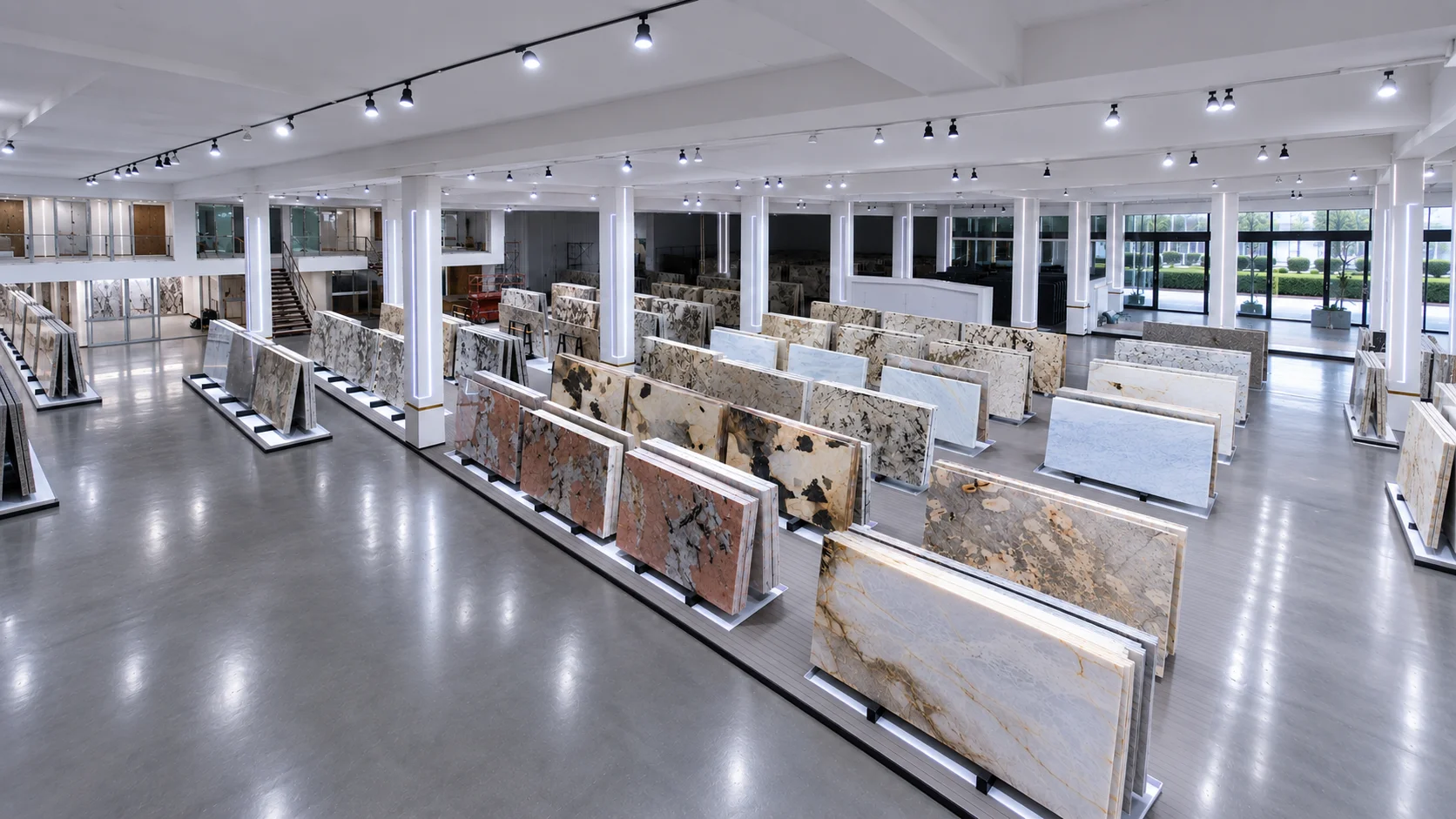
Full-slab review helps the project team evaluate:
- Background colour
- Vein direction
- Pattern concentration
- Natural variation
- Usable slab dimensions
- Visible repairs or fissures
- Compatibility between countertop and front-cladding pieces
Full-slab photography and video can support remote approval for international projects.
3. Define Straight, Curved or Sculptural Geometry
The geometry of the reception desk affects almost every later fabrication decision.
Common designs include:
- Straight reception counters
- L-shaped desks
- U-shaped desks
- Curved reception desks
- Radius fronts
- Faceted stone counters
- Fluted stone fronts
- Mixed stone-and-timber counters
Curved and radius designs require additional coordination because panel size, joint positions, backing, CNC processing and substrate geometry all influence the finished result.
4. Coordinate the Countertop Thickness
Reception-desk countertops commonly use 20mm or 30mm stone, depending on the design and structural support condition.
Thicker visual edges can also be created through mitred built-up fabrication where appropriate.
The drawings should confirm:
- Finished countertop thickness
- Visible front edge
- Side returns
- Overhang
- Support conditions
- Joint positions
These details should be coordinated with the underlying metal or timber structure before cutting.
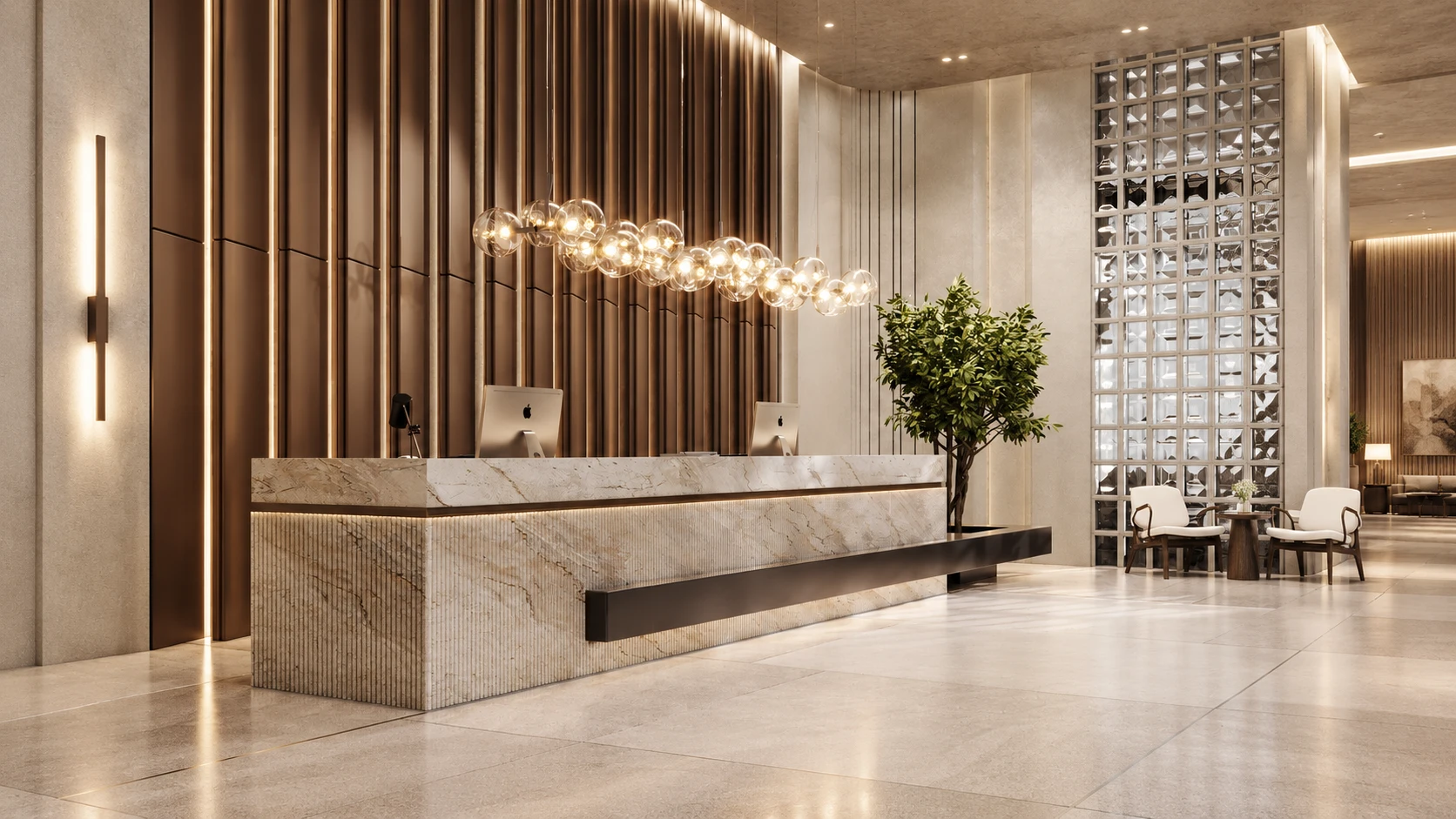
5. Design Front Cladding as a Complete Composition
The front elevation is often the most visible surface of the entire reception desk.
Front cladding may use:
- Large flat panels
- Book-matched marble
- Vein-matched panels
- Fluted stone
- Curved segments
- Backlit onyx
- Stone combined with metal or timber
Common cladding thicknesses are 18mm and 20mm, while other thicknesses can be produced by custom order.
6. Coordinate Curved and Radius Stone Fabrication
Curved natural stone reception desks require close coordination between the design geometry and the fabrication method.
The fabrication process may involve:
- Segmented curved panels
- Radius templates
- CNC machining
- Waterjet processing
- Mitred transitions
- Fluted curved faces
- Custom backing support
The actual radius should be confirmed on approved drawings before production begins.
7. Use Backlit Onyx for Selected Reception Features
Backlit onyx can make a hotel reception desk function as both furniture and a lighting feature.
Possible applications include:
- Front illuminated panels
- Reception-desk feature inserts
- Side panels
- Backlit logo zones
- Decorative counter fronts
Afghan Green Onyx can create a strong green translucent effect for statement lobby concepts.
Onyx is commonly supplied at 16mm for many custom applications. Lighting-related fabrication, backing and support details should be coordinated before production.
8. Coordinate Stone With Metal and Wood Substrates
Most reception desks are composite assemblies rather than solid blocks of stone. Natural stone may be fixed over a metal frame, timber carcass or another approved substrate.
Stone fabrication therefore needs to consider:
- Substrate thickness
- Support points
- Fixing zones
- Access panels
- Lighting cavities
- Joint positions
- Stone returns
- Metal trims
Show Stone can coordinate stone-specific fabrication details with approved metal and timber substrate information supplied by the project team.
9. Plan Equipment Openings Before Cutting
Reception desks often contain more technical equipment than is visible from the guest side.
Typical openings can include:
- Cable holes
- Electrical access openings
- POS equipment cut-outs
- Monitor or screen openings
- Lighting access
- Service access panels
Dimensions should be confirmed from approved equipment information rather than estimated during fabrication.
For a detailed explanation of drawing checks before production, see Natural Stone Shop Drawings Explained: What to Check Before Fabrication.
10. Use Digital Slab Scanning and Cutting Layouts
Digital slab planning helps connect the approved reception-desk drawings with the actual stone.
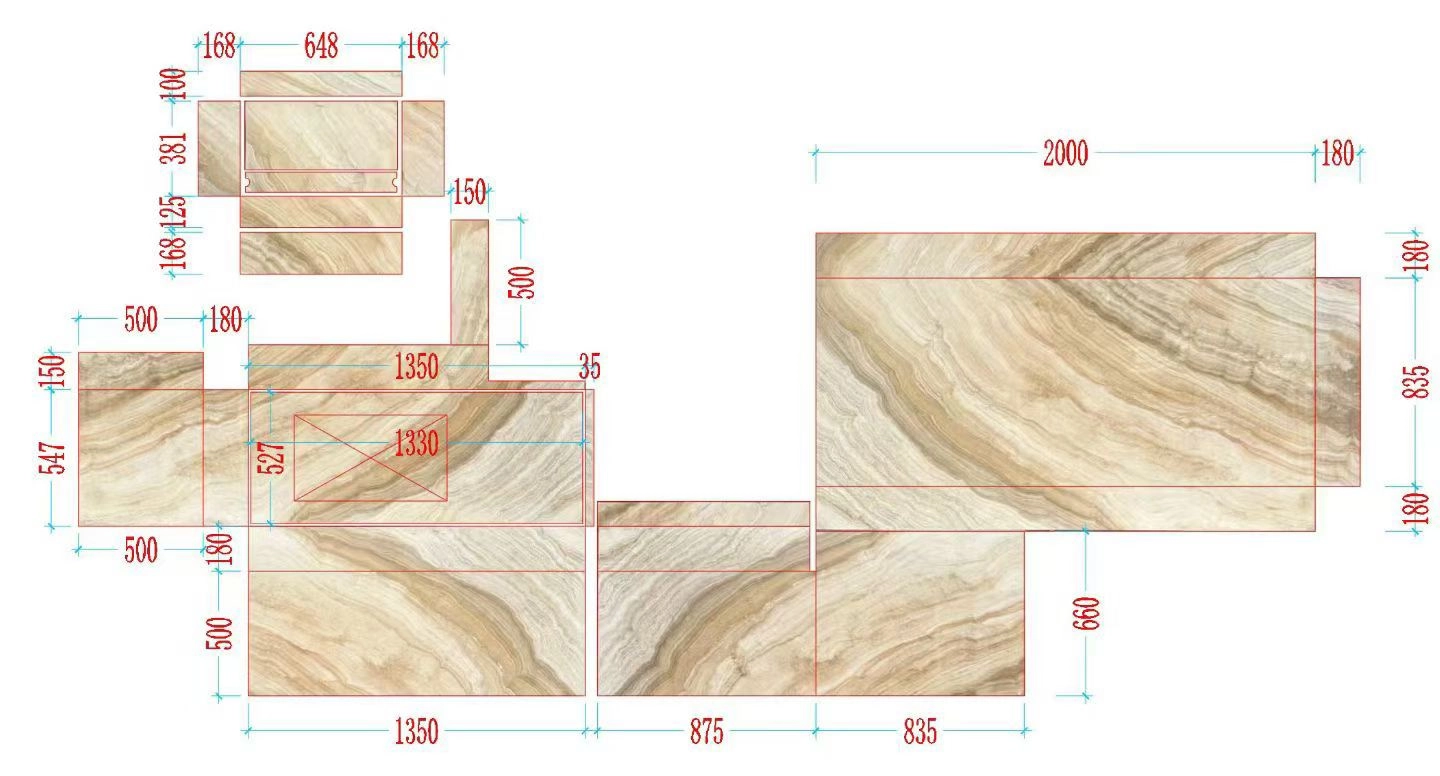
A digital layout can help review:
- Countertop vein position
- Front-panel composition
- Book matching
- Vein continuity
- Side-return relationships
- Cut-outs
- Material yield
This is particularly useful for high-value or highly varied materials such as Calacatta marble and exotic quartzite.
11. Use Mock-Ups and Dry Lay Before Packing
Where the reception desk contains repeated fluting, complex mitres, unusual curves or mixed materials, a mock-up can help confirm the detail before full production.
Dry lay is then useful for checking finished pieces before export.
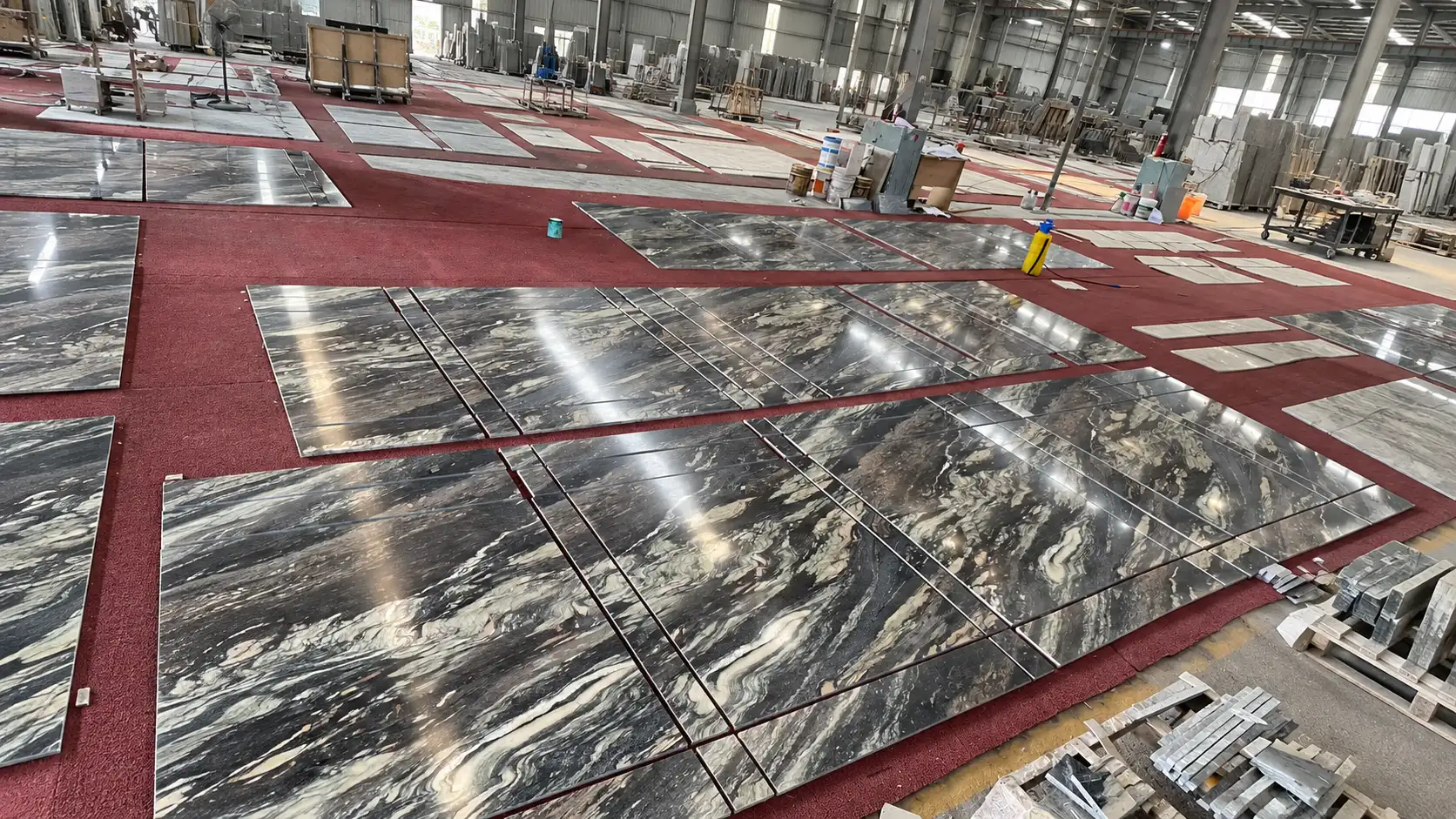
The image above demonstrates a general natural-stone dry-lay workflow. The same process can be applied to reception-desk countertops, front panels, side panels and other multi-piece assemblies.
Dry-lay inspection can help confirm:
- Panel alignment
- Vein relationships
- Dimensions
- Mitred connections
- Piece numbering
- Visual consistency
12. Number and Pack by Desk Section and Installation Sequence
A large reception desk may contain many separate stone pieces. Clear identification helps reduce confusion during site installation.
A practical sequence can follow:
Project → Lobby Zone → Desk Section → Elevation → Piece Number → Crate
Finished stone can be protected with foam and export wooden crates, with crate references linked to the packing list and piece numbers.
Polished vs Honed Reception Desk Finishes
Polished
A polished finish increases reflection and colour depth and can be especially effective for marble, quartzite and onyx used in visually prominent lobby areas.
Honed
A honed finish creates a softer and more understated surface, which may suit contemporary hotel interiors with lower visual gloss.
The final finish should be confirmed according to the selected stone, design intent and maintenance requirements.
Technical Specification Guidelines
| Specification | Typical Project Option | Project Notes |
|---|---|---|
| Materials | Marble / Quartzite / Onyx / Travertine | Select according to hotel concept and application. |
| Countertop Thickness | 20mm / 30mm | Other thicknesses available by custom order. |
| Front Cladding Thickness | 18mm / 20mm | Other thicknesses available according to design. |
| Onyx Thickness | 16mm common | Final thickness depends on backing and application requirements. |
| Finish | Polished / Honed | Other material-specific finishes can be discussed. |
| Geometry | Straight / Curved / Radius / Faceted | Final geometry should be confirmed from approved drawings. |
| Edges | Mitred / Built-up / Custom profiles | According to approved desk details. |
| Openings | Cable / Electrical / POS / Equipment | Dimensions should be confirmed before fabrication. |
| Digital Planning | Slab scanning / Cutting layout | Used for vein positioning and material-yield planning. |
| Fabrication | Waterjet / CNC / Mitres / Curved fabrication | According to the final desk geometry. |
| Reinforcement | Mesh / Resin / Honeycomb when required | Selected according to material and fabrication requirements. |
| Quality Control | Mock-up / Dry lay / Piece numbering | Useful for complex custom desk assemblies. |
| Installation Support | Mechanical / Adhesive coordination | Show Stone does not undertake on-site installation. |
| MOQ | 1 pc | Suitable for mock-ups and custom project pieces. |
| Lead Time | Approximately 4 weeks | Depends on material approval and fabrication complexity. |
| Packing | Foam + export wooden crates | Can be organised by desk section and installation sequence. |
Installation Coordination
Natural stone reception desks should be fabricated with the approved installation and substrate conditions in mind.
Show Stone can coordinate:
- Stone panel dimensions
- Metal and timber substrate interfaces
- Mechanical fixing-related details
- Adhesive installation coordination
- Piece numbering
- Desk-section references
- Installation-sequence information
Show Stone does not undertake on-site installation. Final installation is carried out by the client, contractor, joinery contractor, specialist stone installer or other appointed site team.
Common Mistakes When Specifying Natural Stone Reception Desks
Choosing the Material From a Small Sample Only
A small sample cannot show the full pattern scale or how the stone will appear across a large reception-desk front.
Designing the Stone Without Coordinating the Substrate
Stone thickness, returns, fixing zones and access panels should be coordinated with the metal or timber structure.
Leaving Curved Geometry Until Fabrication
Radius dimensions and curved panel relationships should be approved before CNC or segmented fabrication begins.
Ignoring Equipment Openings
Cables, POS equipment, screens and electrical access should be coordinated before cutting.
Using Strong-Veined Stone Without a Digital Layout
Digital slab allocation allows the most visible areas of the reception desk to be planned before the stone is cut.
Skipping Dry Lay for Multi-Piece Assemblies
Dry lay can identify alignment, vein and numbering issues before the desk components leave the factory.
Packing Without Desk-Section References
Clear piece and crate references make the finished components easier for the appointed installer to identify.
Buyer Checklist Before Ordering
- Design Drawings: Provide the latest reception-desk elevations, sections and plans.
- Material: Confirm marble, quartzite, onyx or travertine.
- Actual Slabs: Review full-slab images or video before reservation.
- Geometry: Confirm straight, curved, radius, faceted or fluted design.
- Countertop: Confirm 20mm, 30mm or another approved thickness.
- Front Cladding: Confirm panel dimensions and thickness.
- Finish: Confirm polished, honed or another approved finish.
- Vein Direction: Confirm the intended visual direction.
- Matching: Identify book matching or vein matching where required.
- Edges: Confirm mitres, built-up edges and custom profiles.
- Openings: Confirm cable, electrical, POS and equipment cut-outs.
- Substrate: Provide approved metal or timber carcass information.
- Lighting: Confirm backlit onyx or integrated lighting requirements.
- Digital Layout: Approve slab allocation before cutting.
- Mock-Up: Approve complex curved, fluted or illuminated details where required.
- Dry Lay: Review connected stone components before packing.
- Numbering: Identify pieces by desk section, elevation and sequence.
- Packing: Confirm crate organisation according to installation sequence.
Frequently Asked Questions
What natural stones are suitable for luxury hotel reception desks?
Marble, quartzite, onyx and travertine can all be suitable depending on the design concept, surface application, fabrication requirements and desired visual effect.
Can natural stone reception desks be curved?
Yes. Curved and radius reception desks can be fabricated using coordinated templates, segmented stone panels, CNC processing and other project-specific fabrication methods.
What thickness is commonly used for a stone reception desk countertop?
20mm and 30mm are common countertop thicknesses, while other thicknesses can be produced according to the approved design and support conditions.
What thickness is commonly used for reception desk front cladding?
18mm and 20mm are common front-cladding thicknesses, while other custom thicknesses are available depending on the material and project requirements.
Can onyx be backlit in a reception desk?
Yes. Suitable translucent onyx can be used for illuminated front panels and decorative reception features when stone thickness, backing, lighting and support details are coordinated together.
Can stone be coordinated with metal or wood reception-desk structures?
Yes. Stone fabrication details can be coordinated with approved metal or timber substrate information supplied by the project team.
Can cable and POS equipment openings be fabricated in the factory?
Yes. Cable holes, electrical openings and equipment cut-outs can be fabricated according to approved dimensions and drawings.
Why is digital slab layout useful for reception desks?
Digital slab layout allows the project team to review vein position, panel composition, book matching, cut-outs and material yield before the actual slabs are cut.
Can reception desk components be dry laid before shipment?
Yes. Dry-lay inspection can be used to review panel alignment, dimensions, vein relationships, mitres and piece numbering before packing.
Does Show Stone install natural stone reception desks on site?
No. Show Stone provides stone fabrication, drawing coordination, dry-lay inspection, piece numbering and mechanical or adhesive installation coordination, while on-site installation is carried out by the client or appointed contractor.
Why Hotel Project Buyers Work With Show Stone
Show Stone supports hotel developers, designers, architects, contractors and procurement teams sourcing custom natural stone reception desks through a workflow that connects slab selection, digital planning, fabrication, inspection, numbering and export delivery.
Project support can include:
- Natural stone sourcing
- Full-slab photography and video approval
- Batch and colour coordination
- Digital slab scanning
- Digital cutting layouts
- Book matching and vein matching
- Reception countertop fabrication
- Front and side cladding fabrication
- Curved and radius stone fabrication
- Mitred and built-up edges
- Custom edge profiles
- Waterjet processing
- CNC fabrication
- Cable and equipment openings
- Backlit onyx fabrication coordination
- Metal and wood substrate coordination
- Mock-ups and sample panels
- Factory dry-lay inspection
- Piece numbering
- Packing by desk section and installation sequence
- Mechanical fixing coordination
- Adhesive installation coordination
- Foam protection and export wooden-crate packing
- International shipment coordination
Show Stone does not undertake on-site installation. Finished components are fabricated, inspected, numbered and packed to support the client’s appointed contractor or specialist installation team.
Project buyers can compare materials including Calacatta Monet Marble, Victoria Green Marble, Taj Mahal Quartzite, Juliet Crystal Quartzite, Travertino Classico, Afghan Green Onyx and Arabescato Marble.
For drawing and fabrication coordination, also see Natural Stone Shop Drawings Explained: What to Check Before Fabrication and Natural Stone Fabrication Process for Hotel and Retail Projects.
For independent technical references on natural stone design and specification, project teams can also review the Natural Stone Institute resources for design professionals.
Final Recommendation
Natural stone reception desks should be specified as complete custom assemblies rather than as a countertop and a few separate wall panels. The strongest results come from coordinating the actual slabs, desk geometry, substrate, edge details, openings, digital layout, lighting and piece numbering before fabrication begins.
For luxury hotel lobbies, mock-ups and dry-lay inspection can provide additional control where the design includes curved geometry, strong veining, fluted stone or backlit onyx.
To discuss a natural stone reception desk for a hotel, resort or hospitality project, please contact Show Stone with your drawings, preferred stone, desk dimensions, countertop thickness, cladding details, finish, approximate quantity and delivery destination.