Natural Stone Fabrication Tolerances: Dimensions, Thickness, Joints & Quality Control
Natural stone fabrication tolerances are a critical part of converting architectural drawings into finished marble, quartzite, granite, travertine and onyx components. A panel can look visually acceptable but still create installation problems if its finished dimensions, thickness, openings, mitres, grooves or joint relationships do not correspond with the approved project information.
For this reason, tolerance control should begin before cutting. The fabricator needs the latest approved drawings, finished dimensions, thicknesses, edge details, opening positions, joint relationships and any project-specific tolerance requirements before production is released.
There is no single fabrication tolerance that should automatically be applied to every natural stone project. A large wall panel, kitchen-island component, carved travertine profile and small onyx panel have different geometries, materials and installation conditions.
Show Stone can inspect dimensions, thickness, squareness, straightness, flatness where applicable, edges, mitres, openings, grooves, CNC profiles, waterjet shapes and dry-lay relationships, with correction and re-inspection before packing where required.
What Are Natural Stone Fabrication Tolerances?
Natural stone fabrication tolerances describe the permitted dimensional or geometric variation between the approved requirement and the finished fabricated component.
Depending on the project, tolerance control may apply to:
- Finished length
- Finished width
- Thickness
- Diagonal measurements
- Squareness
- Straightness
- Flatness where applicable
- Edge profiles
- Mitred joints
- Cut-outs
- Hole positions
- Kerfs and slots
- Groove dimensions
- CNC profiles
- Waterjet shapes
- Joint relationships between adjacent pieces
The relevant requirement should be determined from the approved project documentation rather than assumed from a generic value.
Why One Universal Tolerance Does Not Work
A frequently asked question is: “What is your standard stone fabrication tolerance?”
The useful answer depends on the actual component.
Natural stone fabrication tolerances can be influenced by:
- Stone type
- Component dimensions
- Component geometry
- Stone thickness
- Edge design
- Cut-outs
- CNC or waterjet work
- Joint design
- Adjacent materials
- Installation method
- Approved project specification
A tolerance suitable for a small rectangular tile should not automatically be applied to a long mitred vanity fascia, curved staircase component or large-format wall panel.
Natural stone fabrication tolerances should therefore be defined by the approved drawing, component size, stone type, application and installation requirement.
If a project drawing or specification clearly states a required tolerance, Show Stone can review and fabricate according to that approved project requirement.
1. Finished Length Inspection
Finished length is one of the most basic but important QC checks.
The inspection should compare the fabricated piece with:
- Approved shop drawings
- Cutting lists
- BOQ information
- Panel schedules
- Component references
Length errors can affect joints, alignment with adjacent materials and the overall installation sequence.
For a repeated panel package, it is also useful to verify that the correct dimensions have been applied to the correct piece number rather than checking dimensions without checking identification.
2. Finished Width Inspection
Width inspection is especially important for wall panels, floor pieces, stair components, vanity tops and countertops.
An incorrect width can affect:
- Joint positions
- Overall elevation dimensions
- Floor pattern alignment
- Countertop fit
- Adjacent metal or joinery interfaces
For complex projects, dimensions should be reviewed against the latest approved revision rather than an earlier drawing.
3. Thickness Inspection
Thickness is not only a purchasing specification. It also influences finished interfaces, weight, edge details and installation coordination.
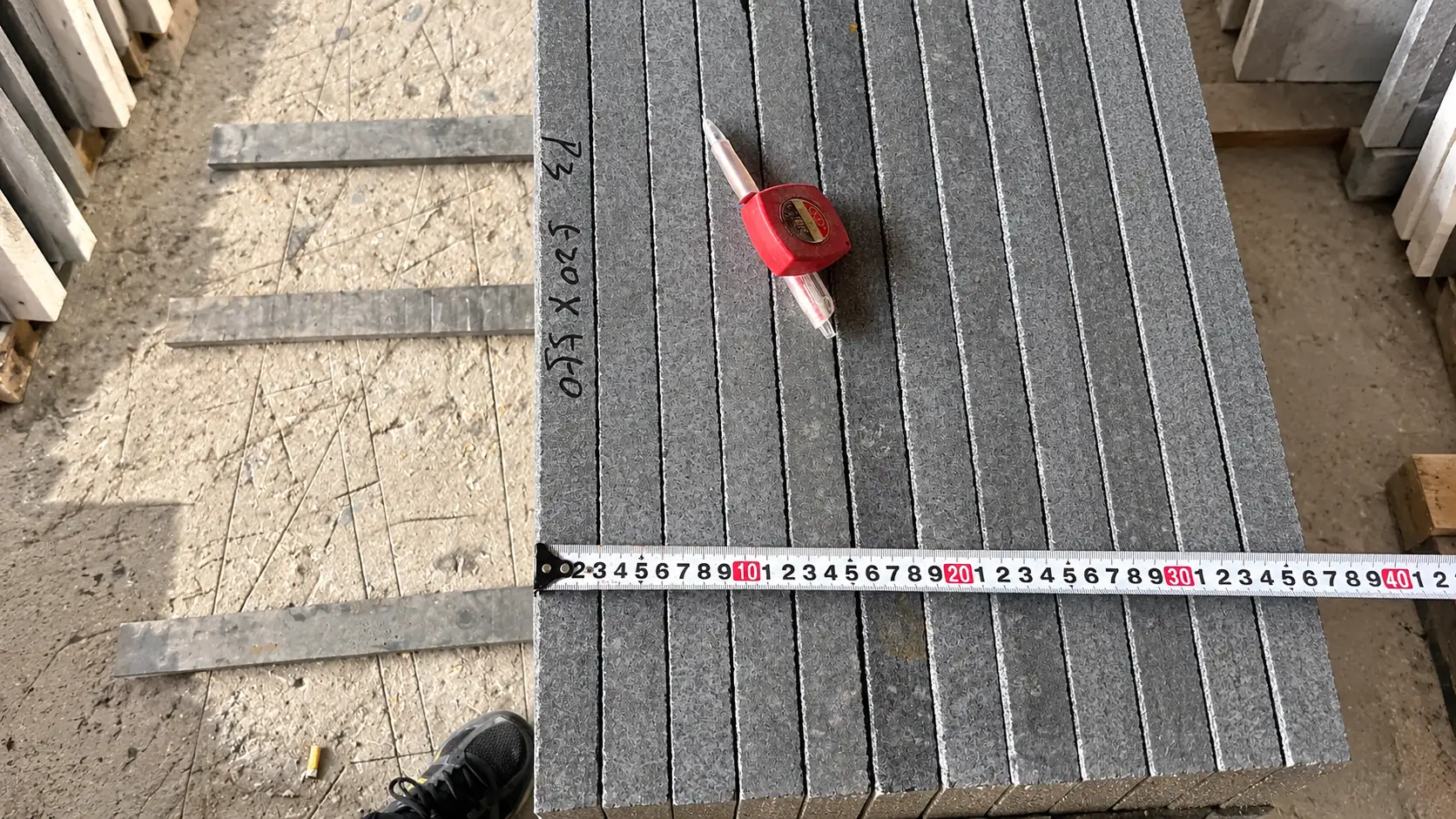
Show Stone can inspect finished thickness using suitable measuring tools such as digital calipers.
Depending on the material and application, common project specifications may include 16mm, 18mm, 20mm, 30mm or custom thicknesses.
For detailed thickness selection, see Natural Stone Thickness Guide: How to Choose 16mm, 18mm, 20mm or 30mm.
4. Diagonal and Squareness Inspection
A rectangular panel can have the correct length and width but still be out of square.
Diagonal measurements can help identify whether opposite corners correspond correctly.
Squareness is particularly relevant for:
- Wall panels
- Floor tiles
- Countertops
- Vanity tops
- Large rectangular cladding pieces
For repeated panel grids, small geometric inconsistencies can become more visible as multiple pieces are assembled together.
5. Straightness and Flatness
Straightness can be checked along fabricated edges where the approved geometry requires a straight line.
Flatness may also be inspected where applicable to the component and project requirements.
These checks are relevant because long wall panels, countertops and architectural strips can interact with:
- Adjacent panels
- Metal trims
- Joinery
- Supporting construction
- Specified joints
Natural stone characteristics, reinforcement and component geometry should be considered when evaluating the finished piece.
6. Edge Profile Inspection
Edge details can be highly visible, particularly on countertops, vanity tops, stairs, reception desks and fireplace components.

Edge inspection may cover:
- Straight polished edges
- Bullnose profiles
- Bevels
- Chamfers
- Built-up edges
- Custom CNC profiles
The finished profile should be compared with the approved detail rather than evaluated only by visual appearance.
7. Mitred Edge Inspection
Mitred fabrication is frequently used to create thicker visual edges, wrapped corners and architectural returns.
QC can review:
- Mitre geometry
- Edge alignment
- Joint relationship
- Finished corner appearance
- Vein relationship where relevant
For strongly patterned materials such as Victoria Green Marble, mitre planning can also consider how the natural pattern continues around the edge.
8. Sink and Cooktop Cut-Out Inspection
Countertops and kitchen islands require accurate opening locations because they must coordinate with fixtures and equipment supplied by other trades.
Taj Mahal Quartzite may be fabricated for kitchen islands and countertops requiring:
- Sink cut-outs
- Cooktop openings
- Tap holes
- Mitred edges
- Waterfall ends
Cut-out inspection should verify the approved size, location and relationship with the finished stone edges.
9. Tap Holes, Drain Openings and Service Holes
Small openings can be just as important as large cut-outs.
QC may include:
- Tap-hole diameter and position
- Drain-opening position
- Electrical openings
- Service penetrations
- Ventilation openings
The inspection should compare the finished component with approved fabrication information before packing.
10. Kerf, Slot and Groove Inspection
Wall-cladding systems and custom architectural pieces may require kerfs, slots or grooves.
The relevant inspection can include:
- Groove width
- Groove depth
- Groove position
- Kerf position
- Slot orientation
- Relationship to panel edges
Roma Classico Travertine can be fabricated into architectural panels and custom pieces where grooves or profiles must follow approved dimensions.
For wall fixing coordination, see Natural Stone Wall Cladding Systems: Adhesive vs Mechanical Fixing for Interior Projects.
11. CNC Profile Dimension Inspection
CNC fabrication is useful for profiles that require repeatable geometry.
This may include:
- Decorative mouldings
- Curved profiles
- Fluting
- Edge shapes
- Custom architectural components
Dimensions should be compared with approved drawings or profile sections rather than relying only on machine programming.
12. Waterjet Shape Inspection
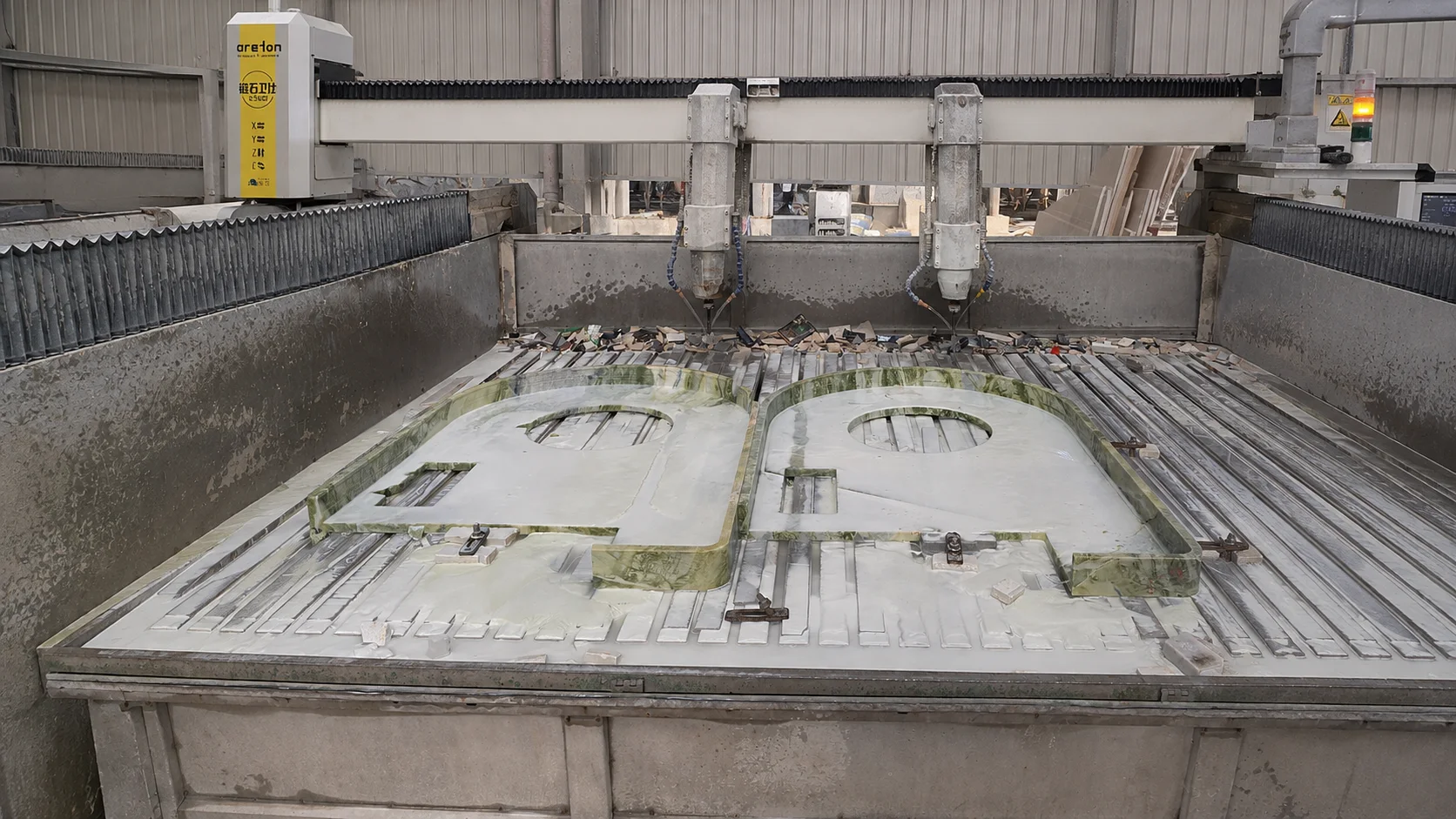
Waterjet fabrication can support:
- Curved pieces
- Geometric floor patterns
- Decorative inlays
- Custom openings
- Complex panel shapes
Finished pieces should still be checked after cutting because equipment accuracy alone does not replace final dimensional QC.
13. Joint Relationships During Dry Lay
Individual dimensional measurements cannot always show how multiple pieces will work together.
Dry lay provides a second level of verification by arranging related components in sequence.
Joint inspection can review:
- Panel-to-panel relationships
- Horizontal alignment
- Vertical alignment
- Pattern continuation
- Joint location
- Piece sequence
This is especially valuable for walls, flooring, staircases and other multi-piece assemblies.
14. Wall Panel Alignment
Large-format wall panels should be checked as a complete elevation where required.
QC can compare the physical dry lay with:
- Approved wall elevation
- Panel schedule
- Bookmatch layout
- Vein-match layout
- Piece numbering drawing
Victoria Green Marble can require close visual control because strong natural movement makes panel alignment and sequence particularly noticeable.
15. Floor and Stair Alignment
Floor patterns and staircase components require dimensional control across multiple pieces rather than only individual-piece measurement.
Floor QC may inspect:
- Pattern alignment
- Border relationships
- Piece orientation
- Joint sequence
Staircase QC may inspect:
- Tread dimensions
- Riser dimensions
- Nosing relationships
- Step sequence
- Landing transitions
Compare Fabricated Stone With Approved Drawings
Measurement is meaningful only when there is an approved reference.
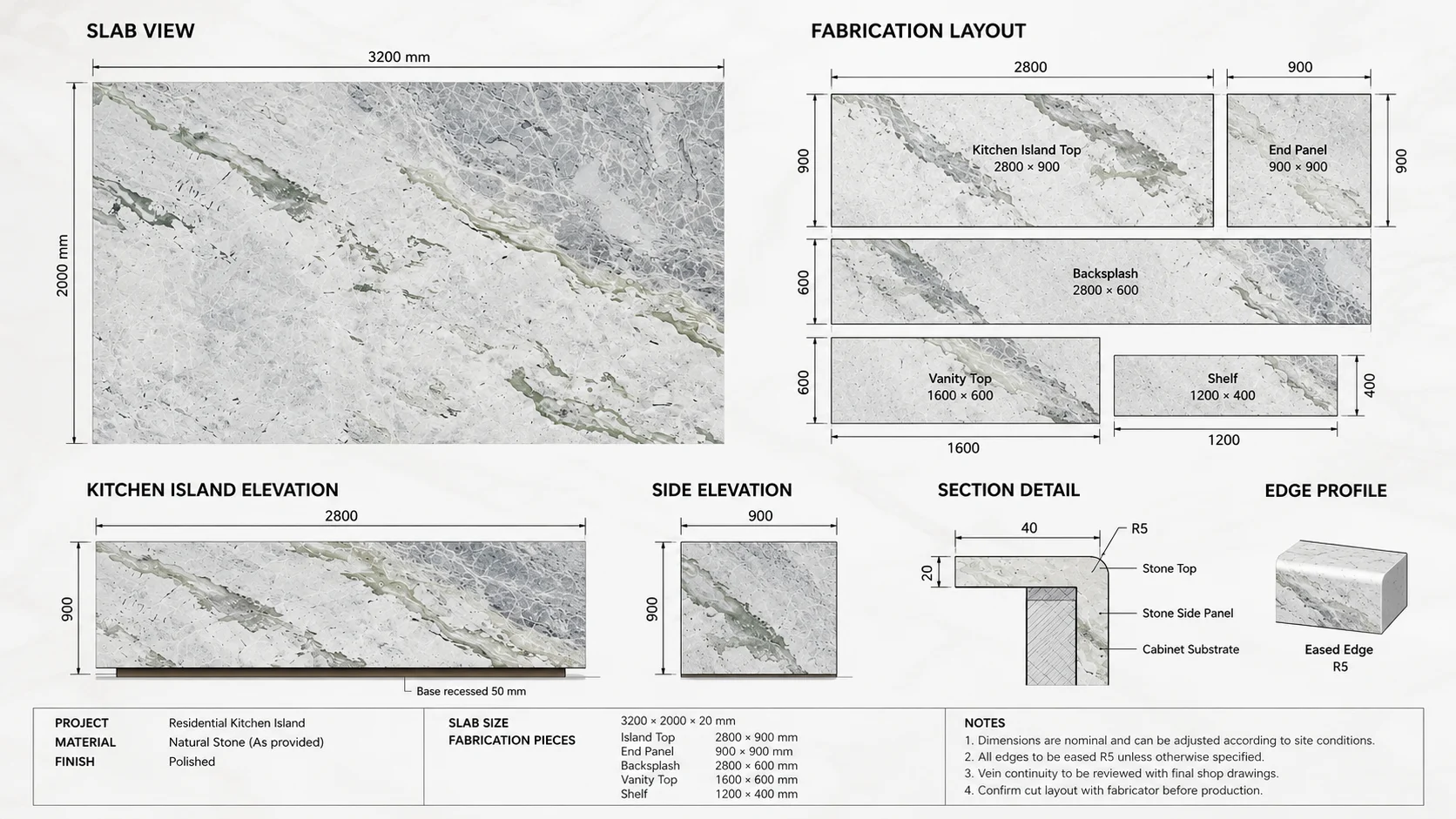
Depending on the project, fabricated pieces can be compared with:
- Approved shop drawings
- Architectural elevations
- Stone fabrication drawings
- Cutting lists
- BOQ information
- Digital slab layouts
The latest approved revision should always be used.
For more detail, see Natural Stone Shop Drawings Explained: What to Check Before Fabrication.
Measuring Tools Used During Stone QC
Different dimensions may require different measuring tools.
Show Stone factory QC can use:
- Digital calipers
- Tape measures
- Straight edges
- Square measuring tools
- Other suitable measuring equipment according to the component
The objective is not simply to record a number. The measurement should confirm whether the fabricated component corresponds with the approved project requirement.
Dry Lay Verification Before Packing
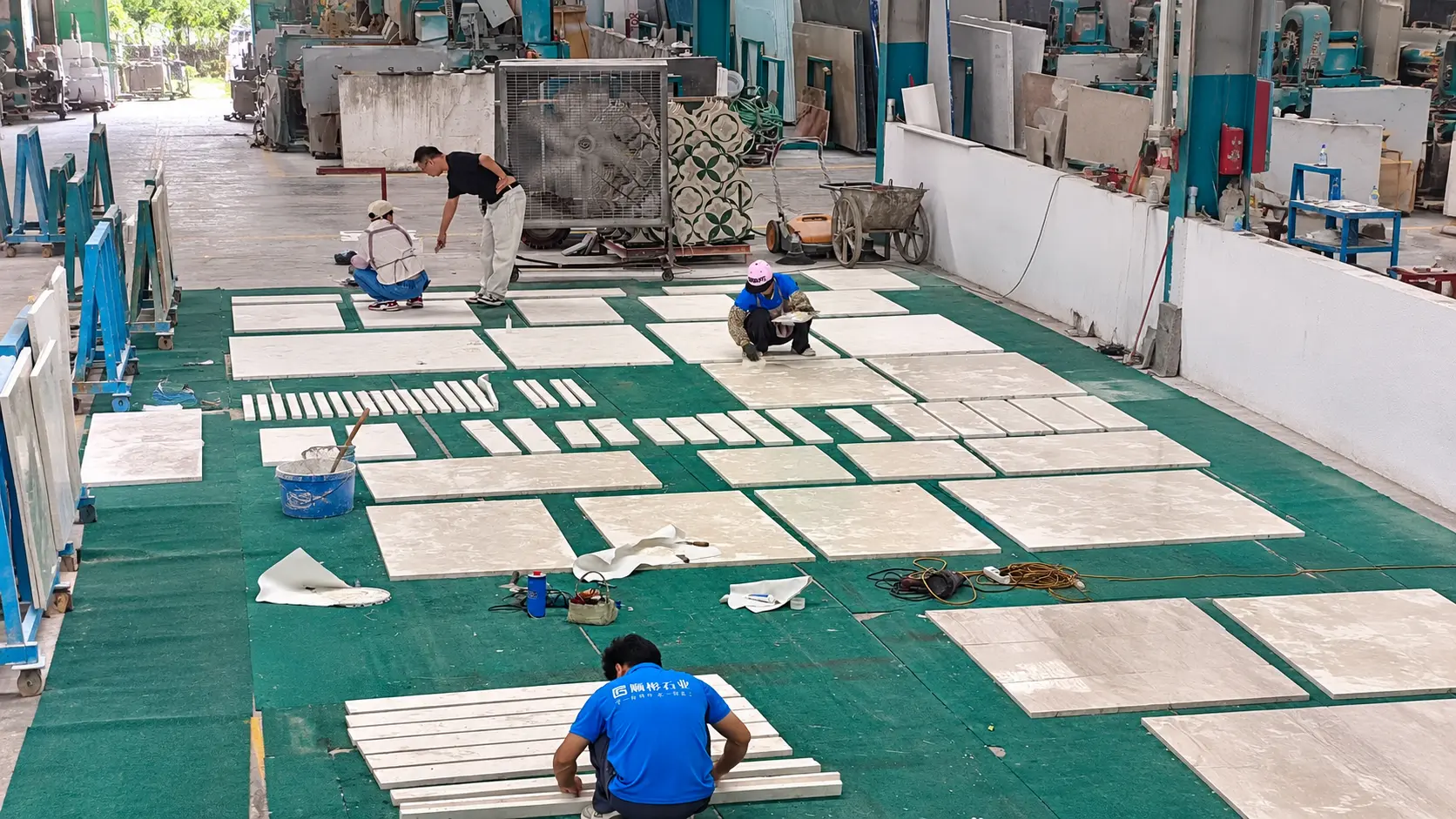
Dry lay is useful because some issues only become visible when multiple pieces are assembled together.
A natural stone dry lay can verify:
- Joint relationships
- Panel alignment
- Piece sequence
- Floor patterns
- Stair relationships
- Bookmatching
- Vein matching
- Piece numbering
The physical dry lay can also be compared with the approved elevation or digital layout.
For the full pre-shipment process, see Natural Stone Dry Lay Inspection: What to Check Before Shipment.
Correction, Re-Cutting and Re-Fabrication
The purpose of QC is not only to identify problems. It is to allow them to be addressed before packing where feasible.
If a fabricated piece does not correspond with the approved requirement, the response can include:
- Edge correction
- Re-polishing
- Groove correction
- Re-machining
- Re-cutting
- Re-fabrication
- Replacement where required
The appropriate action depends on the component, material and nature of the non-conformance.
Corrected or re-fabricated pieces should then be re-inspected before release for packing.
Re-Inspection After Correction
Correction should not automatically be treated as final acceptance.
The affected piece should be checked again against the relevant:
- Drawing
- Dimension
- Profile
- Opening position
- Joint relationship
If the component forms part of a multi-piece assembly, re-dry-lay may also be required.
QC Documentation and Remote Approval
International project buyers cannot always attend factory inspections in person.
QC documentation can include:
- Measurement photographs
- Finished-piece photographs
- Edge details
- Cut-out details
- Dry-lay photographs
- QC video when required
These records can support remote buyer, contractor or designer review before packing.
How Different Natural Stones Affect Fabrication QC
Natural stone fabrication tolerances should be controlled against the project requirement, but the characteristics of the material still matter during handling and fabrication.
Project teams may review:
- Victoria Green Marble for expressive marble panels and custom interiors
- Taj Mahal Quartzite for countertops, islands and precision cut-outs
- Lemurian Blue Granite for heavier premium fabricated components
- Roma Classico Travertine for architectural pieces and custom profiles
- Blue Aqua Gold Onyx for decorative panels requiring careful dimensional and visual QC
The selected stone should be reviewed together with component size, thickness, fabrication detail and intended application.
Natural Stone Fabrication QC Checklist
| Finished Length & Width | Compare with the latest approved drawing, cutting list or BOQ. |
| Thickness | Inspect against the specified finished thickness. |
| Squareness | Check diagonals and corner geometry where applicable. |
| Straightness / Flatness | Inspect according to component geometry and project requirements. |
| Edges & Mitres | Review profile shape, dimensions, polish and joint relationship. |
| Cut-Outs & Holes | Verify finished size and location against approved drawings. |
| Kerfs / Slots / Grooves | Check dimensions and position against approved fixing or fabrication information. |
| CNC / Waterjet | Compare finished geometry with approved profile or shape drawings. |
| Dry Lay | Verify joints, sequence, alignment and multi-piece relationships. |
| Correction | Correct, re-cut or re-fabricate non-conforming pieces where required. |
| Final Release | Re-inspect before piece numbering and export packing. |
Common Mistakes With Natural Stone Fabrication Tolerances
Using one universal ±mm value for every component: Different component sizes, geometries, stones and installation requirements may require different project-specific tolerances.
Checking length and width but not squareness: A rectangular piece can have the correct side dimensions and still be geometrically incorrect.
Ignoring the latest drawing revision: Accurate fabrication against an outdated drawing is still incorrect fabrication.
Checking the machine instead of the finished stone: CNC and waterjet equipment improve precision, but final pieces still require inspection.
Ignoring openings: A correctly sized countertop can still be unusable if sink, cooktop or tap-hole positions are wrong.
Ignoring kerfs and grooves: Fixing-related machining must correspond with approved dimensions and positions.
Inspecting pieces individually but not as an assembly: Joint and alignment issues may only become visible during dry lay.
Packing before correction is approved: Non-conforming pieces should be corrected and re-inspected before final packing.
Buyer Checklist Before Ordering
- Approved Drawings: Provide the latest approved fabrication information.
- Dimensions: Clearly identify finished length and width for each component.
- Thickness: Confirm the required finished stone thickness.
- Tolerances: State project-specific tolerance requirements clearly where applicable.
- Squareness: Identify components where diagonal or square checks are important.
- Edges: Provide detailed dimensions for polished, bevelled, bullnose or custom profiles.
- Mitres: Show mitred corners and built-up edges in sections or fabrication details.
- Cut-Outs: Confirm sink, cooktop, drain and service-opening dimensions.
- Hole Positions: Provide centre positions and relevant dimensions.
- Kerfs / Grooves: Provide approved fixing-related dimensions and locations.
- CNC / Waterjet: Supply accurate profiles or digital drawings for custom geometry.
- Joint Layout: Confirm relationships between adjacent pieces.
- Dry Lay: Identify assemblies requiring pre-shipment dry-lay verification.
- QC Documentation: Confirm photo or video approval requirements.
- Correction: Allow time for re-cutting or re-fabrication if a non-conforming piece is identified.
- Piece Numbering: Connect each finished component to its drawing reference.
- Packing: Release pieces for packing only after required QC approval.
Frequently Asked Questions
What are natural stone fabrication tolerances?
Natural stone fabrication tolerances define the permitted dimensional or geometric variation between approved project requirements and finished fabricated stone components.
Is there one standard tolerance for every natural stone project?
No. A single universal tolerance should not automatically be applied to every project. Requirements should consider the approved drawing, component dimensions, stone type, geometry, application and installation conditions.
Can Show Stone follow project-specific tolerances shown on drawings?
Yes. Clearly stated project-specific tolerance requirements can be reviewed and followed when they are included in the approved drawings or specifications.
How is stone thickness checked during fabrication?
Finished stone thickness can be inspected with suitable measuring tools such as digital calipers and compared with the approved project requirement.
Can squareness and diagonal dimensions be inspected?
Yes. Diagonal and squareness checks can be carried out on components where rectangular geometry and corner relationships are important.
Are sink cut-outs and tap holes checked before shipment?
Yes. Sink, cooktop, tap, drain and other service openings can be inspected for dimensions and position against approved fabrication drawings before packing.
Can kerfs and grooves for wall panels be inspected?
Yes. Kerf, slot and groove dimensions and positions can be inspected against approved fixing-related fabrication information.
Does CNC or waterjet cutting eliminate the need for QC?
No. CNC and waterjet equipment support precision fabrication, but finished stone pieces should still be inspected against approved drawings and dimensions.
What happens if a fabricated stone piece does not meet the approved requirement?
Depending on the issue, the piece can be corrected, re-machined, re-cut or re-fabricated where required and then re-inspected before packing.
Does Show Stone provide on-site installation or structural engineering?
No. Show Stone provides stone fabrication, dimensional QC, dry lay, numbering, packing and coordination based on approved project information, while structural engineering and final on-site installation remain with the appointed project professionals and contractors.
Why Project Buyers Work With Show Stone
Show Stone supports architects, designers, contractors, hotel groups, retailers and international stone buyers through a fabrication workflow connecting approved drawings, digital planning, cutting, machining, QC, dry lay and export packing.
Our fabrication and QC support can include:
- Finished length inspection
- Finished width inspection
- Thickness inspection
- Diagonal and squareness inspection
- Straightness inspection
- Flatness inspection where applicable
- Edge-profile inspection
- Polished-edge inspection
- Mitred-edge inspection
- Built-up-edge inspection
- Sink and cooktop cut-out inspection
- Tap-hole and drain-opening inspection
- Electrical and service-opening inspection
- Kerf, slot and groove inspection
- CNC profile inspection
- Waterjet shape inspection
- Wall-panel alignment inspection
- Floor-pattern inspection
- Stair tread and riser alignment inspection
- Comparison with approved drawings
- Comparison with cutting lists and BOQs
- Dry-lay comparison with approved layouts
- Digital caliper inspection
- Tape and square measurements
- QC photographs
- QC video when required
- Remote buyer approval
- Correction and re-inspection
- Re-cutting or re-fabrication where required
- Piece numbering after QC
- Foam protection and export wooden crates
- International shipment coordination
Show Stone does not apply one universal fabrication tolerance to every project. Project-specific tolerances can be followed when they are clearly defined in approved drawings or specifications.
Show Stone does not undertake structural engineering or final on-site installation.
Project teams can review suitable materials including Victoria Green Marble, Taj Mahal Quartzite, Lemurian Blue Granite, Roma Classico Travertine and Blue Aqua Gold Onyx.
For the wider manufacturing workflow, see Natural Stone Fabrication Process for Hotel and Retail Projects.
For independent natural-stone design and specification resources, project teams can also review the Natural Stone Institute resources for design professionals.
Final Recommendation
Natural stone fabrication tolerances should be treated as project-specific quality-control requirements rather than reduced to one universal ±mm number.
The strongest fabrication workflow begins with approved drawings and clearly defined dimensions, then continues through cutting, edge processing, openings, kerfs, CNC or waterjet work, dimensional inspection, dry lay and final QC.
Where a project specification identifies a particular tolerance, the fabricator should review that requirement before production begins. Where no tolerance has been defined, the responsible project team should clarify the installation and interface requirements rather than relying on an assumed generic value.
For international projects, QC photographs, video, piece numbering and pre-shipment dry lay can further improve traceability between the approved drawing and the finished stone package.
To discuss natural stone fabrication tolerances for your project, contact Show Stone with your approved drawings, stone selection, dimensions, thickness, edge details, openings, quantity and delivery destination.