
Vein Matching vs Bookmatching Natural Stone: Which Layout Is Right for Your Project?
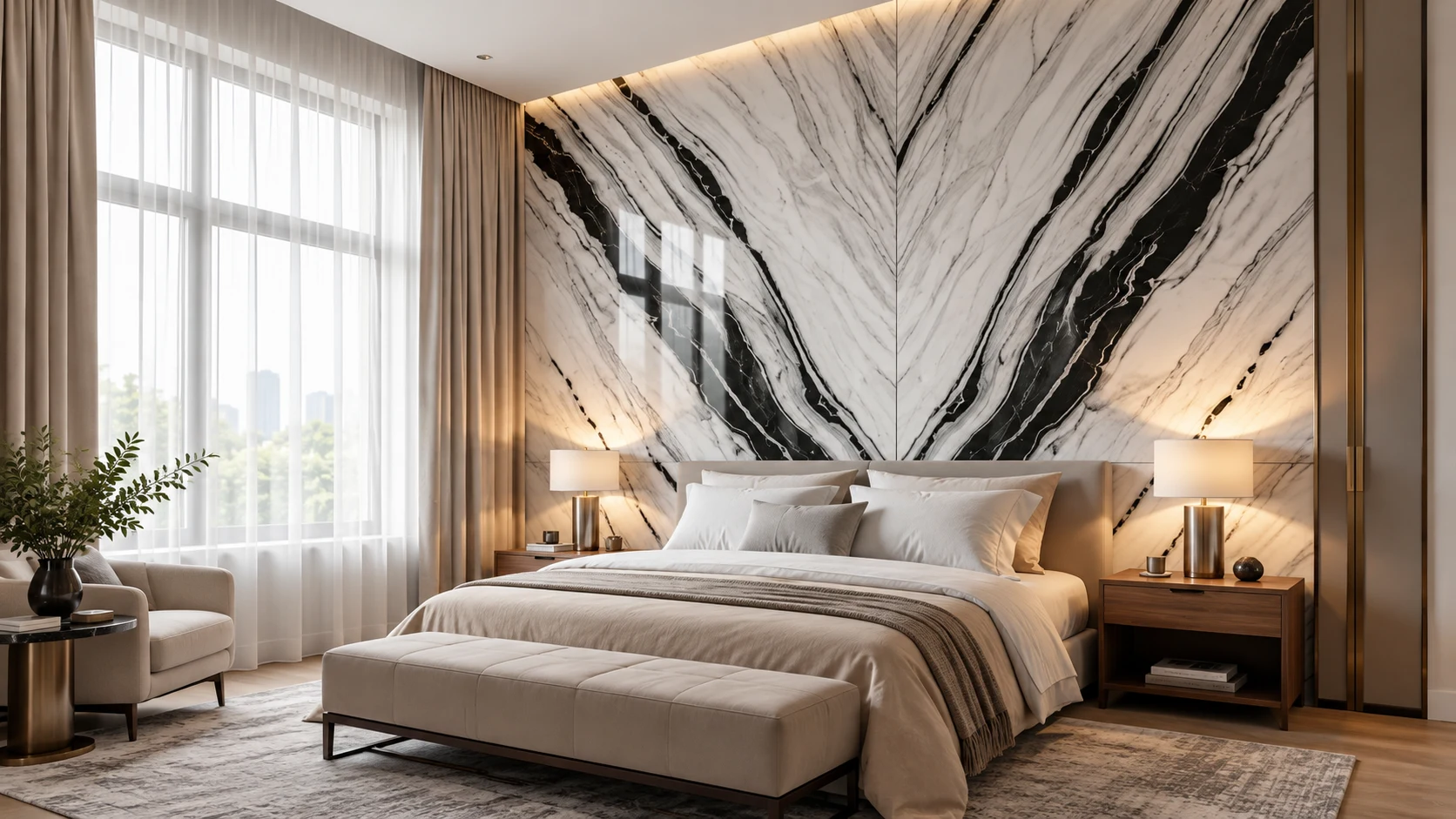
Vein matching vs bookmatching is one of the most important visual decisions when natural stone is used across multiple panels. The terms are sometimes used interchangeably, but they describe different layout strategies and can produce very different results in marble, quartzite, travertine, granite and other directional natural stones.
Bookmatching focuses on symmetry. Consecutive slabs are opened or mirrored so adjacent surfaces create a reflected pattern. Vein matching focuses on continuity. Individual pieces are positioned so the natural movement appears to travel from one panel to the next.
Neither approach is automatically better. The correct layout depends on the actual slabs, the architecture, panel dimensions, application, visual intent, fabrication method and acceptable material yield.
At Show Stone, consecutive slab selection, digital slab scanning, digital bookmatch previews, vein-match layouts, client approval, fabrication, dry lay and piece numbering can be coordinated as one workflow before finished stone is packed for international delivery.
Buyer Decision Check
- Visual Goal: Decide whether the project needs symmetry, continuous movement or a more natural random appearance.
- Actual Slabs: Review consecutive slabs before deciding on the final layout method.
- Application: Wall panels, floors, islands, stairs and fireplaces may require different matching strategies.
- Panel Size: Confirm finished dimensions before finalising the slab layout.
- Material Yield: Understand that highly controlled layouts can require more selective cutting.
- Approval: Review the digital layout before cutting and the physical dry lay after fabrication where required.
What Is Vein Matching?
Vein matching is the process of arranging natural stone pieces so the pattern or directional movement continues visually across adjacent panels.
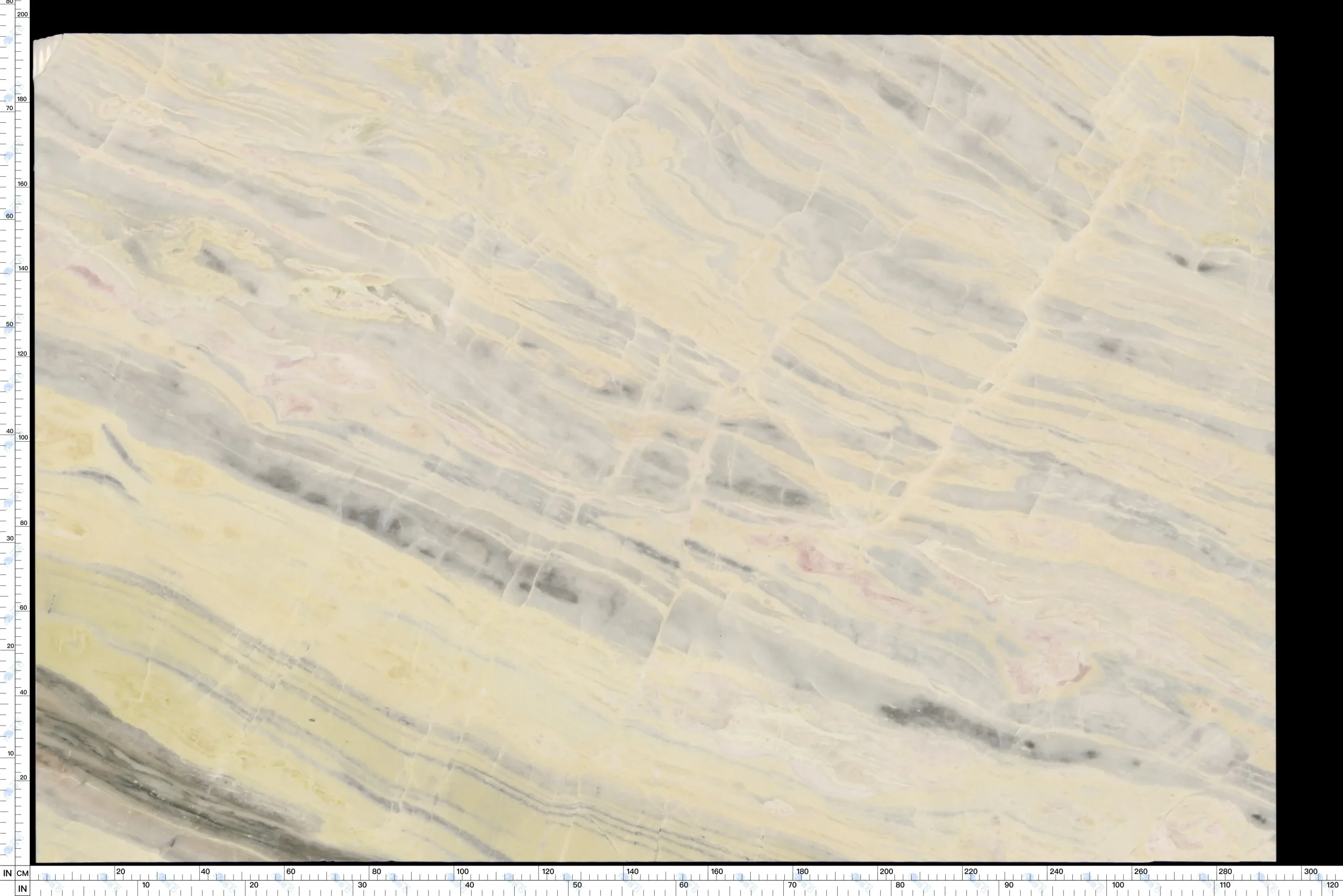
The objective is not necessarily to create a mirror image. Instead, the visual movement should feel intentional as the eye travels across the finished installation.
Vein matching can be planned:
- Horizontally across wall panels
- Vertically from floor to ceiling
- Across stair treads and risers
- Across vanity fronts and tops
- Across kitchen islands and waterfall ends
- Across fireplace panels
- Across reception desk cladding
Materials with linear, flowing or layered movement are particularly suitable for this approach.
Palissandro Blue Marble and Bianco Ondulare Marble are examples of materials where directional movement can become an important part of the finished design.
What Is Bookmatching?
Bookmatching uses consecutive slabs that are arranged like the pages of an open book. One slab is positioned next to its neighbouring slab so the natural pattern creates a mirrored composition around the joint.
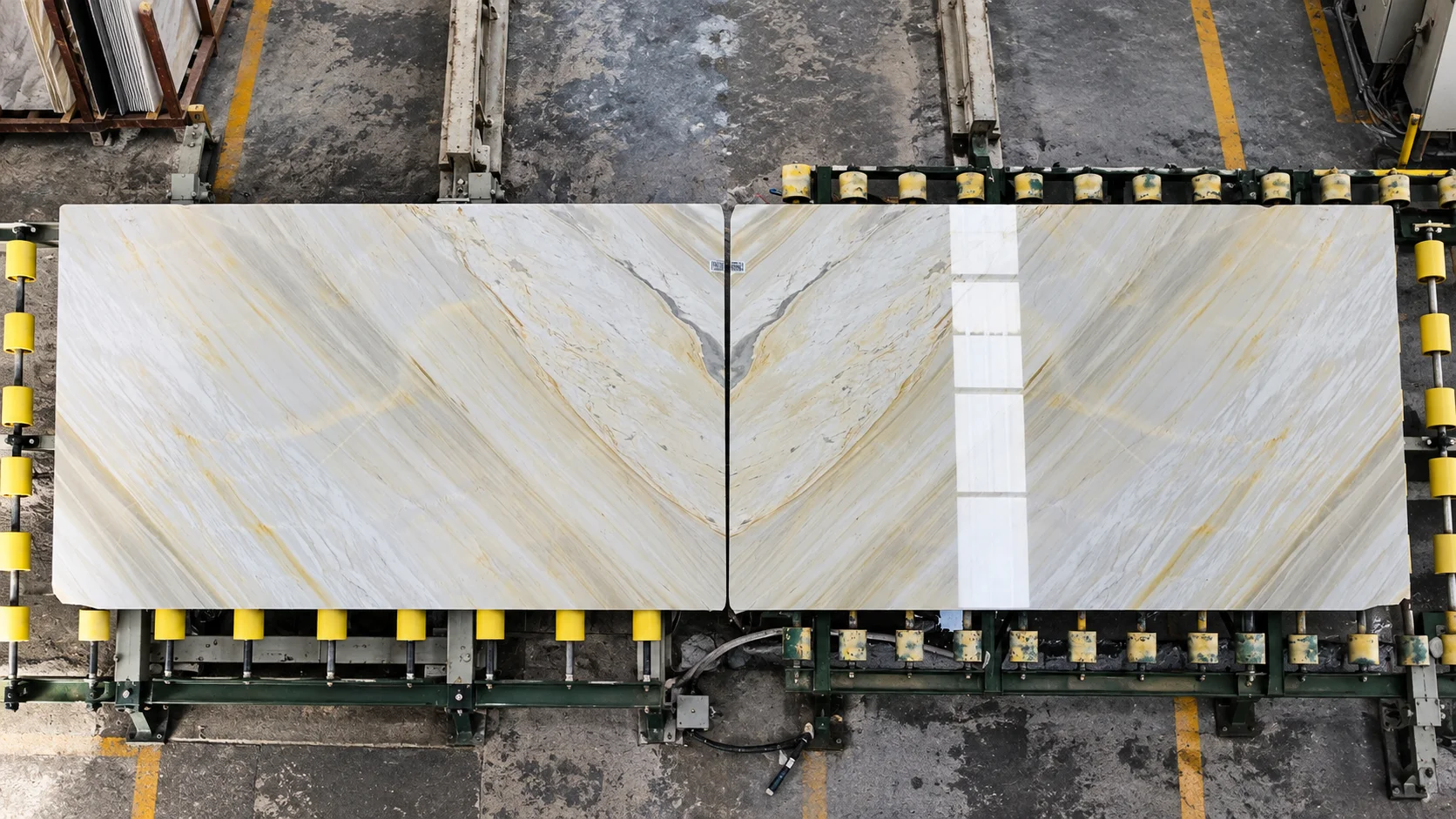
Bookmatching works especially well when the stone has strong, expressive veining.
Typical applications include:
- Hotel lobby feature walls
- Luxury residential feature walls
- Bathroom feature walls
- Fireplace walls
- Reception areas
- Luxury retail interiors
- Large-format decorative panels
Arabescato Marble is well suited to dramatic bookmatch layouts because its strong grey veining can create highly visible mirrored patterns.
Vein Matching vs Bookmatching: Key Differences
| Layout Method | Visual Effect | Typical Applications | Planning Priority |
|---|---|---|---|
| Vein Matching | Continuous natural movement | Walls, floors, stairs, islands, counters | Vein direction and panel sequence |
| Bookmatching | Mirrored symmetry | Feature walls, fireplaces, luxury interiors | Consecutive slabs and mirror relationship |
| End Matching | Pattern continuation from end to end | Long walls, corridors, repeated panels | Sequence and end relationships |
| Random Matching | Natural non-continuous variation | Large floors and less directional applications | Overall colour balance |
What Is End Matching?
End matching is another layout method in which stone pieces are positioned so the pattern at the end of one panel relates visually to the beginning of the next.
It can be useful for:
- Long corridor walls
- Repeated horizontal panels
- Extended flooring layouts
- Long counters
- Architectural cladding sequences
The result is usually less symmetrical than bookmatching but more controlled than random placement.
What Is Random Matching?
Random matching does not attempt to create a continuous or mirrored vein pattern between every neighbouring piece.
Instead, the layout focuses more on:
- Overall colour balance
- Natural variation
- Efficient slab utilisation
- A less formal visual effect
Random layouts can be suitable for larger floor areas or materials where the pattern is relatively uniform and strict matching is not required.
Random does not have to mean uncontrolled. Pieces can still be sorted to prevent undesirable colour concentrations or abrupt transitions.
2-Slab Bookmatch vs 4-Slab Bookmatch
2-Slab Bookmatch
A two-slab bookmatch creates one mirrored relationship around a central joint.
It is commonly used for:
- Feature walls
- Bathroom walls
- Fireplaces
- Smaller reception features
4-Slab Bookmatch
A four-slab composition creates a larger symmetrical pattern and can produce a dramatic visual centre.
It is particularly effective for:
- Hotel lobbies
- Large residential feature walls
- Luxury retail interiors
- Double-height spaces
The larger the composition becomes, the more important it is to review actual slab dimensions, pattern position and finished panel sizes before cutting.
Multi-Panel Bookmatching
Bookmatching is not limited to two or four slabs. A project may require multiple mirrored or coordinated panels across a larger elevation.
Multi-panel layouts require careful control of:
- Slab sequence
- Slab orientation
- Panel dimensions
- Joint locations
- Architectural centre lines
- Openings and doors
- Material yield
Digital layout approval is particularly important before a multi-panel composition is released for fabrication.
Which Materials Work Best for Bookmatching?
Bookmatching is most visually successful when the stone has enough natural movement to create a recognisable mirrored pattern.
Examples from the Show Stone collection include:
The final decision should always be based on the actual available slabs rather than the material name alone.
Which Materials Work Well for Vein Matching?
Vein matching can work with a wider range of directional materials because perfect mirror symmetry is not required.
Materials with long linear movement can be particularly effective.
Italian Silver Travertine can provide a strong linear architectural direction, while Palissandro Blue Marble can support more expressive continuous movement.
Verde Lara Granite can also be used where the goal is a more distinctive decorative layout rather than a conventional white-marble composition.
Feature Walls: When Bookmatching Works Best
Large feature walls are one of the most common applications for bookmatched natural stone because viewers can see the complete composition from a distance.
Bookmatching is particularly effective where the architecture provides:
- A clear visual centre
- A large uninterrupted wall
- Balanced surrounding elements
- Limited openings
Possible applications include hotel lobbies, lift lobbies, retail walls, private residences and luxury bathroom feature walls.
For a deeper guide to this application, see Bookmatched Marble Walls: Slab Selection, Layout, Fabrication & Installation.
Flooring: Vein Matching vs Random Layout
Flooring often requires a different strategy from feature walls.
Perfect bookmatching across a large floor can reduce flexibility in cutting and may not always be necessary.
Depending on the design, project teams may prefer:
- Continuous directional vein matching
- Controlled random matching
- Zone-by-zone colour coordination
- Geometric layouts
Material yield, replacement requirements and room-to-room transitions should also be considered when defining the floor layout.
Staircases: Continuous Vein Matching
Staircases can benefit from carefully planned continuity because treads and risers are viewed as one connected three-dimensional feature.
Vein matching can be coordinated across:
- Individual treads
- Treads and risers
- Landings
- Multiple flights
Bookmatching is usually less relevant to individual stair steps than continuous vein direction and sequence control.
For staircase-specific planning, see Natural Stone Staircases for Luxury Interiors.
Kitchen Islands and Countertops
Kitchen islands often involve several visible stone surfaces:
- Top
- Waterfall end
- Opposite end
- Front cladding
- Adjacent backsplash
Vein matching is often used to create continuity from the countertop down a waterfall edge or across multiple fabricated pieces.
A mirrored bookmatch may also be used on large vertical island fronts where symmetry is part of the design intent.
Vanities and Bathroom Walls
Bathroom projects can combine both methods.
For example:
- A vanity may use vein matching across the top and fascia.
- A shower feature wall may use a two-panel bookmatch.
- Large surrounding wall panels may use continuous vein matching.
The layout method should therefore be chosen by application rather than applying one rule to the entire room.
Fireplace Walls
Fireplaces often create a natural centre line, which makes them well suited to symmetrical bookmatching.
Possible approaches include:
- Two-panel bookmatch around the fireplace opening
- Four-panel bookmatch for a larger full-height wall
- Vein-matched surround panels
- Continuous pattern across mantel, sides and hearth
The opening position should be included in the digital stone layout before cutting begins.
Reception Desks
Reception desks may combine flat, curved, faceted and horizontal stone surfaces, so vein continuity can become more important than perfect symmetry.
Layout planning may coordinate:
- Front cladding
- Side returns
- Countertops
- Curved sections
- Mitred corners
For larger straight front panels, bookmatching can also be used where a strong central composition is desired.
Start With Consecutive Slab Selection
Good vein matching and bookmatching begin before fabrication.
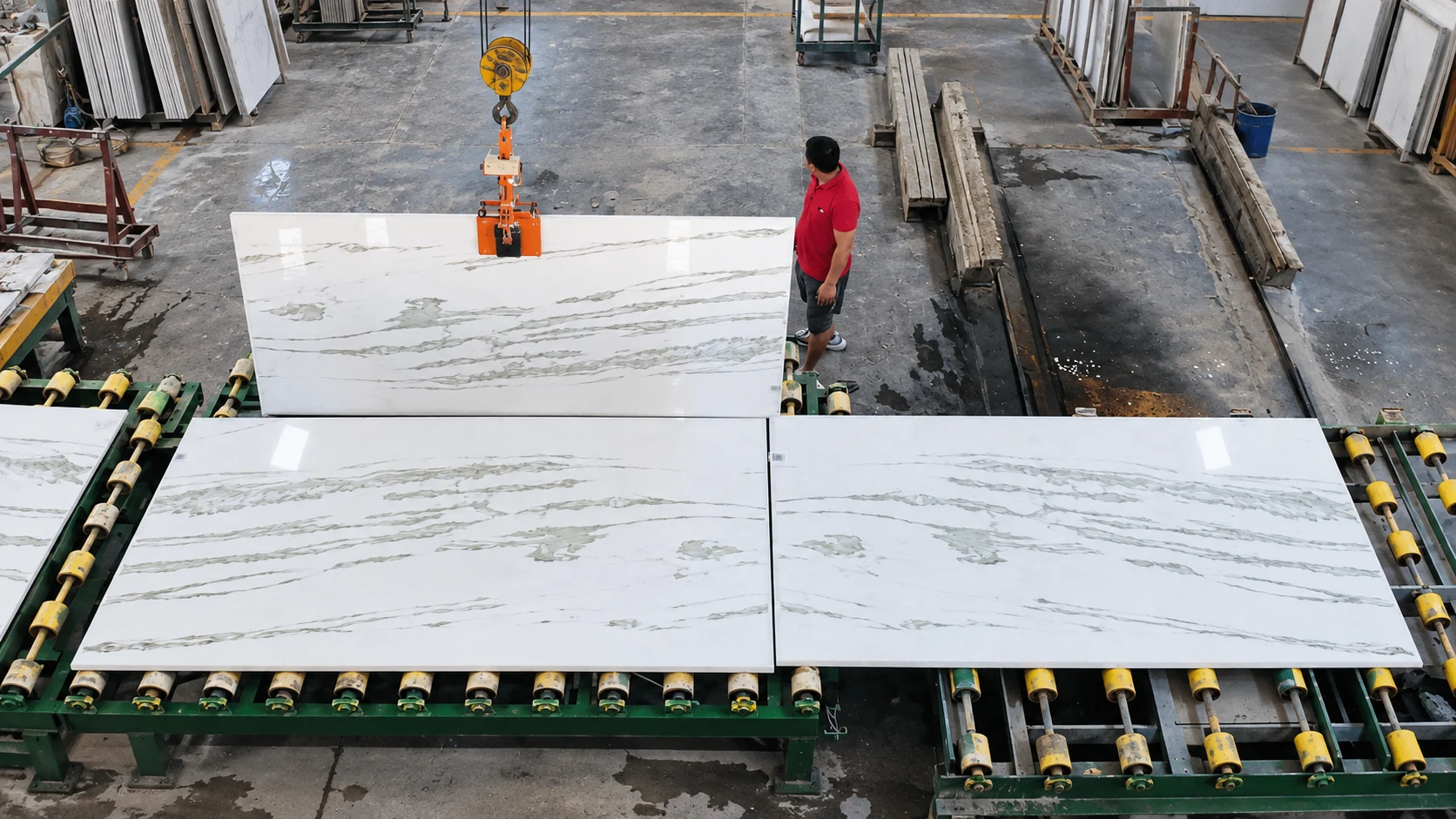
Consecutive slabs are important because the pattern typically develops gradually through the block.
During slab selection, review:
- Slab sequence
- Overall colour
- Vein position
- Pattern concentration
- Available dimensions
- Usable area
Changing from one unrelated slab group to another can interrupt a planned visual sequence.
Use Digital Slab Scanning Before Cutting
Digital slab scanning allows the stone surface to be recorded before the finished pieces are positioned in a cutting layout.
This provides a practical way to evaluate:
- Bookmatch symmetry
- Vein continuation
- Panel orientation
- Cutting position
- Openings
- Material yield
Digital slab photography can also support remote review when the project team is located overseas.
Digital Bookmatch Preview
For bookmatching, slabs can be digitally arranged and mirrored to preview the relationship before cutting.
This allows designers and buyers to compare alternatives such as:
- Different centre joints
- Different slab sequences
- Horizontal vs vertical composition
- Two-panel vs four-panel layouts
- Different cropping positions
The selected option can then become the reference for fabrication.
Slab Rotation and Mirroring
Digital planning can include slab rotation and mirroring where appropriate.
For bookmatching, digital flipping helps show how two consecutive slab faces may create a mirrored design.
Rotation can also be used to study whether horizontal or vertical movement works better for a specific elevation.
These decisions should be finalised before cutting because a layout that works digitally may not be recoverable after the slab has been divided into finished pieces.
Visual Impact vs Material Yield
The most dramatic layout is not always the most material-efficient layout.
A highly controlled bookmatch may require pieces to be cut from very specific slab areas. This can leave larger offcuts or reduce flexibility when fitting additional project pieces onto the same slab.
Vein matching may sometimes provide more flexibility because continuity can be planned across the project without requiring exact mirror symmetry.
The project team should therefore balance:
- Visual impact
- Slab availability
- Finished panel size
- Material yield
- Replacement requirements
- Fabrication complexity
- Project budget
Layout Strategy Comparison for Buyers
| Factor | Bookmatching | Vein Matching | Random Matching |
|---|---|---|---|
| Visual Character | Strong symmetry | Continuous movement | Natural variation |
| Best for Feature Walls | Excellent | Excellent | Project-dependent |
| Best for Large Floors | Selective use | Good for directional layouts | Often practical |
| Slab Sequence Importance | Very high | High | Moderate |
| Digital Layout Value | Very high | Very high | Useful |
| Material Yield Flexibility | Usually lower | Moderate | Usually higher |
| Fabrication Planning | High | High | Moderate |
Approve the Layout Before Cutting
For major bookmatched or vein-matched applications, the client or designer should review the proposed layout before fabrication begins.
Approval can be supported by:
- Full-slab photographs
- Digital layouts
- Bookmatch previews
- Panel references
- Marked elevations
- Photo or video review
Remote approval can be particularly useful for international projects where the project team cannot visit the factory for every selection stage.
Fabrication After Layout Approval
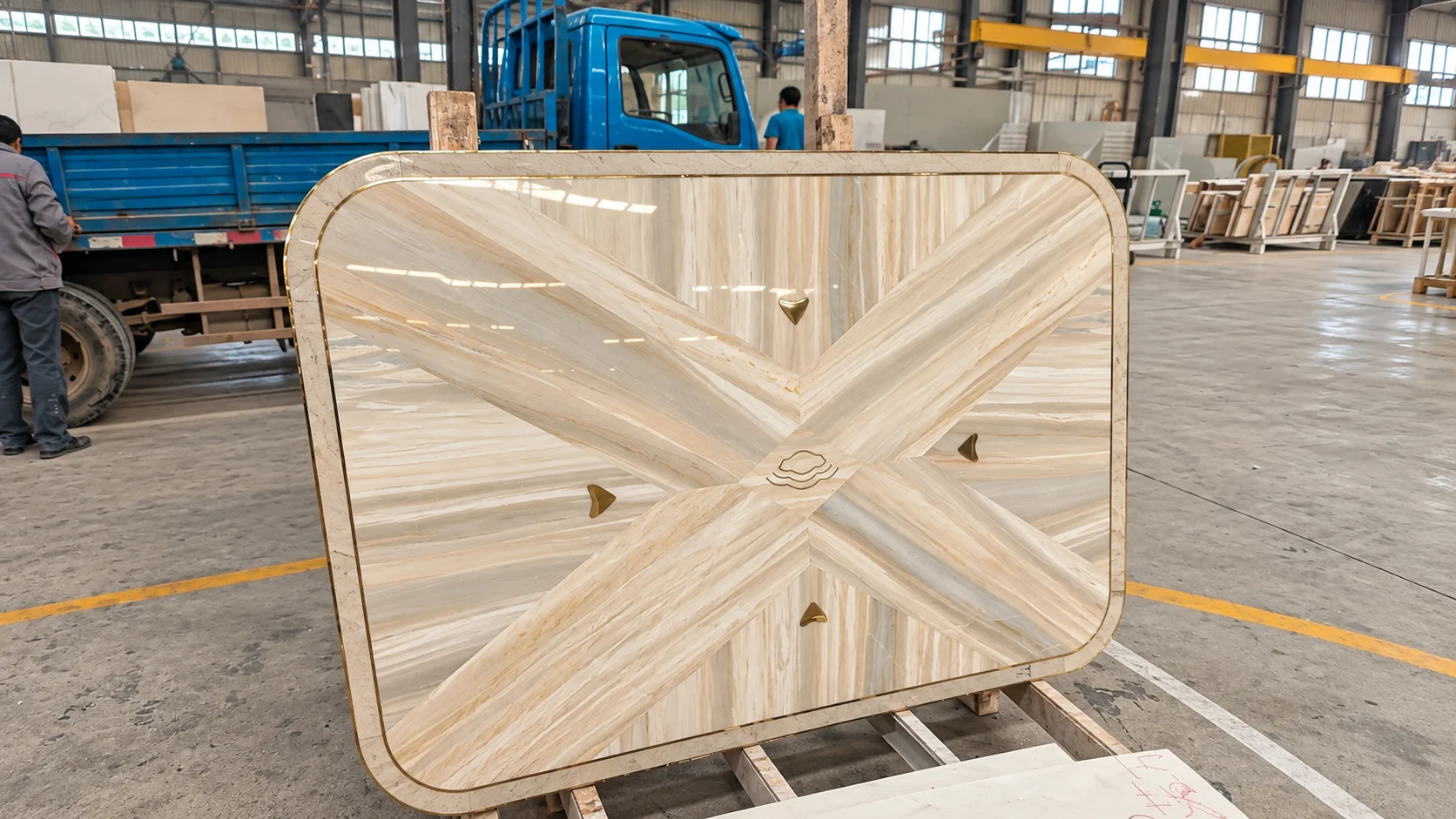
After approval, the digital layout can guide the cutting and fabrication process.
The production workflow may include:
- Panel cutting
- Custom shaping
- Waterjet processing
- CNC fabrication
- Edge finishing
- Mitres
- Cut-outs
- Piece identification
For a broader view of this workflow, see Natural Stone Fabrication Process for Hotel and Retail Projects.
Dry Lay After Fabrication
Digital approval is important, but the finished physical pieces should also be checked where the project requires controlled visual relationships.
Dry lay can verify:
- Panel order
- Bookmatch symmetry
- Vein continuity
- Colour balance
- Joint relationships
- Piece numbering
The physical layout can then be compared with the approved digital layout before packing.
For a detailed QC checklist, see Natural Stone Dry Lay Inspection: What to Check Before Shipment.
Piece Numbering and Elevation References
Bookmatched and vein-matched panels should remain identifiable after dry lay.
A typical reference structure may follow:
Project → Building → Floor → Room → Elevation → Panel
The same piece reference can be used on:
- Digital layouts
- Fabrication drawings
- Finished stone pieces
- Dry-lay photographs
- Packing lists
- Crate labels
This helps the appointed site team understand the intended panel sequence after delivery.
Packing by Elevation and Installation Sequence
Once the layout is approved and dry lay is complete, finished pieces can be protected and packed according to their project sequence.
Possible references include:
- Building
- Floor
- Room
- Elevation
- Panel number
- Installation sequence
Show Stone does not undertake final on-site installation, but drawing coordination, numbering and installation-sequence packing can help support the appointed contractor or specialist stone installer.
Common Mistakes With Vein Matching and Bookmatching
Choosing the Layout From a Small Sample
A small sample cannot show how full-slab veins will interact across a multi-panel wall.
Using Non-Consecutive Slabs Without Reviewing the Transition
Unrelated slabs may create abrupt pattern or colour changes in a controlled layout.
Confusing Vein Matching With Bookmatching
Vein matching focuses on continuity, while bookmatching focuses on mirrored relationships. They should not be specified as if they are identical.
Ignoring Finished Panel Dimensions
A visually attractive slab pair may not work with the actual elevation if panel dimensions, joints and openings are not included in the layout.
Approving the Stone Before Adding Architectural Openings
Doors, fireplaces, TVs, outlets and other openings can significantly change the appearance of the final composition.
Optimising Only for Appearance
An extremely selective bookmatch can increase material use. Visual impact should be balanced with slab availability, yield and project requirements.
Skipping Digital Approval
Cutting before the layout has been approved can make later pattern changes difficult or impossible.
Skipping Dry Lay
Physical dry lay provides an important opportunity to verify that fabricated pieces still reflect the approved layout before packing.
Buyer Checklist Before Ordering
- Material: Confirm the selected natural stone and available slab sequence.
- Application: Identify the wall, floor, staircase, vanity, island, fireplace or reception desk.
- Finished Dimensions: Provide approved panel sizes before layout planning.
- Matching Method: Confirm bookmatch, vein match, end match or controlled random layout.
- Bookmatch Type: Confirm 2-slab, 4-slab or multi-panel composition.
- Direction: Confirm horizontal or vertical vein movement.
- Centre Line: Identify architectural centre lines where symmetry matters.
- Openings: Include doors, fireplaces, TV openings and service penetrations.
- Consecutive Slabs: Confirm slab sequence before final layout.
- Digital Scan: Request actual slab images for layout planning.
- Yield: Review visual goals together with material utilisation.
- Digital Approval: Approve the layout before cutting.
- Fabrication: Link each panel to its approved position.
- Dry Lay: Compare fabricated pieces with the approved digital arrangement.
- Numbering: Use consistent room, elevation and panel references.
- Packing: Organise pieces by elevation and installation sequence.
Frequently Asked Questions
What is the difference between vein matching and bookmatching?
Vein matching arranges stone pieces so natural movement continues from one panel to another, while bookmatching uses consecutive slabs to create a mirrored pattern around a joint or centre line.
Is bookmatching only possible with marble?
No. Bookmatching can be used with suitable marble, quartzite, granite, onyx and other natural stones when consecutive slabs provide a strong enough visual relationship.
Can Show Stone create 2-slab and 4-slab bookmatch layouts?
Yes. Show Stone can support two-slab, four-slab and multi-panel bookmatch planning using consecutive slab selection, digital scanning and layout approval before cutting.
Can natural stone veins be matched across several wall panels?
Yes. Continuous vein matching can be planned across multiple wall panels when suitable slabs, panel dimensions and vein positions allow the intended visual sequence.
Can veins be matched across stair treads and risers?
Yes. Stair treads, risers and landings can be digitally planned to create step-by-step or continuous vein relationships where the selected stone and geometry are suitable.
Can clients approve bookmatching before the slabs are cut?
Yes. Digital slab photographs, bookmatch previews and vein-match layouts can be provided for client or designer review before fabrication begins.
Does bookmatching use more material?
It can. Highly controlled bookmatch layouts may require specific slab areas to be selected for individual panels, which can reduce cutting flexibility compared with less restrictive layouts.
What is end matching?
End matching arranges panels so the pattern at the end of one piece relates visually to the next piece, creating continuity without necessarily producing mirrored symmetry.
Should bookmatched panels be dry laid before shipment?
For important feature walls and multi-panel compositions, dry lay is useful for checking panel order, symmetry, vein position, colour balance and numbering against the approved digital layout.
Does Show Stone install bookmatched stone walls on site?
No. Show Stone provides slab selection, digital layouts, fabrication, dry lay, numbering, packing and installation coordination, while final on-site installation is carried out by the client or appointed contractor.
Why Project Buyers Work With Show Stone
Show Stone supports architects, designers, contractors, hotel groups, luxury retailers and international buyers through a workflow that connects slab selection, visual layout, fabrication, quality control and export delivery.
Our vein matching and bookmatching support can include:
- Consecutive slab selection
- Full-slab photography
- Digital slab scanning
- Digital bookmatch previews
- Digital vein-match layouts
- 2-slab bookmatching
- 4-slab bookmatching
- Multi-panel bookmatch layouts
- Horizontal vein matching
- Vertical vein matching
- Continuous multi-panel vein matching
- Wall-panel layouts
- Floor layouts
- Staircase vein layouts
- Vanity and countertop layouts
- Kitchen-island layouts
- Fireplace-wall layouts
- Reception-desk layouts
- Slab rotation planning
- Digital slab mirroring
- Material-yield planning
- Cutting-layout optimisation
- Client and designer approval before cutting
- Photo and video approval
- Remote review
- Custom fabrication
- Factory dry lay
- Comparison with approved digital layouts
- Panel and elevation numbering
- Packing by room, elevation and installation sequence
Show Stone does not undertake final on-site installation. The appointed contractor or specialist stone installer remains responsible for site conditions, fixing systems and installation.
Project teams can review materials including Ajax White Marble, Palissandro Blue Marble, Verde Lara Granite, Italian Silver Travertine, Bianco Ondulare Marble and Arabescato Marble.
For approval-stage planning before production, see Natural Stone Mock-Ups for Hotel and Retail Projects.
For independent natural-stone design and specification resources, project teams can also review the Natural Stone Institute resources for design professionals.
Final Recommendation
The decision between vein matching vs bookmatching should begin with the actual slabs and the architecture rather than a generic rule. Use bookmatching when strong symmetry and a central visual statement are important. Use vein matching when the design benefits from continuous natural movement across several connected surfaces. End matching and controlled random layouts can provide additional flexibility for larger or less formal applications.
Before cutting, review consecutive slabs, finished panel sizes, openings, digital layouts and material yield together. For important feature areas, approve the digital composition before fabrication and compare the finished stone with the approved layout during factory dry lay.
To discuss a bookmatched or vein-matched natural stone project, please contact Show Stone with your drawings, preferred material, panel dimensions, application, matching requirements, quantity and delivery destination.