Quartzite Countertops for Luxury Kitchens: Specifications and Care Guide
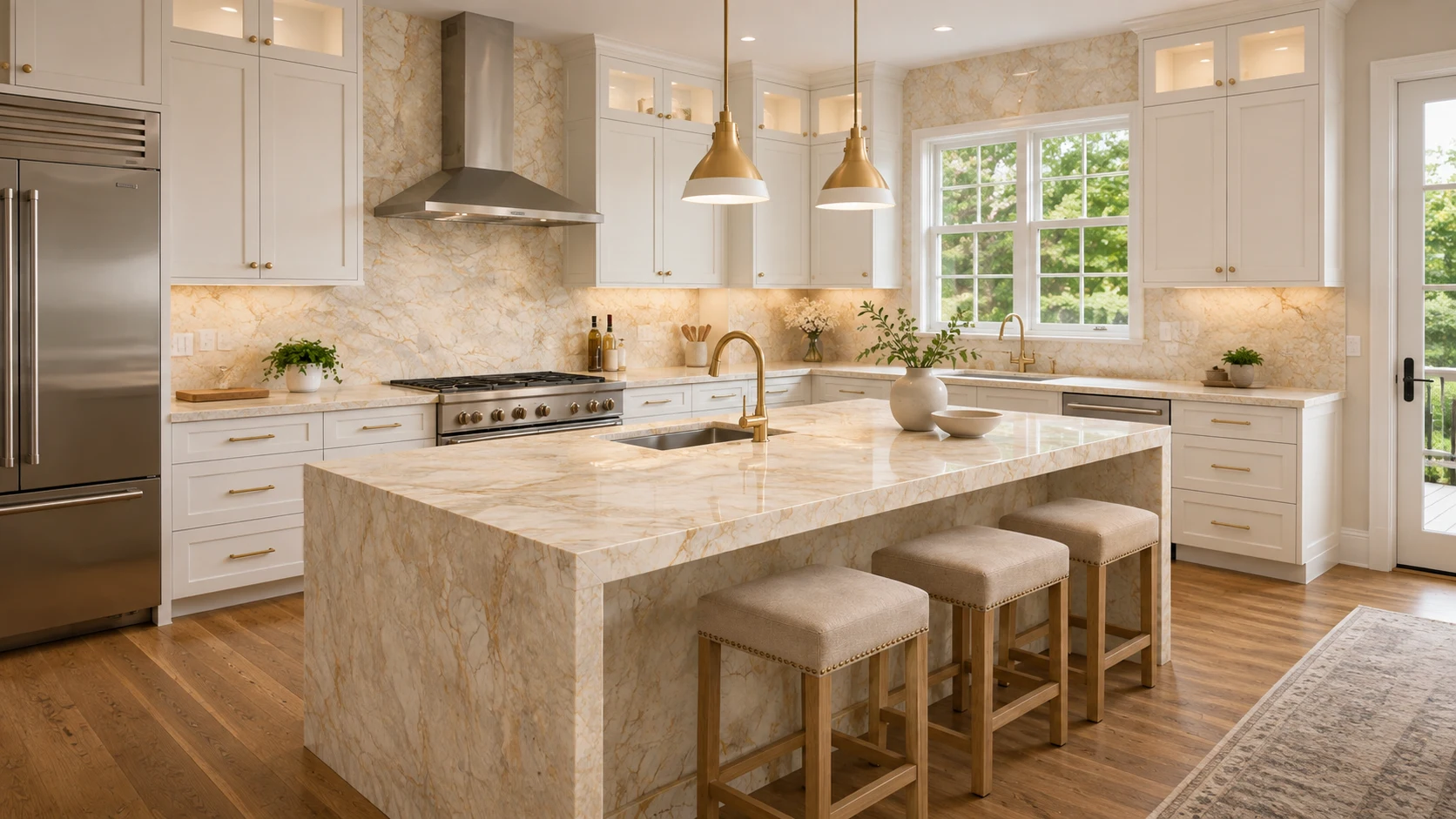
Quartzite countertops for luxury kitchens combine natural stone character with the ability to create large islands, statement worktops, waterfall edges and full-height backsplashes. For architects, kitchen designers, contractors and project buyers, however, selecting the stone is only the first step.
The finished result depends on the actual slabs, available dimensions, batch consistency, cutting layout, seam planning, edge details and fabrication quality. A visually attractive quartzite can still produce a disappointing kitchen if the strongest vein is placed through a sink opening, a waterfall panel is cut from an unrelated slab or the backsplash is fabricated without considering the countertop movement.
This guide explains how to specify, select, fabricate and maintain natural quartzite for premium kitchens. It covers slab approval, thickness, finishes, edges, cut-outs, seams, backsplash coordination, waterfall matching and routine care. Buyers can also review Show Stone’s broader collection of natural quartzite and other natural stone materials.
What Are Natural Quartzite Countertops?
Natural quartzite is a quarried stone that is cut into slabs and fabricated into countertops, wall panels, islands and other architectural components. Each slab contains its own colour movement, veins, mineral concentrations and natural structural characteristics.
This natural variation is one of the main reasons quartzite is used in premium residential interiors. Unlike a printed surface, the composition continues across the full slab and can be positioned intentionally through digital cutting layouts.
Quartzite should not be confused with engineered quartz simply because both names contain the word “quartz.” Buyers deciding between natural stone and manufactured surfaces can review our detailed comparison of Taj Mahal Quartzite vs marble vs quartz.
Why Quartzite Countertops for Luxury Kitchens Are Popular
Quartzite countertops for luxury kitchens are often selected when the design requires the visual individuality of natural stone across large, highly visible surfaces. Kitchen islands can display a large section of the slab, while backsplashes and waterfall panels provide additional opportunities to continue or reinterpret the same movement.
Common luxury-kitchen applications include:
- Large central kitchen islands
- Perimeter countertops
- Full-height backsplashes
- Waterfall island ends
- Breakfast bars
- Integrated splashbacks
- Butler’s pantry countertops
- Stone shelves and ledges
- Custom dining and serving surfaces
Materials such as Taj Mahal Quartzite are frequently chosen for softer cream and taupe interiors, while Patagonia Quartzite can create a stronger architectural feature through contrasting crystalline and mineral areas.
Quartzite Countertop Specifications at a Glance
Before ordering quartzite countertops for luxury kitchens, the buyer should confirm the specification against the actual project drawings rather than relying on a generic countertop standard.
| Specification | Typical Show Stone Option | Project Consideration |
|---|---|---|
| Material | Natural quartzite | Approve actual slabs, batch range and natural variation. |
| Thickness | 20mm or 30mm | Other thicknesses can be discussed according to project requirements. |
| Finish | Polished or honed | Finish affects colour depth, reflection and maintenance appearance. |
| Size | Custom cut-to-size | Final dimensions depend on the slab size and approved cutting layout. |
| Edges | Straight, bevelled, mitred and custom profiles | Confirm visible thickness and support details before fabrication. |
| Cut-outs | Sink, cooktop and tap openings | Templates or approved dimensions should be confirmed before cutting. |
| Special Fabrication | Waterfall edges and full-height backsplashes | Digital vein planning is recommended for connected visible pieces. |
| MOQ | 1 pc | Suitable for individual kitchens and larger project packages. |
| Typical Lead Time | Approximately 4 weeks | Final timing depends on material approval, drawings and fabrication scope. |
| Packing | Foam protection and export wooden crates | Packing should suit finished dimensions, edges and shipping requirements. |
1. Select the Actual Quartzite Slabs
The first step in specifying quartzite countertops for luxury kitchens is reviewing the actual slabs rather than approving the project from a small sample alone.
A small sample can show the general colour and finish, but it cannot show:
- Full vein movement
- Changes between slabs
- Large crystalline areas
- Natural fissures
- Resin or reinforced areas
- Usable slab dimensions
- Potential island orientation
- Waterfall matching opportunities
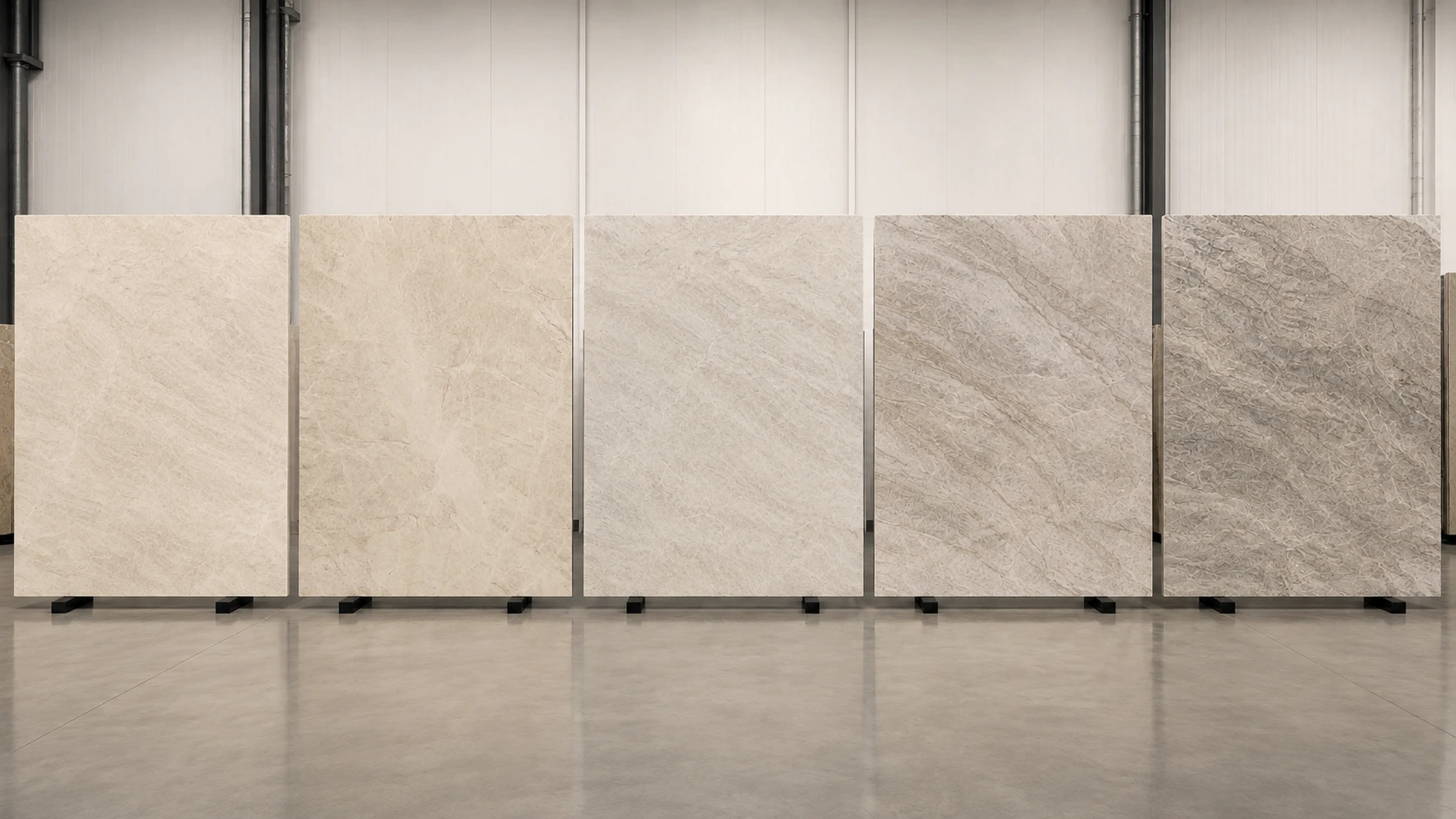
For larger kitchens, multiple slabs should be reviewed together. The buyer should establish an acceptable range for background tone, vein density and movement before the slabs are allocated to the island, perimeter countertops and backsplash.
Our guide on how to select natural stone slabs for large projects explains full-slab approval and batch coordination in greater detail.
2. Match the Quartzite Batch Before Fabrication
Two slabs with the same commercial stone name can still show meaningful differences. One Taj Mahal Quartzite slab may appear warmer and more beige, while another may contain stronger grey movement or darker linear veining.
Batch matching should consider:
- Background colour
- Warm or cool undertones
- Vein density
- Vein direction
- Large mineral areas
- Contrast between adjacent slabs
For an island requiring more than one slab, closely related pieces should be reserved before fabrication. The same principle applies when the backsplash and countertop are intended to read as one coordinated stone composition.
Buyers importing materials remotely should also review the common risks described in Common Mistakes When Buying Quartzite From Overseas Suppliers.
3. Choose the Right Countertop Thickness
For quartzite countertops for luxury kitchens, 20mm and 30mm are two commonly specified thicknesses in Show Stone’s custom fabrication workflow. The final selection should reflect the design, component size, support system and desired edge appearance.
20mm Quartzite Countertops
A 20mm profile can create a visually lighter and more contemporary appearance. It may be suitable for perimeter worktops, backsplashes and designs where a thinner edge is part of the architectural concept.
30mm Quartzite Countertops
A 30mm profile creates a stronger visual edge and may be preferred for large islands or designs where a more substantial countertop appearance is required.
The apparent edge thickness can also be changed through mitred or laminated fabrication. Buyers should therefore distinguish between the slab thickness and the final visible edge thickness.
4. Polished vs Honed Quartzite Finish
Surface finish changes the way light interacts with quartzite and can affect how the colour and veins are perceived.
Polished Finish
A polished surface generally increases reflection and visual depth. It can make crystalline sections, darker veins and mineral colour differences appear more pronounced.
Honed Finish
A honed surface produces a softer reflection and can work well in contemporary kitchens that use matte cabinetry, timber finishes or quieter architectural details.
Finish samples should be reviewed with the selected material whenever the appearance is critical. The same stone can look noticeably different under polished and honed finishing.
5. Check Slab Size Before Designing the Island
Large kitchen islands are often designed before the stone slabs are selected. This can create problems when the finished dimensions exceed the usable slab area.
The buyer should confirm:
- Actual slab length
- Actual slab width
- Usable cutting area
- Natural fissure positions
- Required overhang
- Edge-processing allowance
- Sink or cooktop location
- Waterfall-panel requirements
If a single slab cannot accommodate the intended island, the design team should decide where a seam can be accepted before fabrication begins.
6. Plan Seam Positions Before Cutting
Seams are not automatically a sign of poor fabrication. Large natural stone countertops may require joints because of slab dimensions, transport limits, access conditions or component geometry.
A good seam position should consider both technical installation and visual continuity.
Avoid placing seams without reviewing:
- Strong veins
- Sink openings
- Cooktop openings
- Highly visible front edges
- Unsupported areas
- Changes in slab colour
Digital slab layouts make it easier to evaluate seam positions before the approved quartzite is physically cut.
7. Coordinate Vein Direction Across the Kitchen
Natural stone veining can make a kitchen appear longer, wider or more visually dynamic depending on its orientation.
For a long island, the designer may choose to run the principal movement along the island length. For a full-height backsplash, the same material may be rotated to create vertical movement.
The important point is that these decisions are made intentionally.
Digital layout approval can help coordinate:
- Island orientation
- Perimeter countertops
- Backsplashes
- Waterfall ends
- Breakfast bars
- Feature wall panels
8. Match Waterfall Edges Before Fabrication
A waterfall island is one of the most visible applications for quartzite countertops for luxury kitchens because the horizontal worktop turns down into a vertical stone panel.
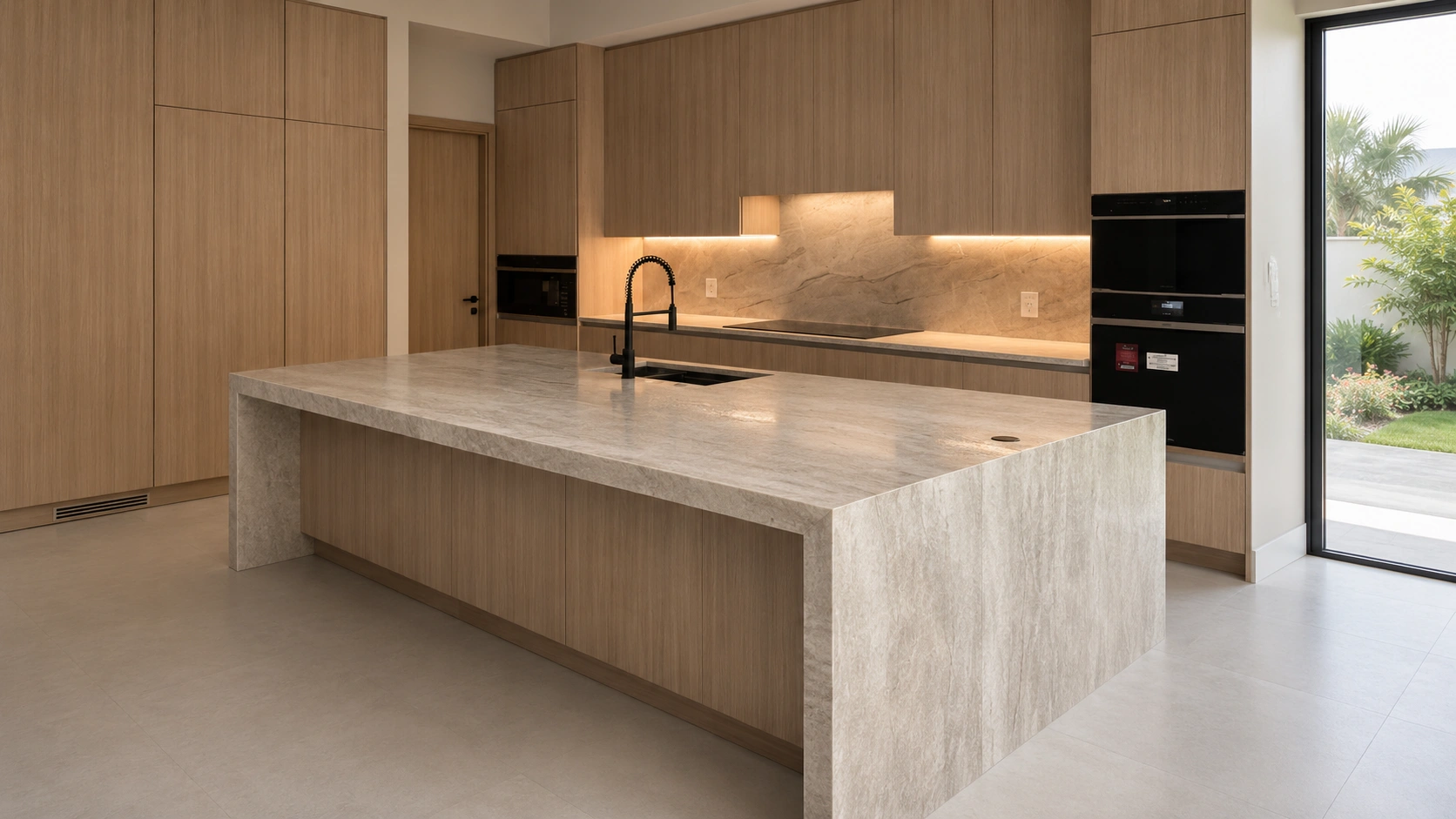
The strongest result usually comes from planning the horizontal and vertical pieces together before cutting. Depending on the slab and design, the fabricator can position the pieces to create a more continuous transition at the mitred corner.
Before approving a waterfall island, confirm:
- Which slab supplies the top
- Which slab supplies each side panel
- Vein direction
- Mitre positions
- Visible finished thickness
- Floor and cabinetry dimensions
- Support requirements
9. Coordinate Countertops and Full-Height Backsplashes
Using the same quartzite on the countertop and backsplash can make the stone a stronger architectural feature. However, ordering the two surfaces independently can produce disconnected veining or abrupt colour changes.
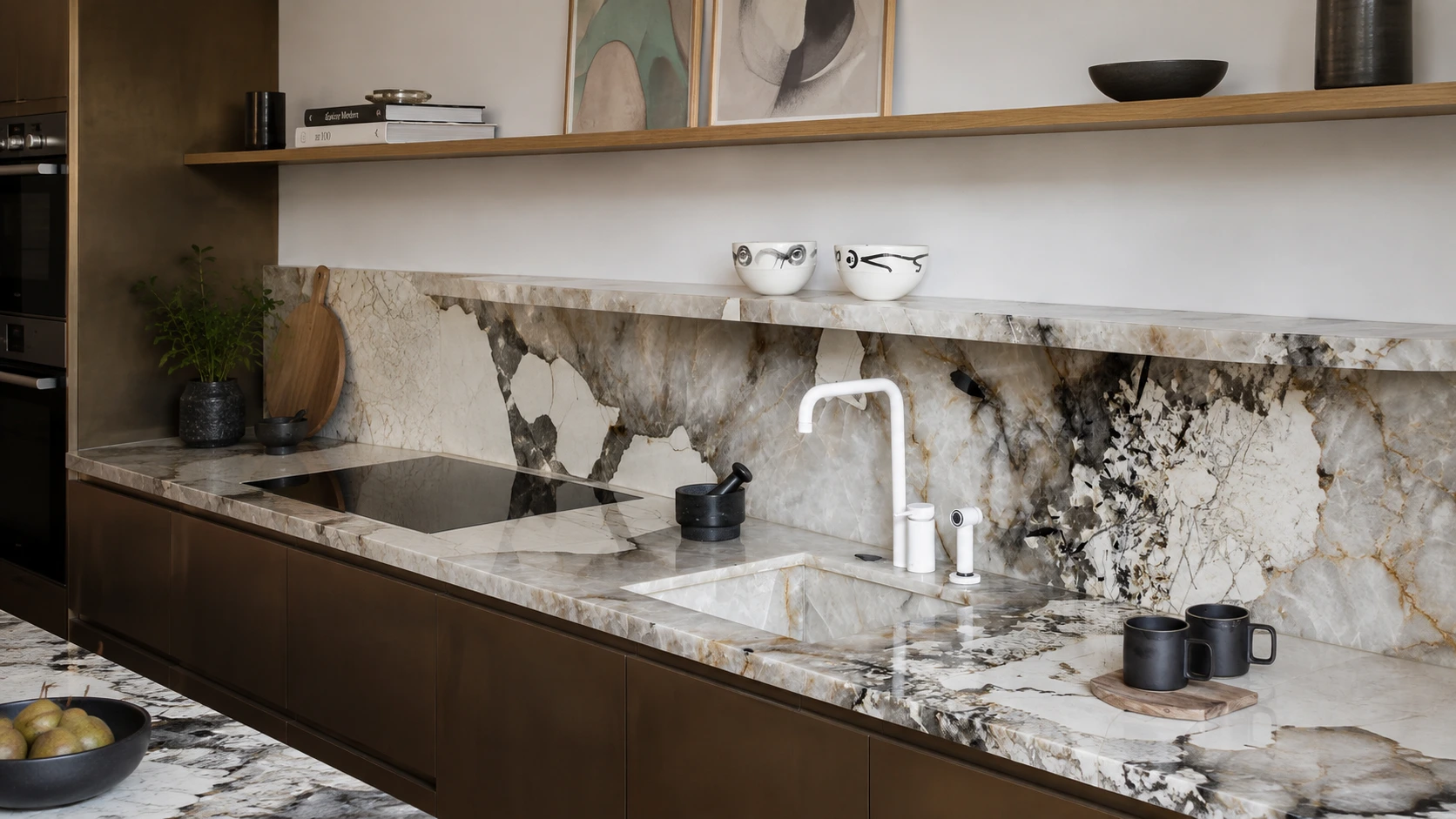
This becomes particularly important for dramatic materials such as Patagonia Quartzite, where large crystalline areas and contrasting mineral zones can dominate the design.
The layout should consider:
- Countertop depth
- Backsplash height
- Cabinet and appliance positions
- Power outlets
- Cooktop position
- Window openings
- Vein movement
- Available slab dimensions
A digital cutting layout allows the buyer and designer to review the complete composition before fabrication.
10. Confirm Sink and Cooktop Cut-Outs
Sink and cooktop openings reduce the amount of stone remaining around the cut-out. Their positions should therefore be considered during both slab selection and fabrication planning.
Before cutting, provide:
- Approved sink model
- Approved cooktop model
- Manufacturer dimensions or templates
- Tap-hole positions
- Required edge treatment
- Mounting method
- Cabinet opening information
A strong natural fissure or visually important vein may need to be avoided around a narrow section of the countertop. This is one reason the cutting layout should be prepared from the actual slab image.
11. Select the Edge Profile
Edge profiles influence both the visual weight and the fabrication complexity of a countertop.
Common options include:
- Straight polished edge
- Small bevel
- Chamfered edge
- Mitred edge
- Laminated built-up edge
- Custom decorative profiles
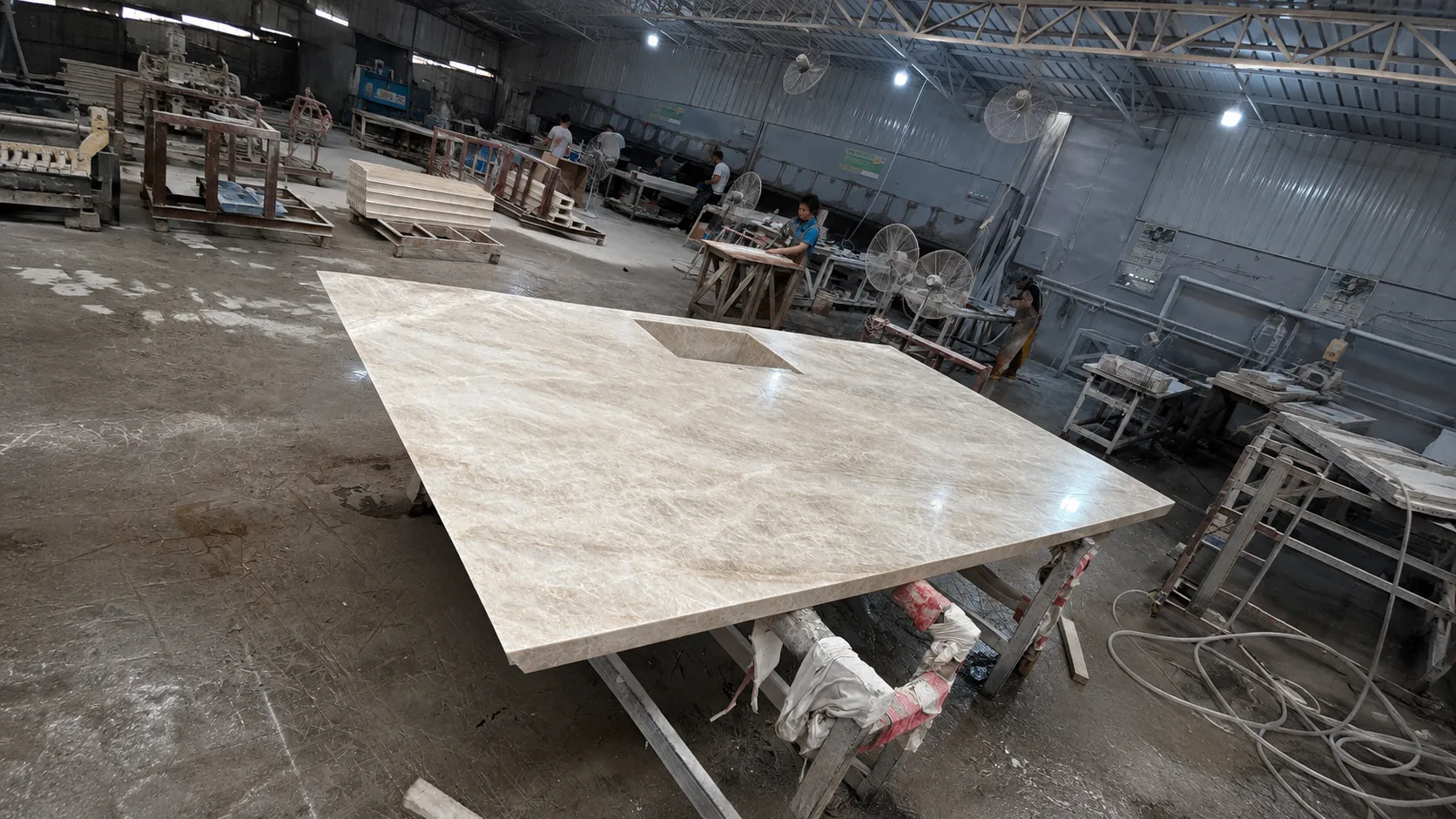
Mitred edges are frequently used when the designer wants a thicker visual profile without using a single slab of the same thickness. The mitre joint should be inspected for alignment, edge quality and visual continuity.
12. Review Fabrication Before Shipment
Custom kitchen stone should be inspected against the approved drawings before packing.
Typical factory checks can include:
- Length and width
- Finished thickness
- Diagonal measurement
- Sink cut-out dimensions
- Cooktop opening
- Tap-hole positions
- Edge profiles
- Mitred joints
- Surface finish
- Vein direction
- Piece numbering
The wider natural stone fabrication process for hotel and retail projects explains how digital scanning, cutting, CNC processing, dry laying, inspection and packing can be coordinated through one production workflow.
13. Understand Support and Installation Requirements
Stone fabrication cannot compensate for an unsuitable cabinet or support structure. Large quartzite islands, overhangs and narrow stone sections require appropriate support based on the project design.
Before installation, confirm:
- Cabinet level and alignment
- Support-frame position
- Overhang design
- Appliance clearances
- Wall condition
- Backsplash substrate
- Site access
- Lifting and handling method
Large islands should also be checked against access routes before shipment. A component that can be fabricated in one piece still has to pass through doors, lifts, corridors and the final kitchen entrance.
14. Sealing Quartzite Countertops
Whether a particular quartzite requires sealing, and how often, depends on the material, finish, installation and sealer system selected for the project. A one-size-fits-all maintenance schedule should therefore be avoided.
Before use, confirm the sealing procedure with the stone supplier, fabricator or installer and follow the instructions for the specific sealer used.
Important questions include:
- Was the surface sealed before shipment or installation?
- Which sealer was used?
- Does the selected finish change absorption behaviour?
- How should the surface be cleaned before resealing?
- What curing time is required?
Additional industry resources are available from the Natural Stone Institute.
15. Daily Care for Quartzite Countertops
Routine care is an important part of maintaining quartzite countertops for luxury kitchens. Cleaning practices should preserve the finish without leaving abrasive residue or exposing the surface to unnecessary chemicals.
For daily use:
- Remove spills promptly.
- Use a soft cloth or non-abrasive sponge.
- Use cleaners approved for natural stone.
- Avoid abrasive scouring products.
- Use cutting boards instead of cutting directly on the countertop.
- Use trivets or suitable protection for very hot cookware.
- Keep strong household chemicals away from the surface unless approved for the stone and sealer.
Natural stones marketed as quartzite can vary in mineral composition and surface behaviour. Project-specific care recommendations should therefore follow the actual material supplied rather than a generic internet rule.
Quartzite vs Marble for Luxury Kitchen Countertops
Marble and quartzite can both create premium natural-stone kitchens, but the final choice should consider appearance, expected use, maintenance expectations and the specific stone being supplied.
Marble is often selected for its classic veining and broad range of white, grey, green, red and brecciated patterns. Buyers interested in alternatives can review Show Stone’s natural marble collection.
Quartzite is often considered when the design requires natural slab movement combined with a different mineral structure from marble. However, buyers should still review the actual material and technical requirements rather than selecting solely from the commercial category name.
Common Specification Mistakes
Many problems with quartzite countertops for luxury kitchens begin before fabrication rather than during installation. The following mistakes are worth avoiding.
Approving Only a Small Sample
A sample cannot show the complete slab movement, usable area or batch variation.
Designing an Island Without Confirming Slab Size
This can create unexpected seams or require redesign after the stone has already been selected.
Ordering Slabs Without Batch Coordination
Adjacent countertops and backsplashes may show abrupt changes in tone or vein density.
Ignoring Vein Direction
Pieces may fit dimensionally but still appear visually disconnected.
Positioning Cut-Outs Without Reviewing the Slab
A sink or cooktop can remove the most attractive part of the material or leave a sensitive narrow section.
Planning the Waterfall Edge After the Top Is Cut
The horizontal and vertical components should be coordinated before fabrication.
Using Generic Appliance Dimensions
Final cut-outs should follow approved models, drawings or templates.
Comparing Countertop Suppliers by Square-Metre Price Alone
A quotation should also be evaluated for slab selection, digital layout, fabrication scope, edge details, inspection and packing.
Ignoring Packing and Site Access
Large finished pieces require appropriate export protection and must physically reach the installation area.
Buyer Checklist Before Ordering
Before ordering quartzite countertops for luxury kitchens, buyers should confirm the following information with the stone supplier and fabricator.
- Actual Slabs: Review current full-slab photographs, videos or digital scans.
- Batch Range: Confirm acceptable colour and vein variation.
- Slab Dimensions: Compare actual usable sizes with the kitchen drawings.
- Thickness: Confirm 20mm, 30mm or another approved thickness.
- Finish: Approve polished or honed appearance.
- Island Size: Confirm whether the top can be produced in one piece.
- Seams: Approve joint positions before cutting.
- Vein Direction: Mark countertop, backsplash and waterfall orientations.
- Waterfall Edges: Coordinate horizontal and vertical pieces digitally.
- Backsplash: Confirm height, outlets, windows and vein relationships.
- Sink: Provide approved dimensions or templates.
- Cooktop: Confirm model, opening and clearance requirements.
- Tap Holes: Confirm diameter and exact positions.
- Edges: Approve straight, bevelled, mitred or other profiles.
- Support: Confirm cabinet, frame and overhang requirements.
- QC: Define dimensions and visible details to be inspected.
- Packing: Confirm foam protection and export wooden-crate requirements.
- Lead Time: Coordinate drawing approval, production and shipping schedules.
Frequently Asked Questions
Are quartzite countertops for luxury kitchens available in 20mm and 30mm thicknesses?
Yes. Show Stone commonly fabricates quartzite countertops in 20mm and 30mm thicknesses, while other thicknesses can be discussed according to the project design and fabrication requirements.
Should I choose polished or honed quartzite for a kitchen?
Both finishes can be used depending on the design. Polished quartzite generally creates stronger reflection and colour depth, while honed quartzite has a softer visual appearance. The selected finish should be reviewed on the actual material.
Can a quartzite kitchen island be fabricated in one piece?
It depends on the finished island dimensions, actual slab size, usable cutting area, natural features and transport or site-access conditions. The slab dimensions should be reviewed before the island design is finalised.
Can quartzite be used for a waterfall kitchen island?
Yes. Quartzite can be fabricated with waterfall ends. The countertop and vertical panels should be planned together so vein direction, mitred joints and visible transitions can be reviewed before cutting.
Can the same quartzite be used for countertops and a full-height backsplash?
Yes. Using the same quartzite can create a coordinated kitchen composition. Digital slab layouts are useful for planning the relationship between the countertop and backsplash before fabrication.
How should sink and cooktop cut-outs be specified?
The fabricator should receive approved appliance models, dimensions or templates together with the required mounting method, edge treatment and hole positions before cutting begins.
Do quartzite countertops need sealing?
The sealing requirement depends on the specific quartzite, finish, installation and sealer system. Buyers should confirm the recommended sealing procedure for the actual material supplied and follow the sealer manufacturer’s instructions.
How should quartzite countertops be cleaned?
Use a soft cloth or non-abrasive sponge with a cleaner approved for natural stone, remove spills promptly and avoid unapproved abrasive or aggressive chemical cleaners.
How can buyers check vein matching before fabrication?
High-resolution slab images and digital cutting layouts can show where countertops, waterfall panels and backsplashes will be positioned on the actual slabs before cutting.
What information should I send before ordering custom quartzite countertops?
Provide kitchen drawings, finished dimensions, material preferences, thickness, finish, edge details, sink and cooktop information, backsplash requirements, vein direction, project schedule and delivery destination.
Why Project Buyers Choose Show Stone
Show Stone supports designers, contractors, importers and project buyers sourcing quartzite countertops for luxury kitchens with slab selection, digital layout planning, custom fabrication, quality inspection, packing and international shipment coordination.
Our workflow can include:
- Actual slab photography and video approval
- Batch and colour-range coordination
- High-resolution slab scanning
- Digital cutting layouts
- Vein-direction planning
- Waterfall-edge matching
- Countertop and backsplash coordination
- 20mm and 30mm custom fabrication
- Sink and cooktop cut-outs
- Tap holes
- Mitred and custom edge profiles
- CNC and precision cutting
- Dimensional quality inspection
- Piece numbering
- Foam protection and export wooden crates
Our approximately 10,000-square-metre finishing centre includes digital slab scanning, five-axis bridge cutting, infrared cutting, waterjet and CNC equipment for custom stone fabrication. More information is available through Show Stone project solutions and the About Show Stone page.
For more stone selection, specification and procurement guidance, visit the Show Stone blog.
Final Recommendation
Successful quartzite countertops for luxury kitchens begin with the actual slabs, not simply a stone name or sample. The buyer should coordinate slab selection, batch range, dimensions, thickness, finish and fabrication requirements before production starts.
For large islands, waterfall edges and full-height backsplashes, digital layout approval provides an additional level of control by showing where each finished component will sit on the natural stone. Sink and cooktop openings, seams and visible edge details can then be planned around the selected slab rather than decided after cutting.
After installation, appropriate cleaning and maintenance should follow the actual quartzite, finish and sealing system used for the project.
To review available Taj Mahal Quartzite, Patagonia Quartzite or other natural stone slabs for a kitchen project, please contact Show Stone with your drawings, required dimensions, thickness, finish, edge details, quantity, project schedule and delivery destination.