Bookmatched Marble Walls: Slab Selection, Layout, Fabrication & Installation
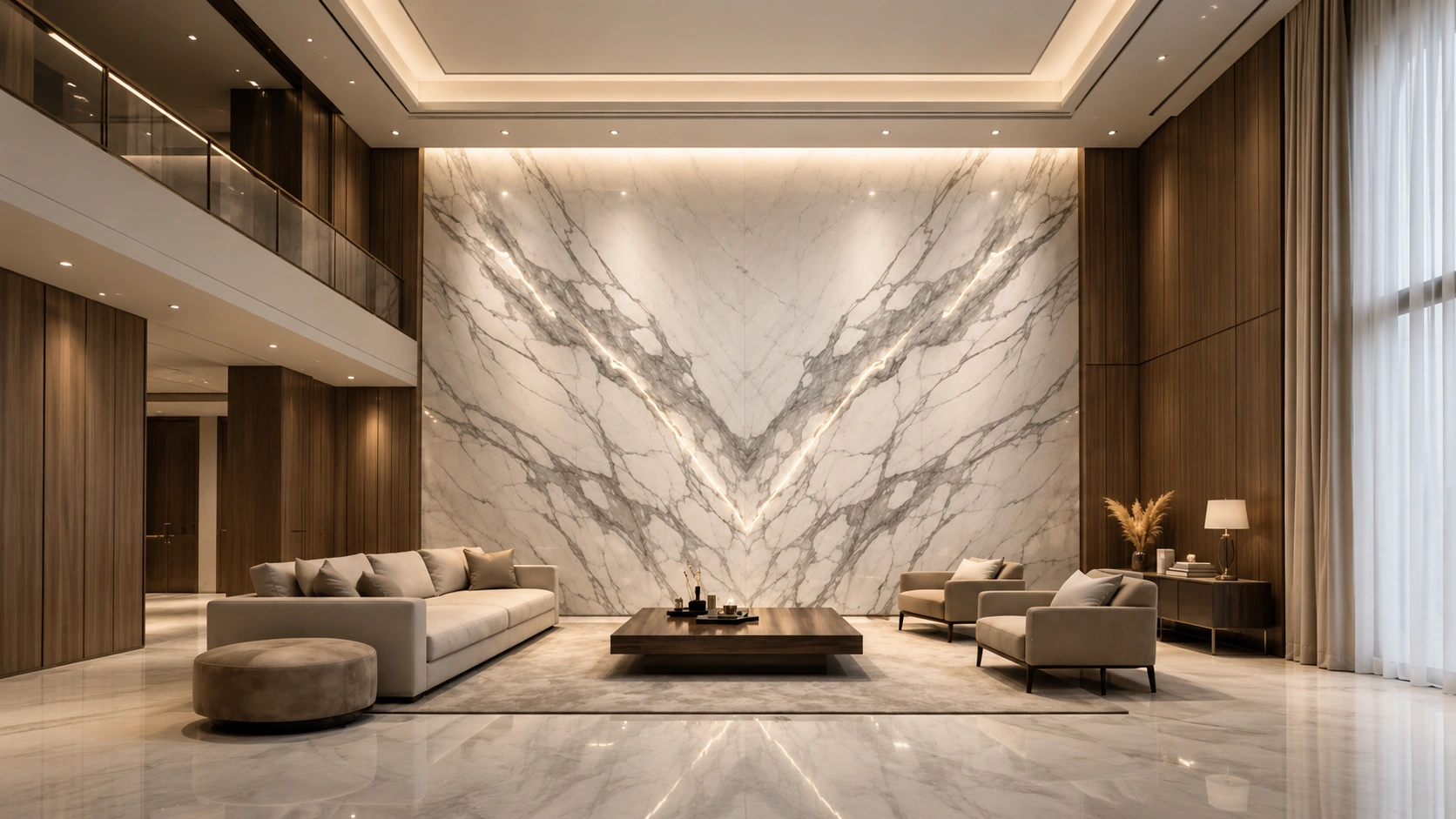
Bookmatched marble walls are among the most visually striking ways to use natural stone in luxury interiors. By arranging compatible marble slabs in mirrored or coordinated sequences, designers can transform natural veining into a large architectural composition rather than treating each slab as an isolated surface.
The finished effect may appear symmetrical, flowing, dramatic or quietly balanced depending on the marble selected and the way the slabs are cut and positioned. This makes bookmatched marble walls especially suitable for hotel lobbies, luxury residences, reception areas, feature walls, fireplaces, retail interiors and other spaces where the stone itself is intended to become a focal point.
However, good book matching does not begin at installation. It begins with the actual slabs. The process requires suitable slab sequences, full-slab approval, digital layout planning, careful fabrication, dry-lay inspection and clear piece numbering. This guide explains how bookmatched marble walls should be selected, planned, fabricated and prepared for installation in premium projects.
Buyers can also explore Show Stone’s wider natural marble collection, including materials with strong book-matching potential such as Breccia Violetta Marble, Verde Lapponia Marble, Volakas Marble, Calacatta Burgundy Marble and Arabescato Marble.
Buyer Decision Check
- Best for: Feature walls, hotel lobbies, luxury living rooms, fireplace surrounds, reception areas and premium retail interiors.
- Main material decision: Select marble with sufficient slab compatibility, attractive veining and suitable consecutive faces for the intended layout.
- Main layout decision: Decide whether the design requires two-panel, four-panel, mirrored book match or continuous vein matching.
- Main fabrication requirement: Approve digital layouts, seam positions, panel sizes, centre lines and visible edges before cutting.
- Main quality-control requirement: Review the finished pieces through dry lay, visual inspection and numbering before packing.
What Are Bookmatched Marble Walls?
Bookmatched marble walls are created by arranging related marble slab faces so that the natural veining reflects or continues across a joint. The effect is similar to opening the pages of a book, which is where the term “book matching” comes from.
When suitable slabs are used, the two faces can create a mirrored pattern around a central joint. More complex designs may use four or more panels to form larger symmetrical compositions.
The important point is that book matching depends on the relationship between the actual slab faces. It cannot be created accurately from unrelated slabs simply because they share the same commercial stone name.
Bookmatched Marble Walls vs Vein-Matched Marble Walls
Book matching and vein matching are related design techniques, but they are not the same.
Book Matching
Book matching usually creates a mirrored relationship between adjacent slab faces. The central joint becomes part of the composition, and the veining appears to open outward from that line.
Vein Matching
Vein matching focuses on continuing the visual movement from one panel into the next. Rather than creating a mirror image, the goal is to make the veins flow naturally across joints, corners or connected surfaces.
Bookmatched marble walls are often preferred for symmetrical feature walls, while vein matching can be more suitable for long elevations, fireplaces, corridors, returns or multi-surface compositions.
Which Marbles Work Well for Book Matching?
Not every marble creates the same book-matched effect. Materials with visible directional veining, strong colour movement or large-scale pattern variation often produce the most dramatic results.
- Breccia Violetta Marble: Strong purple, burgundy and violet movement can create highly decorative mirrored walls. See Breccia Violetta Marble.
- Verde Lapponia Marble: Green tonal movement can create distinctive feature walls for hospitality, retail and residential interiors. See Verde Lapponia Marble.
- Volakas Marble: White backgrounds with softer grey movement can produce more restrained and elegant bookmatched marble walls. See Volakas Marble.
- Calacatta Burgundy Marble: Strong high-contrast veining can create a dramatic central composition. See Calacatta Burgundy Marble.
- Arabescato Marble: Grey veining over a lighter background can work well for classic and contemporary mirrored layouts. See Arabescato Marble.
The commercial material name should only be the starting point. The final decision should always be made using the actual slabs available for the project.
Step 1: Select the Actual Marble Slabs
The first step in successful bookmatched marble walls is selecting the actual stone rather than relying only on samples, catalogue images or material names.
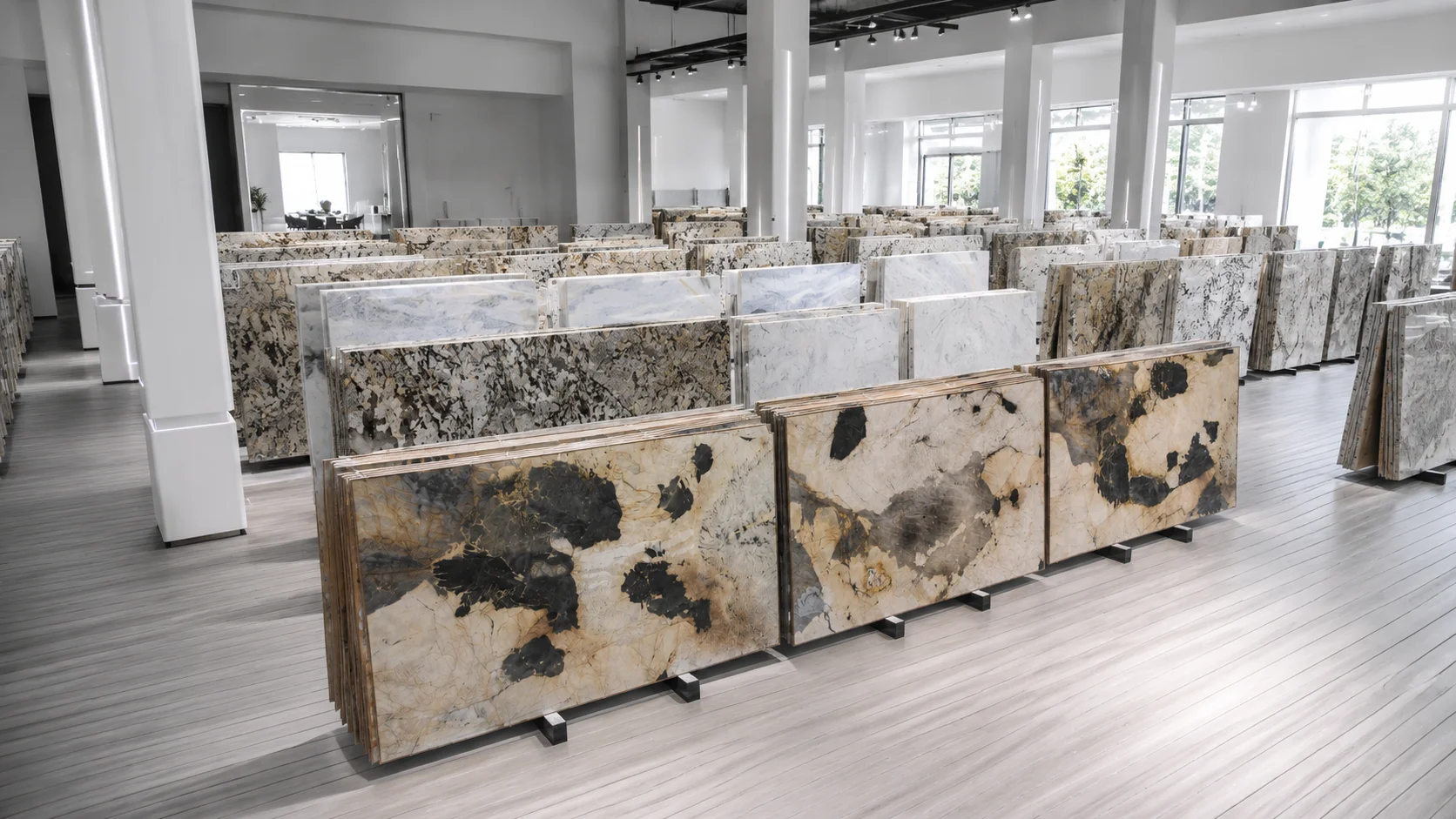
During slab selection, buyers should review:
- Overall background colour
- Vein direction
- Vein density and scale
- Natural fissures and repairs
- Usable slab dimensions
- Consecutive slab availability
- Whether the available faces can create the intended mirror or flow effect
For large feature walls, it is usually better to evaluate several slabs together rather than approving them individually.
More detailed slab-selection guidance is available in our guide to how to select natural stone slabs for large projects.
Step 2: Confirm Consecutive Slab Selection
Consecutive slab selection is especially important for bookmatched marble walls because the visual relationship between adjacent slabs determines whether the final composition feels natural and controlled.
Where possible, slabs from the same block and closely related cutting sequence should be grouped together. This helps maintain consistency in background tone, vein structure and pattern scale.
However, consecutive numbering alone does not automatically guarantee a perfect book match. The actual slab faces still need to be reviewed to confirm whether they create the intended mirrored relationship.
Step 3: Approve Full-Slab Photography and Video
For remote international projects, buyers do not always need to stand in the warehouse to review the material. Full-slab photography and video approval can help architects, designers and contractors evaluate the actual stone before reservation and cutting.
Useful approval information can include:
- Full-face slab photographs
- Slab numbers
- Dimensions
- Videos showing surface condition and colour
- Sequence information
- Notes on visible natural characteristics
This creates a clearer connection between the approved slab and the later digital layout.
Step 4: Digitally Scan the Marble Slabs
Digital slab scanning is one of the most useful tools for planning bookmatched marble walls because it creates a high-resolution visual reference of the actual material.
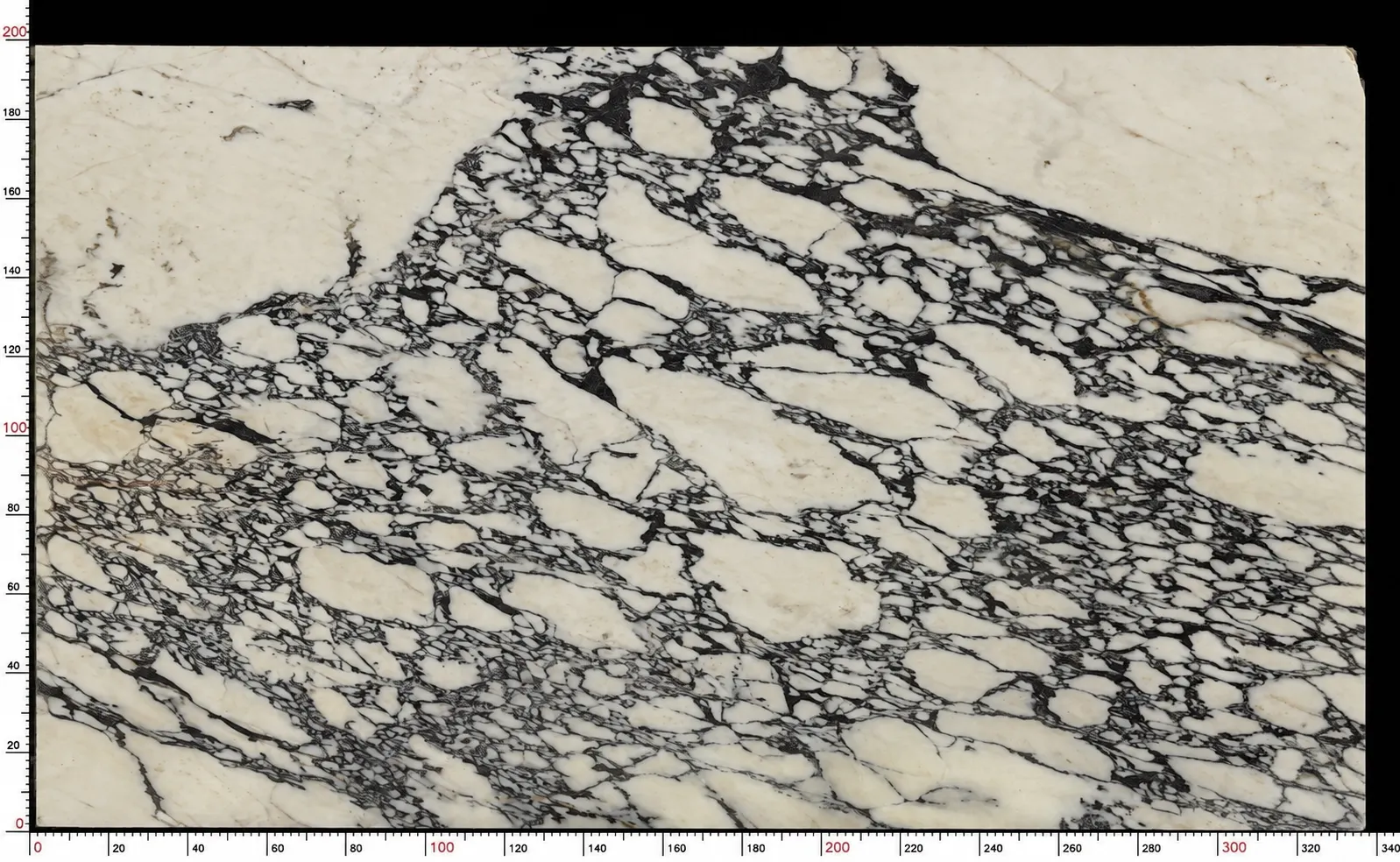
Once the slabs are scanned, the digital images can be used to test different panel positions and relationships without physically cutting the stone.
This is particularly valuable when the marble contains strong directional veining or when the design team needs to control the exact centre point of the composition.
Step 5: Create the Digital Book-Match Layout
The digital cutting layout connects the approved marble slabs with the finished wall dimensions.
For bookmatched marble walls, the layout should review:
- Overall wall dimensions
- Panel sizes
- Centre line
- Horizontal and vertical joints
- Mirror relationship between slabs
- Doors, niches and openings
- Fireplace or TV positions
- Visible corners and returns
- Material yield
Digital planning allows the designer to compare several layout options before approving the final cutting arrangement.
Two-Panel vs Four-Panel Book Matching
The number of panels used has a major effect on the final appearance.
Two-Panel Book Match
A two-panel arrangement is the simplest and most common option. Two coordinated slab faces meet at one central joint, producing a strong mirrored effect.
Four-Panel Book Match
A four-panel arrangement can create a much larger symmetrical composition. It may be used for hotel lobbies, double-height walls, large living rooms and major retail feature areas.
Four-panel layouts require more careful slab selection because all four pieces need to work together visually.
Control the Centre Joint and Main Viewing Axis
The centre joint is often the most important line in bookmatched marble walls. If it is poorly positioned, the entire wall can feel unbalanced even when the slabs themselves are attractive.
The centre line should therefore be coordinated with the architecture. Depending on the space, it may align with:
- The centre of a fireplace
- A television or artwork
- A reception desk
- A doorway
- The central axis of a lobby
- A furniture composition
The best marble layout is not always the one that uses the stone most efficiently. In a high-value feature wall, visual composition may be more important than maximising slab yield.
Step 6: Fabrication of Bookmatched Marble Panels
After approval of the digital layout, fabrication can begin. The cutting sequence should follow the approved panel positions so that the actual stone remains consistent with the drawing.
Typical fabrication considerations include:
- Custom cut-to-size production
- 18mm or 20mm thickness
- Other thicknesses by custom order
- Polished or honed finish
- Mitred edges where required
- Visible edge finishing
- Openings and cut-outs
- Corner returns
- Panel tolerances
The fabrication process should preserve both the approved dimensions and the intended vein relationship.
For more detail on production control, see our guide to the natural stone fabrication process for hotel and retail projects.
Step 7: Dry Lay the Finished Marble Panels
Dry laying is one of the most valuable quality-control stages for bookmatched marble walls. Finished panels are arranged in the intended sequence so the visual composition can be reviewed before packing.
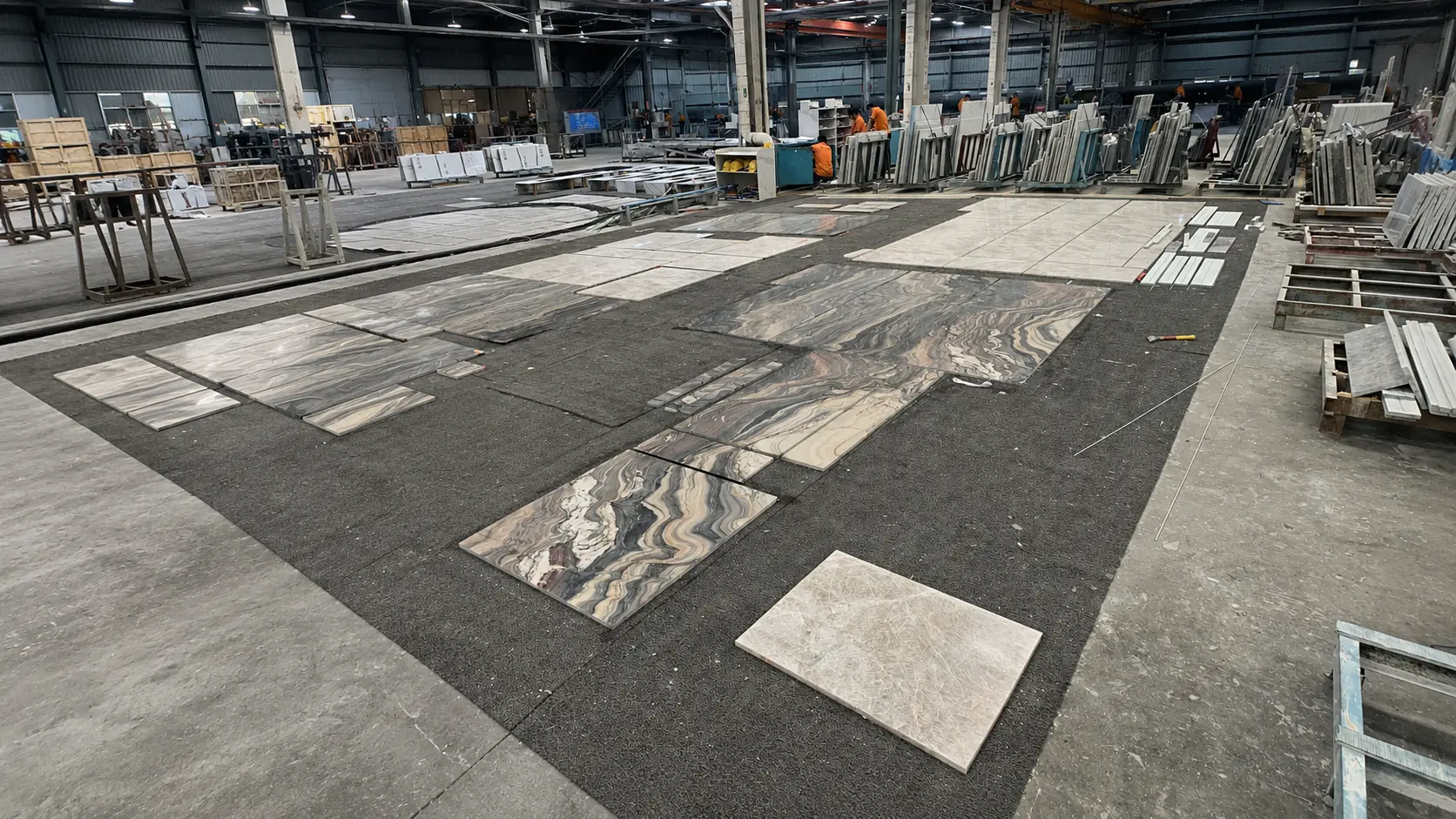
During dry-lay inspection, the project team can review:
- Book-match symmetry
- Vein continuity
- Centre-joint relationship
- Colour transitions
- Panel dimensions
- Visible edges
- Opening positions
- Overall elevation composition
If a panel relationship needs adjustment, it is easier to identify the issue in the factory than after international shipment.
Step 8: Number Every Finished Piece
Piece numbering helps connect the fabricated marble panels with the approved elevation and installation sequence.
A useful numbering system can identify:
- Project area
- Room or elevation
- Panel row
- Panel column
- Left / right relationship
- Installation sequence
For large bookmatched marble walls, this documentation reduces the risk of installing visually compatible pieces in the wrong position.
Step 9: Pack According to the Installation Sequence
Bookmatched marble panels should be packed with enough protection for international transport while still supporting efficient installation at site.
Show Stone can use foam protection and export wooden crates, with crate identification and piece references coordinated with the project drawings.
Where practical, pieces can be grouped by wall or installation sequence rather than packed randomly. This helps the site team locate the correct panels more efficiently.
Installation Considerations for Bookmatched Marble Walls
Even well-selected and well-fabricated bookmatched marble walls depend on careful installation.
The installer should confirm:
- Substrate condition
- Approved installation method
- Panel sequence
- Joint width
- Centre-line position
- Level and alignment
- Corner and return details
- Relationship with surrounding joinery or metalwork
The installation team should work from the same approved elevation and numbering system used during fabrication and dry lay.
Bookmatched Marble Fireplace and Residential Feature Walls
Bookmatched marble walls are not limited to hotel lobbies or large commercial projects. They can also be used in high-end residential interiors where a fireplace, television wall or living-room feature becomes the visual centre of the space.
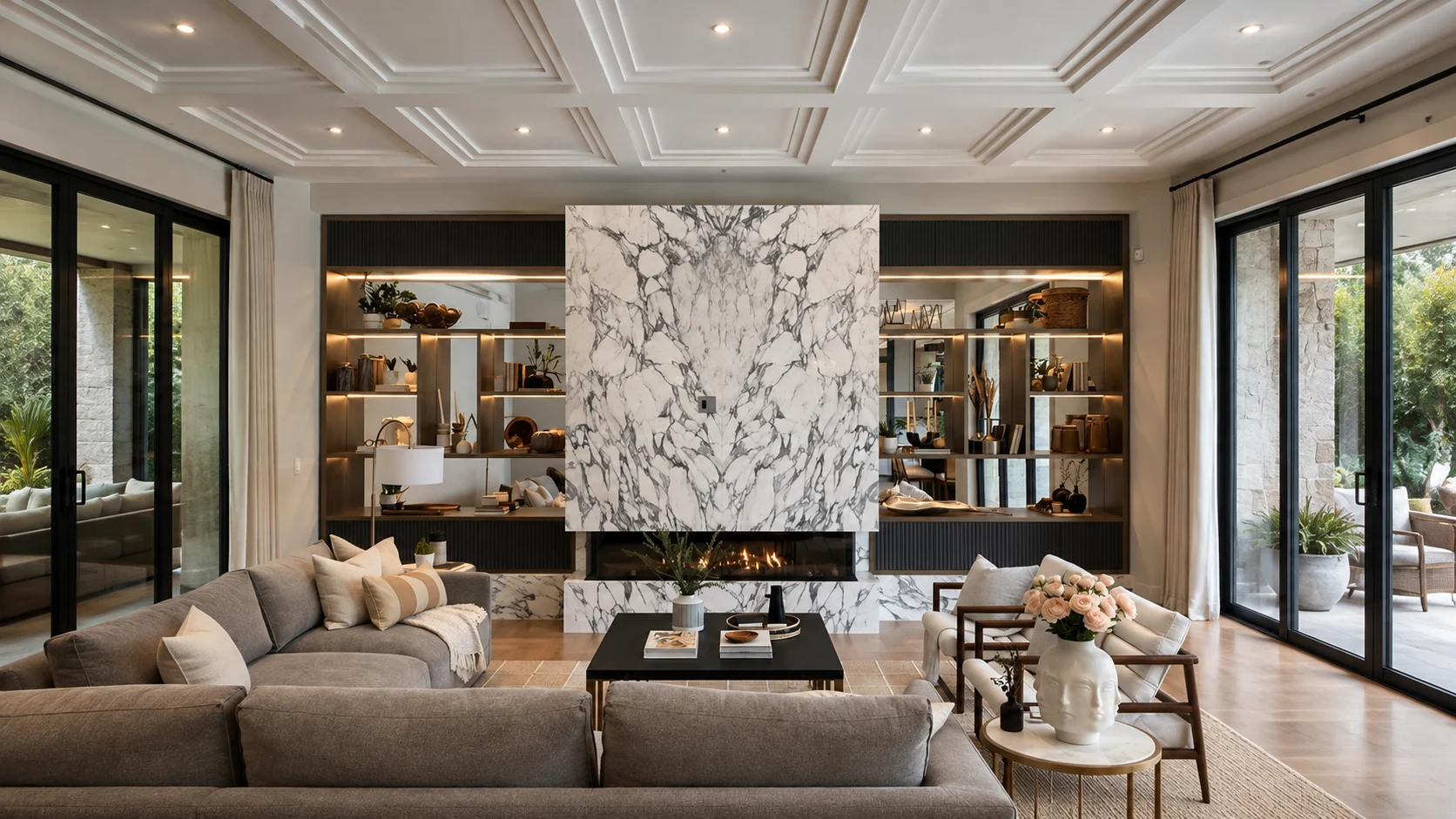
For residential feature walls, the layout should consider the position of the fireplace, shelving, screens, lighting and furniture. The stone composition should support the architecture rather than compete with it.
Technical Specification Guidelines
| Specification | Typical Project Option | Project Notes |
|---|---|---|
| Material | Natural marble | Select actual slabs according to colour and pattern. |
| Thickness | 18mm / 20mm | Other thicknesses available by custom order. |
| Finish | Polished / Honed | Choose according to project design and visual intent. |
| Matching | Book matching / Vein matching | Plan from actual slab imagery before cutting. |
| Slab Approval | Full-slab photography / video | Useful for remote approval and batch coordination. |
| Digital Planning | Digital slab scanning / cutting layout | Supports seam control, pattern positioning and yield planning. |
| Fabrication | Custom cut-to-size / edge / mitre fabrication | According to approved shop drawings and layout. |
| Inspection | Dry lay inspection + piece numbering | Recommended for multi-panel feature walls. |
| MOQ | 1 pc | Suitable for custom pieces and larger project supply. |
| Lead Time | Approximately 4 weeks | Depends on material approval, quantity and fabrication scope. |
| Packing | Foam + export wooden crates | Pieces can be identified according to elevation and installation sequence. |
Common Mistakes With Bookmatched Marble Walls
Choosing the Marble Name Without Reviewing Actual Slabs
Natural marble varies significantly, so the final visual effect should be judged from the actual slabs rather than from a sample alone.
Assuming Every Consecutive Slab Will Create a Perfect Mirror
Consecutive slabs are useful, but the actual faces still need to be reviewed and digitally arranged before approval.
Ignoring the Centre Joint
The central seam often defines the visual balance of bookmatched marble walls and should be coordinated with the architectural axis.
Cutting Before Approving the Digital Layout
Once the slabs are cut, the pattern cannot simply be repositioned. Digital approval should happen before fabrication.
Skipping Dry-Lay Inspection
Dry lay allows the completed composition to be reviewed before the pieces leave the factory.
Packing Without Clear Piece Numbers
Unclear numbering increases installation risk, particularly when several similar panels belong to one large elevation.
Buyer Checklist Before Ordering
- Material: Confirm the exact marble and review the actual slabs available.
- Slab Sequence: Check whether suitable consecutive or compatible slab faces are available.
- Pattern: Decide whether the design requires book matching or vein matching.
- Wall Dimensions: Provide finished elevation dimensions, openings and architectural centre lines.
- Thickness: Confirm 18mm, 20mm or another approved custom thickness.
- Finish: Confirm polished or honed marble.
- Full-Slab Approval: Review slab photos, videos and identification numbers.
- Digital Layout: Approve the book-match composition and cutting positions before fabrication.
- Fabrication: Confirm panel sizes, cut-outs, edges, mitres and returns.
- Dry Lay: Review the finished elevation before packing where possible.
- Numbering: Match every panel with the approved installation drawing.
- Packing: Confirm foam protection and export wooden crates.
- Lead Time: Coordinate slab approval, layout approval, production and shipment with the project programme.
Frequently Asked Questions
What are bookmatched marble walls?
Bookmatched marble walls use coordinated marble slab faces arranged so that the natural veining creates a mirrored or symmetrical pattern across one or more joints.
What is the difference between book matching and vein matching?
Book matching creates a mirrored relationship between adjacent slab faces, while vein matching focuses on continuing the natural vein movement from one panel into the next.
Which marble is best for bookmatched walls?
Marbles with visible directional veining and strong natural movement often create the most dramatic results, but the actual slabs should always be reviewed before selecting a material for book matching.
Do bookmatched marble walls require consecutive slabs?
Consecutive or closely related slabs are usually preferred because they can provide better colour and pattern compatibility, but the actual slab faces still need to be reviewed to confirm the intended book-match effect.
Why is digital slab scanning useful for book matching?
Digital slab scanning allows the actual marble pattern to be used in layout planning so panel positions, seams, centre lines and vein relationships can be reviewed before cutting.
What thickness is commonly used for bookmatched marble wall panels?
18mm and 20mm are common project thicknesses, while other thicknesses can be produced by custom order depending on the design and installation requirements.
Can bookmatched marble be polished or honed?
Yes. Bookmatched marble panels can be supplied in polished or honed finishes depending on the required appearance and project specification.
Why should bookmatched marble panels be dry laid before shipment?
Dry laying allows the completed wall composition to be reviewed for symmetry, vein continuity, colour transitions, joints and piece sequence before packing and shipment.
How are marble wall panels numbered for installation?
Each finished panel can be assigned a piece number linked to the approved elevation, room, row, column or installation sequence so installers can identify the correct position on site.
What information should I provide before requesting a bookmatched marble wall quotation?
Provide the preferred marble, wall dimensions, drawings, panel sizes, thickness, finish, openings, edge details, required matching style, approximate quantity, project schedule and delivery destination.
Why Global Project Buyers Work With Show Stone
Show Stone supports architects, designers, contractors and stone buyers planning bookmatched marble walls with a workflow that connects material selection, digital planning, fabrication, inspection and export delivery.
Our project support can include:
- Actual marble slab selection
- Consecutive slab coordination
- Full-slab photography and video approval
- Digital slab scanning
- Book-match and vein-match layouts
- Digital cutting plans
- Custom cut-to-size fabrication
- Edge and mitre processing
- Factory dry-lay inspection
- Piece numbering
- Foam protection and export wooden-crate packing
- International shipment coordination
Project buyers can compare suitable materials through the marble collection or review individual options such as Breccia Violetta Marble, Verde Lapponia Marble, Volakas Marble, Calacatta Burgundy Marble and Arabescato Marble.
For related design and material guidance, see our previous article on Backlit Onyx for Hotels and Luxury Retail.
For independent industry references on natural stone design and technical considerations, project teams can also review the Natural Stone Institute resources for design professionals.
Final Recommendation
Bookmatched marble walls should be planned as complete architectural compositions rather than as individual stone panels. The best results come from selecting compatible actual slabs, digitally reviewing the intended pattern, controlling the centre line and joints, and checking the completed elevation before shipment.
For luxury hotels, residences, retail interiors and statement feature walls, this workflow allows the natural movement of marble to become a deliberate design element while reducing avoidable surprises during installation.
To discuss a bookmatched marble wall project, please contact Show Stone with your preferred marble, wall elevation, dimensions, thickness, finish, matching requirements, drawings and delivery destination.