Taj Mahal Quartzite vs Marble vs Quartz: Which Is Better?
Choosing between Taj Mahal Quartzite, natural marble and engineered quartz is not simply a question of which material is more expensive or visually impressive. Each surface responds differently to scratching, acidic liquids, heat, staining, fabrication and long-term use. The right choice depends on how the space will be used and what the buyer expects the material to look like after several years.
Taj Mahal Quartzite is often considered by buyers who appreciate the soft elegance of marble but want stronger everyday performance. Natural marble remains highly desirable for projects where distinctive veining, depth and traditional stone character are the main priorities. Engineered quartz appeals to buyers who value controlled colours, repeatable patterns and relatively straightforward daily care.
This comparison explains the practical differences between the three materials and helps designers, contractors, importers and project buyers decide which option is better for countertops, waterfall islands, backsplashes, vanity tops, hotels and high-end residential interiors.
Quick Answer: Which Material Is Better?
There is no single material that is better for every project.
- Choose Taj Mahal Quartzite when you want warm marble-like movement, genuine natural variation and comparatively strong resistance to everyday scratching and acidic substances.
- Choose natural marble when authentic veining, mineral depth and a surface that develops character over time are more important than preventing every etch mark or scratch.
- Choose engineered quartz when pattern consistency, controlled colours and simplified routine maintenance are more important than natural slab individuality.
The final decision should consider the actual material batch, intended application, expected level of use, edge and cut-out design, installation conditions and the client’s tolerance for natural variation or visible ageing.
What Is Taj Mahal Quartzite?
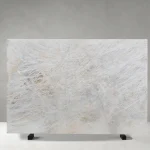
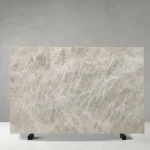
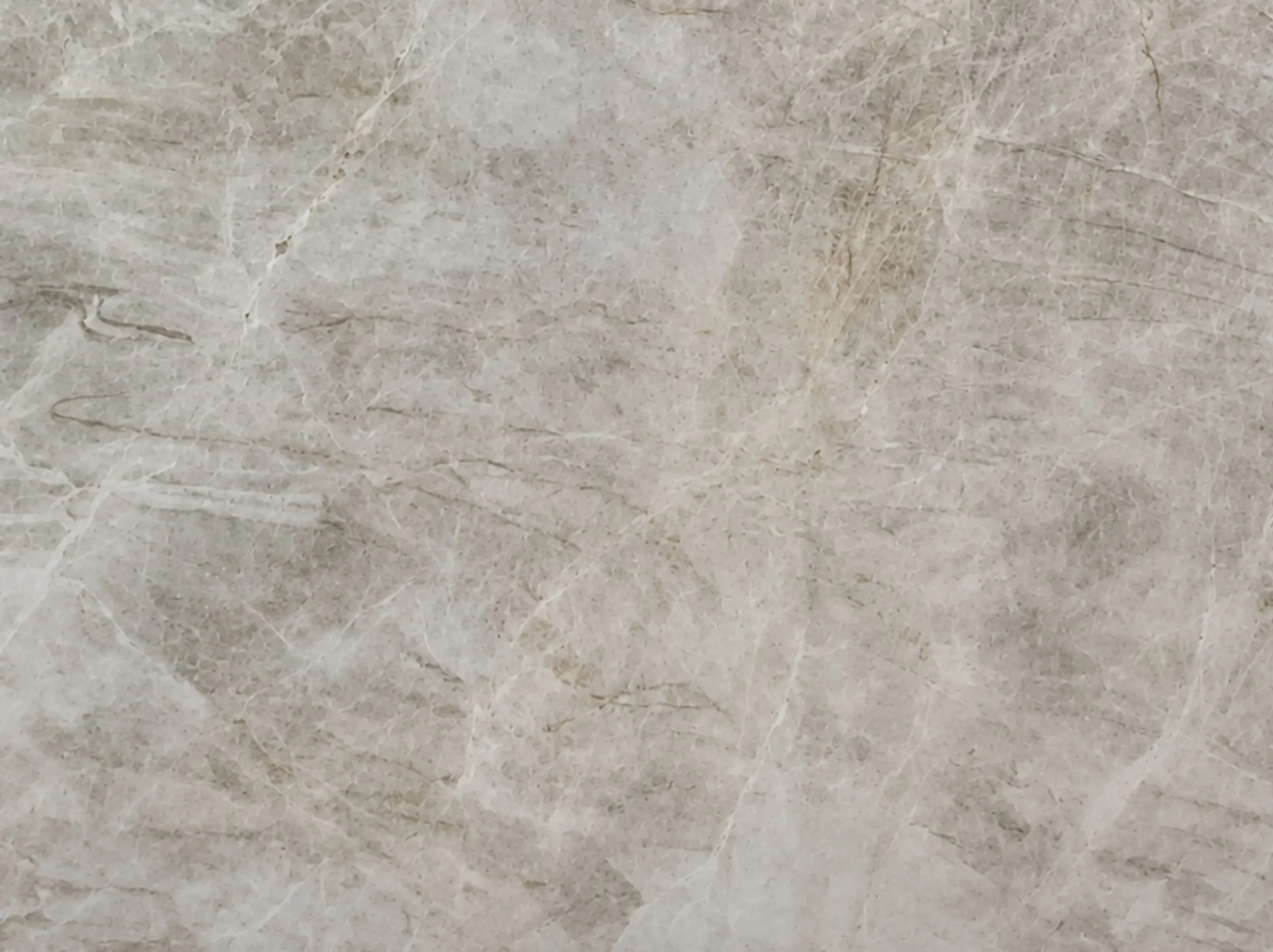
Taj Mahal Quartzite is a natural stone generally recognised for its warm ivory, cream and pale beige background with soft veins in gold, taupe, brown or grey. Its restrained movement allows it to work with natural timber, warm white cabinetry, brushed metal and neutral interior palettes.
Quartzite forms when quartz-rich sandstone is transformed by geological heat and pressure. During this process, the original quartz grains recrystallise and become tightly bonded, producing a dense natural stone that is generally harder than calcite-based marble.
Taj Mahal Quartzite is quarried in blocks and processed into individual slabs. Colour, vein movement, mineral areas and natural structure can vary between blocks and production batches. Buyers should therefore approve the actual slabs rather than relying only on a small sample or commercial stone name.
For a more detailed material introduction, read what Taj Mahal Quartzite is, how it performs and how to select it. Available material can also be reviewed on the Taj Mahal Quartzite product page.
What Is Natural Marble?
Natural marble is a metamorphic stone that usually develops when limestone is changed by heat and pressure. It is primarily associated with calcite or dolomite minerals and is valued for its crystalline depth, distinctive veining and ability to take a refined polished or honed finish.
Marble covers a very broad range of appearances. Some varieties have quiet white or beige backgrounds, while others show dramatic purple, green, red, black or gold movement. This variety makes marble highly relevant for feature walls, flooring, bathroom interiors, reception counters and statement furniture.
Natural marble is generally more sensitive to acidic substances than genuine quartzite. Lemon juice, vinegar, wine and certain cleaning products can react with calcium-based minerals and create dull marks known as etching. Many designers accept this natural ageing, especially in projects where material authenticity is more important than keeping the surface visually unchanged.
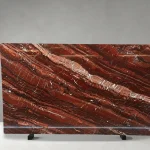
For example, Breccia Violetta Marble creates a highly expressive design through burgundy, violet and grey veining. It represents a very different visual direction from the restrained warmth of Taj Mahal Quartzite and should be selected for its own natural character rather than treated as a direct visual substitute.
What Is Engineered Quartz?
Engineered quartz is a manufactured surface made from mineral particles combined with pigments and polymer-based binders. The exact formulation varies by manufacturer and product series.
Unlike natural quartzite and marble, engineered quartz is produced in controlled manufacturing conditions. This allows colours and patterns to be more repeatable across sheets, although some movement and shade variation may still occur between production batches.
Engineered quartz is commonly selected for kitchens, vanity tops and multi-unit developments where predictable appearance and easier replication are important. It is generally non-porous and does not usually require penetrating sealer, but the resin content means direct contact with extreme heat should be avoided.
Natural quartzite and engineered quartz should not be treated as the same material. One is a quarried natural stone with unique slab movement; the other is a manufactured composite designed to provide greater visual consistency.
Appearance and Design Differences
Taj Mahal Quartzite
Taj Mahal Quartzite offers a warm and quiet appearance. The background usually moves between cream, ivory, light beige and greige, while the veins tend to be soft rather than highly contrasted. It is well suited to transitional, contemporary and understated luxury interiors.
Natural Marble
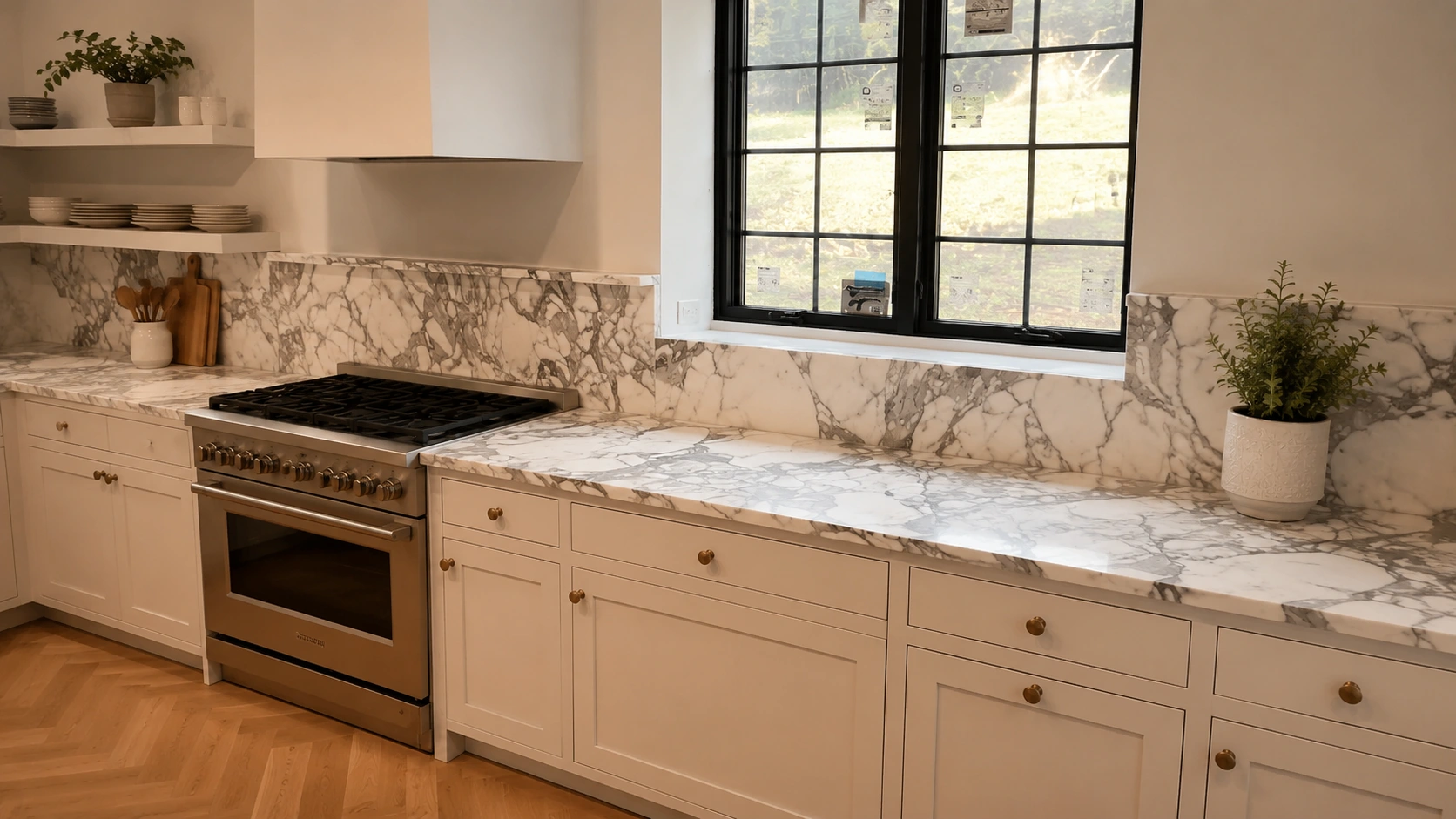
Marble provides a wider visual spectrum. It can appear calm and classical or bold and highly expressive, depending on the variety. Its crystalline structure and natural vein transitions can produce a level of depth that is difficult to reproduce in manufactured surfaces.
Engineered Quartz
Engineered quartz generally provides more controlled colours and repeatable patterning. It is useful when a project requires numerous countertops with a similar appearance or when the design specification allows limited natural variation.
Some engineered quartz products imitate marble-style veining, but repeated motifs may become visible across larger installations. Buyers should review full-sheet images and physical samples rather than evaluating only a small printed or digital representation.
Taj Mahal Quartzite vs Marble vs Quartz: Performance Comparison
| Comparison | Taj Mahal Quartzite | Natural Marble | Engineered Quartz |
|---|---|---|---|
| Material type | Quarried natural quartzite | Quarried natural stone, commonly calcite- or dolomite-based | Manufactured mineral and resin composite |
| Appearance | Warm cream tones with soft natural movement | Extensive colour range with natural crystalline depth | Controlled colours and more repeatable patterns |
| Slab consistency | Natural variation between slabs and batches | Natural variation can be subtle or dramatic | Generally more consistent, subject to production batches |
| Scratch resistance | Generally strong for genuine quartzite | Usually lower than quartzite | Generally good, but cutting boards remain recommended |
| Acid sensitivity | Generally more resistant than calcite-based marble | Can etch when exposed to common acidic substances | Does not etch like marble, but harsh chemicals may damage resin or finish |
| Heat consideration | Natural heat resistance; trivets still recommended | Natural heat resistance; thermal shock and installation conditions still matter | Heat resistant but not heat proof; protect resin from hot cookware |
| Stain consideration | Depends on the actual slab, finish and sealing condition | Depends on stone type, finish, absorption and sealing | Generally low absorption, but discolouration from chemicals or heat remains possible |
| Maintenance | Natural-stone cleaning and material-specific sealing assessment | Natural-stone care with acceptance of possible etching and patina | Routine non-abrasive cleaning; usually no penetrating sealer |
| Fabrication planning | Requires slab layout, vein planning and structural assessment | Requires vein planning and careful handling of natural structure | Requires manufacturer-compliant fabrication and heat planning |
| Best suited for | Natural luxury with balanced practical performance | Projects prioritising authentic veining and material character | Projects prioritising consistency and controlled specifications |
This comparison should be used as a general purchasing framework rather than a substitute for evaluating the actual slab or product. Commercial stone names, natural mineral composition, engineered formulations and surface finishes can vary.
Which Material Is Better for Kitchen Countertops?
Taj Mahal Quartzite for Balanced Natural Performance
Taj Mahal Quartzite is often the strongest overall choice for buyers who want a natural surface with light marble-like movement but do not want the same level of acid sensitivity normally associated with calcite-based marble.
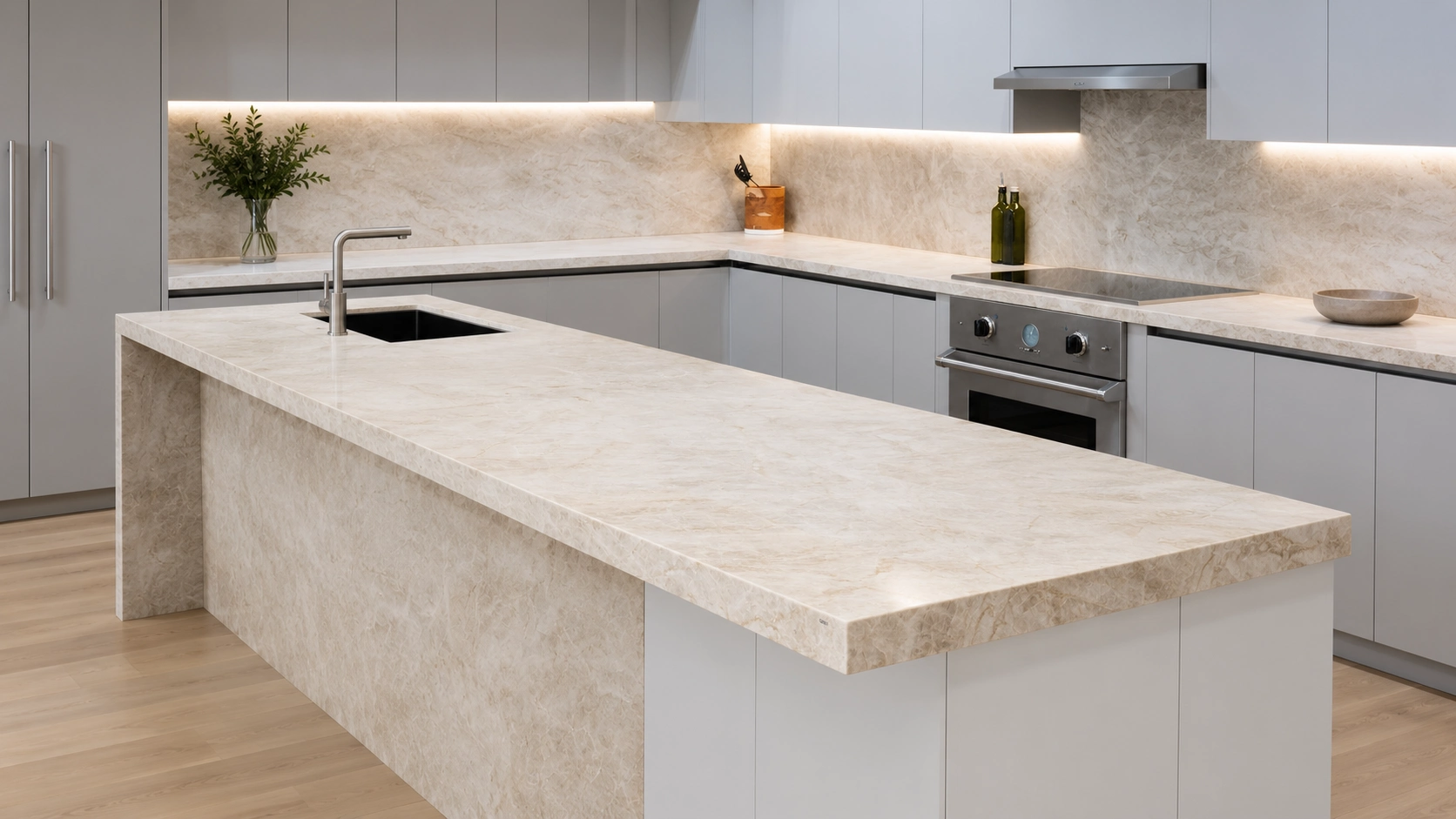
It is particularly effective for large kitchen islands, perimeter countertops and full-height backsplashes. However, the actual slabs must be reviewed for usable dimensions, natural fissures, colour range and vein continuity before cutting.
Marble for Distinctive Character
Marble is appropriate when the buyer accepts that the surface may gradually develop etching, fine scratches or a patina. In many European-style kitchens, boutique interiors and statement spaces, these changes are treated as part of the material’s natural life rather than failures.
Marble may be less suitable for clients who expect the countertop to remain visually unchanged despite frequent contact with citrus, vinegar, wine or aggressive cleaning products.
Engineered Quartz for Controlled Appearance
Engineered quartz works well for kitchens that require more predictable patterning and lower concern about sealing. It can be practical for apartments, repeated residential units and standardised kitchen programmes.
Hot pans and heat-producing appliances should not be placed directly on the surface. Fabricators must also follow the relevant manufacturer’s specifications for cut-outs, support, joints and installation.
Which Material Is Better for Waterfall Islands?
Taj Mahal Quartzite and marble can produce highly individual waterfall islands because their natural movement can continue from the horizontal countertop down the vertical panel. The success of the result depends on slab dimensions, cut orientation and the ability to align the veins at the mitred edge.
Engineered quartz can also be used for waterfall islands and may offer easier pattern repetition. However, highly directional printed patterns must still be reviewed carefully at joints. A repeated or abruptly interrupted vein can make the island appear manufactured rather than continuous.
For natural stone, the supplier should prepare a marked slab layout or digital rendering before cutting. The buyer should approve where the main veins, seams and mitred connections will appear.
Which Material Is Better for Full-Height Backsplashes?
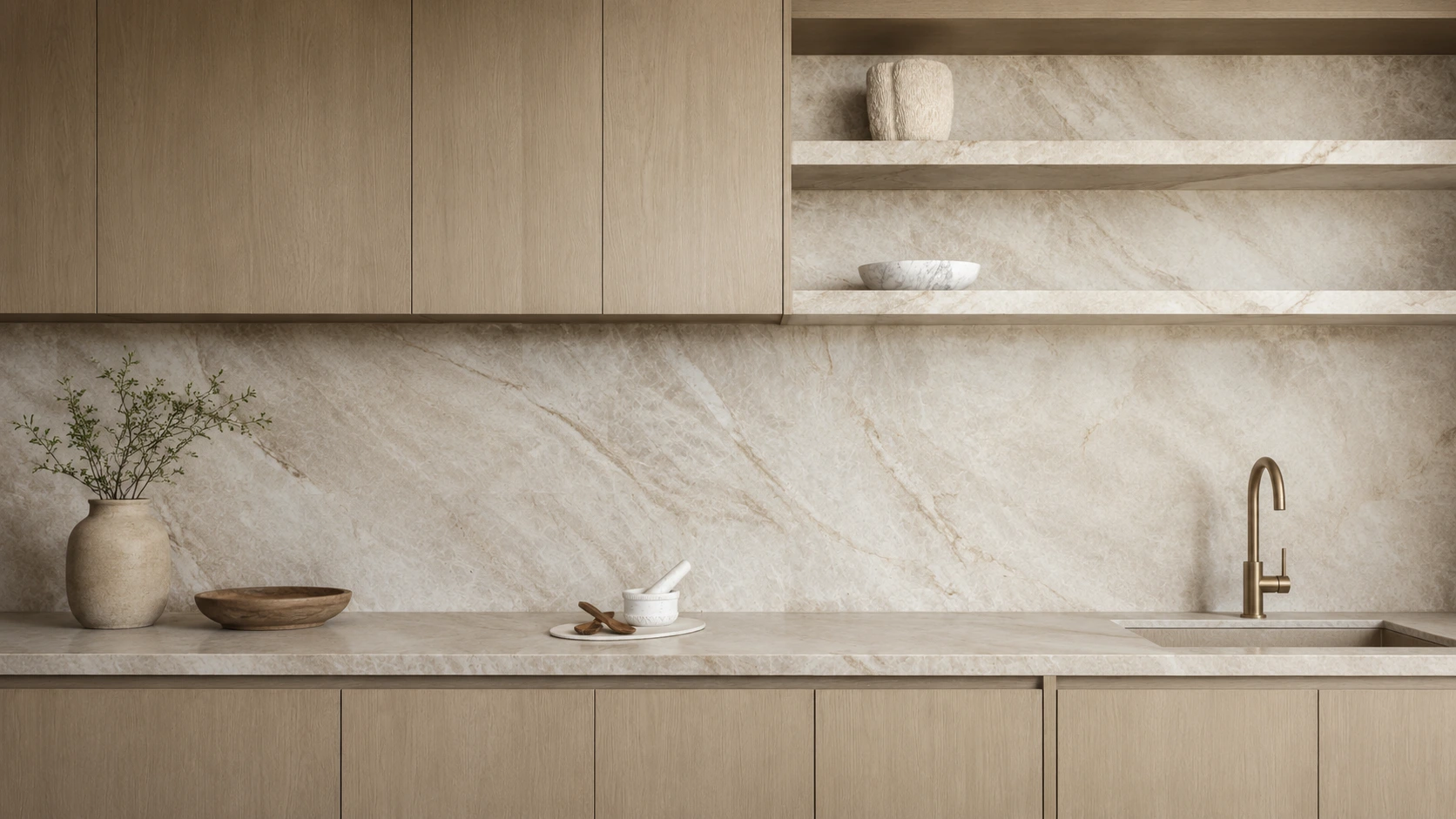
Taj Mahal Quartzite is particularly effective for full-height backsplashes because its soft movement creates continuity without overwhelming cabinetry or lighting. The stone can connect the countertop and wall surface into one coordinated composition.
Marble backsplashes can create a stronger focal point, particularly when the stone has dramatic colour or brecciated movement. Because backsplashes normally receive less mechanical wear than worktops, they can be a suitable location for expressive marble even when another material is selected for the countertop.
Engineered quartz offers a more repeatable option but may have sheet-size limitations, visible pattern repetition or specific requirements around heat-producing cooking equipment. Product-specific installation guidance should be confirmed.
Which Material Is Better for Bathrooms?
All three materials can be used for vanity tops and bathroom surfaces when the product, substrate and installation system are appropriate.
Taj Mahal Quartzite provides warmth and natural variation without the stronger visual drama of many marbles. Marble is suitable when the design prioritises a traditional spa-like atmosphere or a distinctive statement stone. Engineered quartz offers colour consistency for repeated vanity units and multi-room developments.
Natural stone in wet environments should be evaluated for finish, absorption, sealing, drainage and compatibility with cleaning products. Shower floors and continuously wet areas require additional slip-resistance and installation considerations beyond the countertop comparison discussed in this article.
Which Material Is Better for Hotels and Luxury Retail?
Hotels and luxury retail interiors often use more than one material rather than selecting a single surface for the entire project.
Taj Mahal Quartzite may be used for reception counters, bar tops, vanity units and display furniture where a calm premium appearance and practical daily performance are required. Marble can be introduced for feature walls, floors, decorative panels and statement furniture where visual identity is the main objective.
Engineered quartz may be suitable for repeated back-of-house counters, standardised guest-room vanities or areas requiring a more controlled visual range. Project specifications should consider fire, installation, maintenance and local compliance requirements rather than relying only on residential countertop expectations.
Show Stone provides custom natural stone solutions for hospitality, retail, residential and commercial projects, including slab selection, cutting layouts, countertops, wall panels, furniture and project-based packing.
How to Choose Based on Your Priorities
Choose Taj Mahal Quartzite When:
- You want genuine natural stone with warm and restrained movement.
- You prefer stronger everyday scratch resistance than most marbles.
- You need a premium material for an island, countertop or backsplash.
- You accept natural slab variation and are willing to approve actual slabs.
- You can coordinate fabrication, seams and vein direction before production.
Choose Natural Marble When:
- Distinctive veining and mineral depth are the main design priorities.
- You accept etching, patina and natural ageing as part of the material.
- The project requires a traditional, artistic or highly expressive surface.
- You are prepared to use natural-stone cleaning and maintenance methods.
- The application allows the stone’s visual character to outweigh strict uniformity.
Choose Engineered Quartz When:
- You need more consistent colours and patterns across multiple units.
- You prefer a surface that normally does not require penetrating sealer.
- The design can accommodate a manufactured appearance or repeated pattern.
- The application can be protected from direct high heat.
- The fabricator can follow the selected manufacturer’s technical requirements.
How to Select Slabs and Plan Fabrication
Review Full Slabs or Full Sheets
A small sample cannot show the complete movement, colour range or pattern repetition of any of these materials. Natural-stone buyers should review high-resolution slab photographs or videos. Engineered quartz buyers should review the full sheet and confirm the production batch when visual consistency is important.
Confirm Usable Dimensions
Natural slabs may include edge damage, fissures, resin-filled areas or mineral sections that influence cutting yield. Engineered sheets have fixed manufacturing dimensions and may still require additional material for joints, edge build-ups and replacement risk.
Plan Vein Direction and Seams
Countertops, islands and backsplashes should be positioned on the slab or sheet before cutting. The layout should show vein direction, seam locations, waterfall panels, sink openings, cooking cut-outs and visible edge returns.
Assess Cut-Outs and Narrow Sections
Sink rails, hob openings, internal corners and narrow strips can become structurally sensitive areas. Reinforcement, corner radii, support systems and handling methods should be determined according to the material and finished design.
Confirm Finish and Edge Details
Polished and honed finishes can present the same stone differently. Edge thickness, mitred build-ups, exposed laminations and corner profiles also influence the visual result. These details should be included in approved drawings rather than decided during production.
Fabrication and Installation Considerations
Successful fabrication begins with accurate information. Before production, the supplier and buyer should confirm:
- Final site measurements or approved shop drawings
- Material, colour range and approved slab or sheet numbers
- Finished thickness and built-up edge details
- Surface finish and visible-face orientation
- Sink, tap, socket and cooking-appliance cut-outs
- Seam positions and vein alignment
- Waterfall panels and mitred edge connections
- Overhangs, brackets and cabinet support
- Backsplash dimensions and wall conditions
- Dry-lay, numbering and packing sequence
Natural stone benefits from full-slab scanning and cutting-layout review because every slab is different. Engineered quartz may simplify colour matching, but it still requires careful control of joints, directional patterns and manufacturer-specific fabrication rules.
For international projects, finished components should be inspected for dimensions, edge quality, surface condition, repairs and labelling before packing. Pieces can be numbered according to rooms, elevations or installation zones to support the site team.
Common Buying and Specification Mistakes
1. Comparing Only the Purchase Price
The lowest material price does not always produce the lowest installed project cost. Cutting yield, reinforcement, edge fabrication, shipping, site modification and future replacement should also be considered.
2. Treating Quartzite and Quartz as the Same Material
Natural quartzite and engineered quartz have different composition, appearance, heat behaviour, slab variation and maintenance requirements. Specifications should clearly identify which material is being supplied.
3. Assuming Every Marble Performs Identically
Marble includes many calcite- and dolomite-based materials with different structures, absorption levels and finishes. A statement about one marble variety should not automatically be applied to all marble.
4. Selecting Natural Stone From a Small Sample
A small sample may confirm the general colour but cannot show full slab movement, mineral areas or the relationship between several pieces. Actual slab approval is essential for visual control.
5. Expecting Natural Stone to Be Completely Uniform
Variation is an inherent part of quartzite and marble. Projects requiring tightly controlled repetition across many units should establish an acceptable colour range or consider whether engineered quartz better fits the specification.
6. Ignoring Direct Heat on Engineered Quartz
Engineered quartz contains polymer-based binders that can be affected by excessive heat. Trivets, appliance clearance and manufacturer instructions should be included in the use and installation plan.
7. Planning Seams After Material Selection
Seam positions affect pattern continuity, structural support and finished appearance. They should be considered while reviewing slab or sheet dimensions, not after cutting has started.
Buyer Checklist Before Ordering
| Item to Confirm | Why It Matters |
|---|---|
| Exact material type | Prevents confusion between natural quartzite, marble and engineered quartz. |
| Actual slab or full-sheet images | Shows natural variation, complete movement or manufactured pattern repetition. |
| Approved colour range or batch | Supports visual coordination across multiple pieces or rooms. |
| Usable dimensions | Determines seams, cutting yield and whether large components can be produced. |
| Thickness and finish | Affects appearance, edge design, weight and fabrication method. |
| Cutting layout and vein direction | Controls the visual relationship between countertops, waterfalls and backsplashes. |
| Cut-outs and support | Reduces structural risk around sinks, hobs, corners and overhangs. |
| Care and heat requirements | Sets realistic expectations for sealing, cleaning, etching and hot cookware. |
| Quality inspection | Confirms dimensions, finish, edges, repairs and visible surfaces before shipment. |
| Packing and installation sequence | Protects finished pieces and helps the site team identify where each component belongs. |
Care and Maintenance
Taj Mahal Quartzite
Clean Taj Mahal Quartzite with a pH-neutral cleaner suitable for natural stone. Blot spills promptly, use cutting boards and protect the surface from impact around edges and cut-outs. Sealing requirements should be evaluated according to the actual slab, finish and application rather than following one universal schedule.
Natural Marble
Use natural-stone cleaning products and avoid acidic or abrasive cleaners. Prompt cleaning can reduce staining risk, but sealing does not prevent acid etching. Clients should understand that a marble worktop may gradually develop a patina.
Engineered Quartz
Use a soft cloth and cleaning products approved by the manufacturer. Avoid strong chemicals, abrasive pads and direct contact with extremely hot cookware. Penetrating sealer is normally unnecessary, but care instructions vary by brand and product range.
Frequently Asked Questions
Is Taj Mahal Quartzite better than marble for kitchen countertops?
Taj Mahal Quartzite is generally more resistant to scratching and acidic substances than calcite-based marble, making it a practical option for active kitchens. Marble may still be preferred when distinctive natural veining and the development of a patina are central to the design.
Is Taj Mahal Quartzite the same as engineered quartz?
No. Taj Mahal Quartzite is a quarried natural stone formed through geological processes. Engineered quartz is a manufactured composite made from mineral particles, pigments and polymer-based binders.
Does Taj Mahal Quartzite require sealing?
It may benefit from sealing depending on the absorption of the actual slab, surface finish and intended application. The sealing requirement should be evaluated after material selection rather than assumed from the commercial name alone.
Does natural marble always etch?
Most calcite-based marbles can react with common acidic substances and develop dull etch marks. The visibility of etching depends on the stone, finish, lighting and use conditions.
Can hot pans be placed directly on engineered quartz?
Direct contact with hot cookware is not recommended because excessive heat can affect the polymer-based binders in engineered quartz. Trivets or heat-resistant pads should be used.
Which material has the most consistent pattern?
Engineered quartz generally provides the greatest pattern and colour consistency. Taj Mahal Quartzite and marble are natural stones, so variation between slabs and batches should be expected.
Which material is best for a waterfall kitchen island?
Taj Mahal Quartzite is a strong choice when natural movement and practical performance are priorities. Marble creates a more expressive natural statement, while engineered quartz can provide a more controlled appearance. All three require careful seam and pattern planning.
Can Taj Mahal Quartzite and marble be used in the same project?
Yes. Designers may use Taj Mahal Quartzite for active work surfaces and introduce marble on feature walls, furniture, floors or lower-wear areas. The colours, finishes and vein directions should be coordinated during material selection.
How should buyers approve natural stone for a large project?
Buyers should review full slab photographs or videos, agree on an acceptable colour range, confirm usable dimensions and approve a cutting layout. Multi-slab projects may also require dry-lay inspection, piece numbering and installation-sequence packing.
Why Source Taj Mahal Quartzite and Marble From Show Stone?
Show Stone supports architects, designers, contractors, importers and project buyers with natural-stone selection, slab approval, batch coordination, fabrication, inspection, packing and international shipment.
Our 10,000-square-metre finishing centre is equipped with an intelligent slab scanner, five-axis bridge cutting equipment, infrared cutters, waterjet machines and CNC carving machines. These capabilities support countertops, islands, backsplashes, wall panels, vanity tops, furniture and custom architectural components produced according to approved drawings.
For natural-stone projects, our team can assist with:
- Full-slab photography and video approval
- Colour-range and multi-slab coordination
- Digital slab scanning and cutting layouts
- Vein matching and dry-lay inspection
- Sink, hob and fixture cut-outs
- Mitred edges, built-up profiles and special shapes
- Dimensional and surface quality inspection
- Piece numbering and project-based packing
- Export wooden crates and shipment coordination
Buyers can explore additional natural stone materials, review the wider natural quartzite collection or compare options from the natural marble collection.
More information about our production capabilities and project service model is available on the About Show Stone page. Further material comparisons and specification guidance can be found in the Show Stone natural stone blog.
Final Recommendation
Taj Mahal Quartzite is generally the most balanced choice for buyers who want warm natural movement, a premium appearance and stronger everyday performance than many traditional marbles. Natural marble remains the stronger design choice when distinctive veining, crystalline depth and natural ageing are essential to the concept. Engineered quartz is appropriate when repeatable colour and simplified routine care take priority over natural slab individuality.
The correct material cannot be selected from the name alone. Buyers should review the actual slab or full sheet, confirm the colour range, study the cutting yield and approve seams, edges, cut-outs and vein direction before fabrication.
To compare Taj Mahal Quartzite with suitable marble options or request material recommendations for a kitchen, hotel, retail or residential project, please contact Show Stone with your required dimensions, quantity, finish, application and delivery destination.