Natural Stone Waste Allowance: How Much Extra Stone Should You Order for a Project?
Ordering the correct quantity of natural stone is an important part of managing an international construction or interior design project. Buyers must consider not only the finished surface area but also the additional material required for cutting, fabrication, pattern matching, installation adjustments and future maintenance.
Natural stone waste allowance is the additional quantity of stone required beyond the net finished project area. It accounts for material that cannot become part of the final installation because of cutting losses, natural characteristics, fabrication requirements and project-specific conditions.
However, calculating the correct allowance is not as simple as adding 10% or 15% to every order. A hotel flooring project using standard rectangular tiles has different material requirements from a luxury retail project involving bookmatched marble walls, curved components or custom waterjet patterns.
The type of stone also matters. Marble, quartzite, granite, travertine and onyx have different visual characteristics, natural structures and fabrication considerations. Even slabs from the same material batch may contain variations that influence the cutting plan.
A project-specific natural stone waste allowance is more reliable than applying one fixed percentage to every stone order. For international buyers, an accurate material calculation should combine quantity estimation, actual slab inspection, digital cutting layouts and fabrication planning before production begins.
This guide explains how to calculate natural stone waste allowance, identify the main sources of material loss and improve slab utilization for hotel, commercial and luxury residential projects.
What Is Natural Stone Waste Allowance?
Natural stone waste allowance refers to the additional material purchased or reserved to cover the difference between the quantity of stone specified in the finished design and the quantity required to manufacture and complete the project.
It is important to distinguish between four different quantities:
- Net Finished Quantity: The actual stone area or number of components required by the approved drawings.
- Fabrication Allowance: Additional material needed for cutting, edge processing, shaping, openings and other production operations.
- Installation Allowance: Additional material required for site trimming, fitting adjustments and installation-related cutting.
- Spare Material: Extra pieces retained for future repairs, replacements or maintenance.
The natural stone waste allowance should be reviewed after the actual slab dimensions and finished component sizes are confirmed.
These quantities should be identified separately during procurement. Otherwise, buyers may either order insufficient material or purchase excessive quantities without understanding where the additional allowance is being used.
For large projects, the material calculation should be based on approved drawings and actual cutting layouts rather than a general percentage applied to the total square footage.
How Much Extra Natural Stone Should You Order?
The required allowance depends on the application, layout complexity, stone characteristics and fabrication method. Natural stone waste allowance for patterned flooring may increase when diagonal cuts and repeated motifs create unusable offcuts.
The following ranges can be used as preliminary budgeting references. They are indicative planning ranges rather than mandatory industry standards or guaranteed waste rates.
| Project Type | Indicative Additional Allowance | Main Considerations |
|---|---|---|
| Straight Rectangular Tiles | 5–10% | Regular layouts, simple room geometry and limited cutting. |
| Diagonal or Patterned Flooring | 10–15% or more | Diagonal cuts, pattern alignment and perimeter adjustments. |
| Complex Flooring and Wall Layouts | 15–20% or more | Irregular rooms, multiple openings and selective material matching. |
| Standard Slab Countertops | Project-specific calculation; 15–20% can be an initial budgeting reference. | Sink cut-outs, joints, edge profiles and slab dimensions. |
| Bookmatched Stone Applications | Potentially 25–40% or more in demanding layouts. | Vein continuity, mirrored patterns and slab selection. |
| Custom Shapes and Architectural Components | Project-specific calculation required. | CNC machining, waterjet cutting, curved profiles and dimensional requirements. |
These figures should not be interpreted as fixed purchasing specifications. The actual requirement can be lower or higher depending on slab dimensions, material selection and the approved production drawings.
For expensive marble, quartzite and onyx, it is particularly important to prepare a cutting layout before confirming the final slab quantity.
7 Factors That Affect Natural Stone Waste Allowance
1. Stone Slab Dimensions and Material Yield
The dimensions of the available slabs are one of the most important factors affecting material utilization.
Natural stone slabs are produced in different sizes, and their dimensions are not always identical. Even within the same material category, the available slab length, width and usable area can vary.
A project may require several components with different dimensions. If these pieces cannot be arranged efficiently within the available slabs, additional material may be needed even when the total net area appears relatively small.
For example, a project requiring 100 square metres of finished stone does not necessarily require only 100 square metres of slab material. The actual quantity depends on how efficiently the individual pieces can be arranged and cut.
Material yield is generally calculated as:
Material Yield (%) = Finished Usable Stone Area ÷ Total Raw Material Area × 100
A higher yield indicates more efficient material utilization. However, maximizing yield should not compromise vein continuity, appearance, structural suitability or finished component quality.
Accurate slab measurement helps establish a realistic natural stone waste allowance before the production quantity is finalized.
2. Natural Veining and Colour Variation
Natural stone is not a manufactured material with perfectly uniform patterns. Veining, colour distribution, mineral formations and natural characteristics can vary from one slab to another.
When a project requires consistent appearance across multiple floors, walls or countertops, some areas of a slab may be unsuitable for specific components even when the material itself is usable.
For example, a designer may require light-background marble for the main visible areas, while slabs with stronger colour variation may be allocated to less prominent locations.
This selective approach can reduce the usable yield compared with a simple area-based calculation.
For projects using materials such as Arabescato Marble, Breccia Pontificia Marble and Pinkura Marble, actual slab inspection and cutting orientation should be considered before the final quantity is approved.
For visually selective materials, the natural stone waste allowance must account for colour distribution and vein continuity.
3. Vein Matching and Bookmatching Requirements
Vein matching and bookmatching can increase material consumption because the cutting sequence must follow the intended visual arrangement.
For ordinary stone cutting, the main objective may be to produce the required components efficiently. For bookmatched applications, the slab arrangement must also preserve the relationship between adjacent patterns.
This may require:
- Selecting slabs with compatible vein directions.
- Reviewing multiple slabs together before cutting.
- Maintaining the correct sequence of slab sections.
- Allowing additional material for pattern alignment.
- Avoiding cuts that interrupt important visual features.
For large feature walls, hotel reception areas and luxury retail interiors, the visual result can be more important than achieving the highest possible material yield.
Where continuous veining or mirrored patterns are required, slab selection and cutting layouts should be approved before production begins.
Bookmatched applications require a carefully calculated natural stone waste allowance because slab sequence and mirrored patterns influence usable material.
4. Complex Cutting and Custom Fabrication
Custom stone fabrication can create additional material loss because the finished components may require more complex shapes than standard rectangular tiles or slabs.
Examples include:
- Curved stone components.
- Custom stair treads and risers.
- Waterjet decorative patterns.
- Stone columns and architectural profiles.
- Custom vanity tops and sink openings.
- Mitred countertop edges.
- Irregular furniture components.
- Decorative wall panels.
Complex geometry may leave unused areas between cutting paths. Some offcuts can be reused for smaller components, while others may not meet the required dimensions or appearance.
The natural stone waste allowance for custom components should be based on individual piece geometry rather than total square footage alone.
For these applications, material consumption should be calculated using individual component dimensions and cutting layouts rather than relying only on the finished square footage.
5. Saw Kerf, Edge Trimming and Finishing
Stone cutting removes material through the cutting process itself. The width of the cut, commonly referred to as the kerf, must be considered when arranging adjacent components.
Additional material may also be removed during:
- Slab edge trimming.
- Squaring and dimension correction.
- Edge profiling and polishing.
- Mitred edge preparation.
- Surface finishing.
- Final dimensional adjustment.
When calculating natural stone waste allowance, include saw kerf, edge trimming, openings and finishing operations.
Although each operation may remove a relatively small amount of material, the combined effect can become significant across a large production batch.
Accurate fabrication drawings and cutting plans help identify these requirements before material is processed.
6. Natural Defects and Material Selection
Natural stone may contain geological characteristics such as fissures, mineral concentrations, veins, open pores and other variations.
Some characteristics are acceptable and form part of the stone’s natural appearance. Others may affect the suitability of a particular area for a specific component.
For this reason, material selection should consider both appearance and intended application.
For example:
- Large visible wall panels may require more selective slab matching.
- Countertops require attention to cut-out positions and vulnerable areas.
- Stair treads require appropriate material selection and dimensional planning.
- Decorative components may require specific colour and pattern characteristics.
Not every natural variation should automatically be classified as waste. The decision should be based on approved samples, project specifications and the intended application.
7. Transportation, Handling and Spare Material Requirements
International stone projects also need to consider transportation and handling risks.
Large slabs, finished countertops and custom architectural components may require protective packing and carefully planned handling procedures.
Additional material may be reserved for:
- Replacement of components damaged during handling or installation.
- Future repairs and maintenance.
- Unexpected site adjustments.
- Design changes approved after production.
- Matching materials for future extensions.
However, spare material should be calculated separately from cutting waste whenever possible. This makes the procurement budget more transparent and avoids unnecessary duplication of allowances.
How to Calculate Natural Stone Waste Allowance
A practical calculation should begin with the approved net quantity and then account for the expected cutting and project requirements.
Step 1: Calculate the Net Finished Area
Start with the dimensions shown in the approved architectural or fabrication drawings.
For rectangular components:
Area = Length × Width
For projects containing multiple components, calculate each item separately and then add the quantities together.
Step 2: Determine the Preliminary Additional Allowance
For straightforward projects, an initial allowance can be applied to the net quantity for preliminary budgeting.
Preliminary Order Quantity = Net Finished Quantity × (1 + Allowance Percentage)
For example, if the net requirement is 100 square metres and the agreed additional allowance is 10%:
- Net finished quantity: 100 sqm
- Additional allowance: 10 sqm
- Preliminary order quantity: 110 sqm
This is a preliminary estimating method. It does not replace actual slab layout calculations for complex projects.
Step 3: Check Actual Slab Dimensions
Once the preliminary quantity is established, review the available slab dimensions and determine whether the required components can be produced efficiently.
For slab-based projects, the number of usable slabs may be more important than the total square metres.
A cutting layout should consider:
- Individual component dimensions.
- Slab length and width.
- Cutting direction.
- Natural defects and unusable areas.
- Kerf and trimming requirements.
- Vein direction and pattern matching.
- Joint positions and finished edges.
The final natural stone waste allowance should be checked against the approved cutting layout before the purchase order is confirmed.
Step 4: Add Project-Specific Spare Material
Determine whether the project requires additional spare pieces for future repairs or replacement.
For a hotel or commercial development, the client may request retained material from the same batch to help maintain consistency during future maintenance.
This requirement should be discussed before production because additional material from the original batch may be difficult or impossible to obtain later.
Step 5: Confirm the Final Purchase Quantity
The final purchase quantity should be based on the approved cutting layout, actual slab availability and agreed spare material requirements.
For high-value materials, it is preferable to confirm the required slab count through a detailed layout rather than purchasing additional material based only on a general percentage.
Why Digital Cutting Layouts Improve Material Utilization
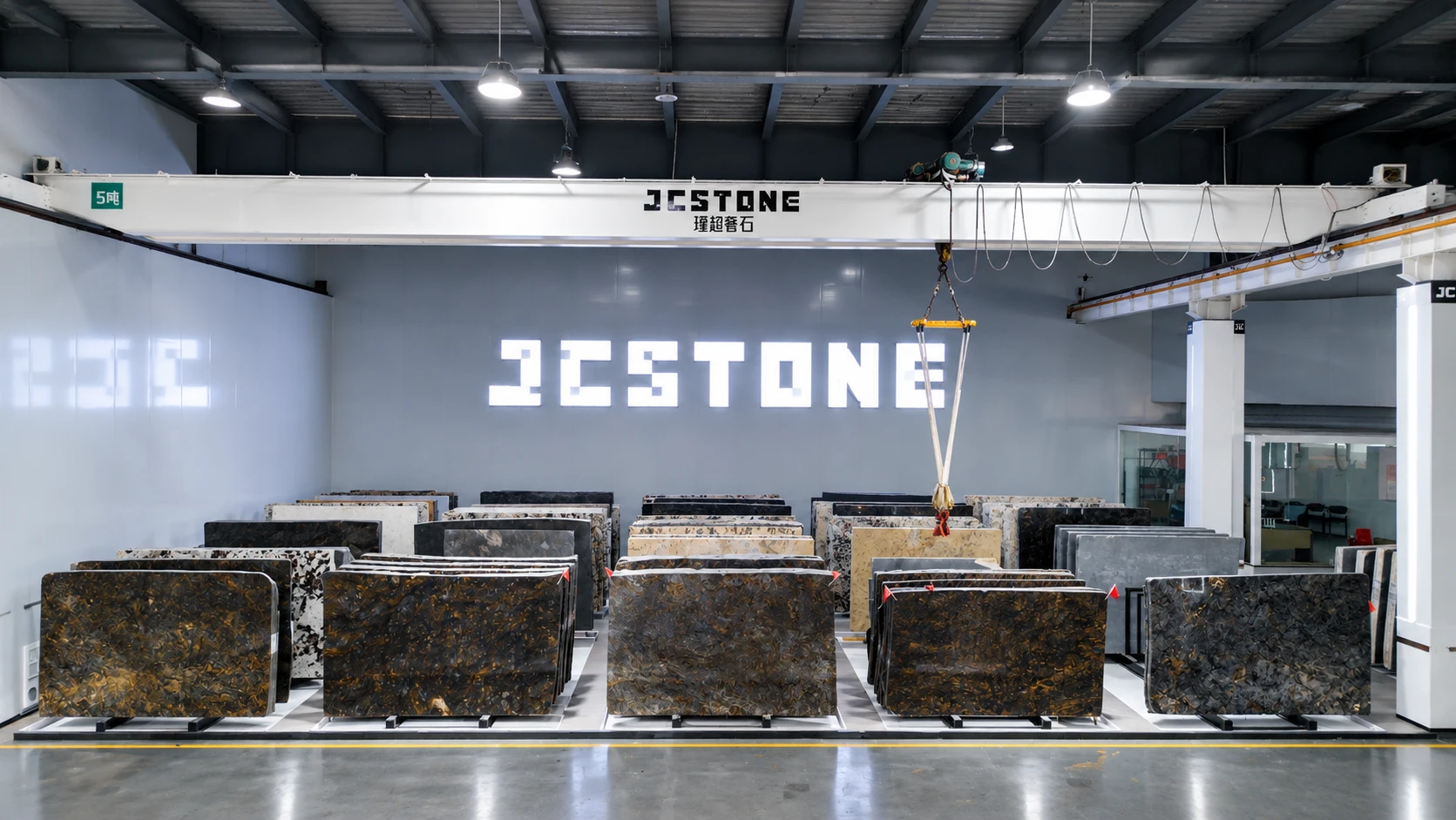
Digital cutting layouts help manufacturers plan how individual components will be arranged within available stone slabs before fabrication begins.
Rather than cutting components independently, production teams can review the complete arrangement and identify opportunities to improve material utilization.
Key advantages include:
- Improved Nesting: Different component dimensions can be arranged to reduce unused spaces.
- Accurate Dimensions: Cutting positions can be coordinated with approved fabrication drawings.
- Better Vein Planning: Slab patterns and cutting directions can be reviewed before production.
- Reduced Rework: Potential dimensional conflicts can be identified earlier.
- Better Material Control: Slab allocation can be planned according to the required component quantities.
- Production Traceability: Cutting plans can be connected with component identification and quality inspection.
Digital nesting can reduce avoidable material loss, but it does not eliminate the natural stone waste allowance required for selective pattern matching.
Digital optimization is particularly useful for projects involving large quantities of repeated components, custom dimensions or complex cutting arrangements.
However, software should support rather than replace professional material selection. A layout that maximizes cutting efficiency may not produce the best visual result when natural veining and colour continuity are important.
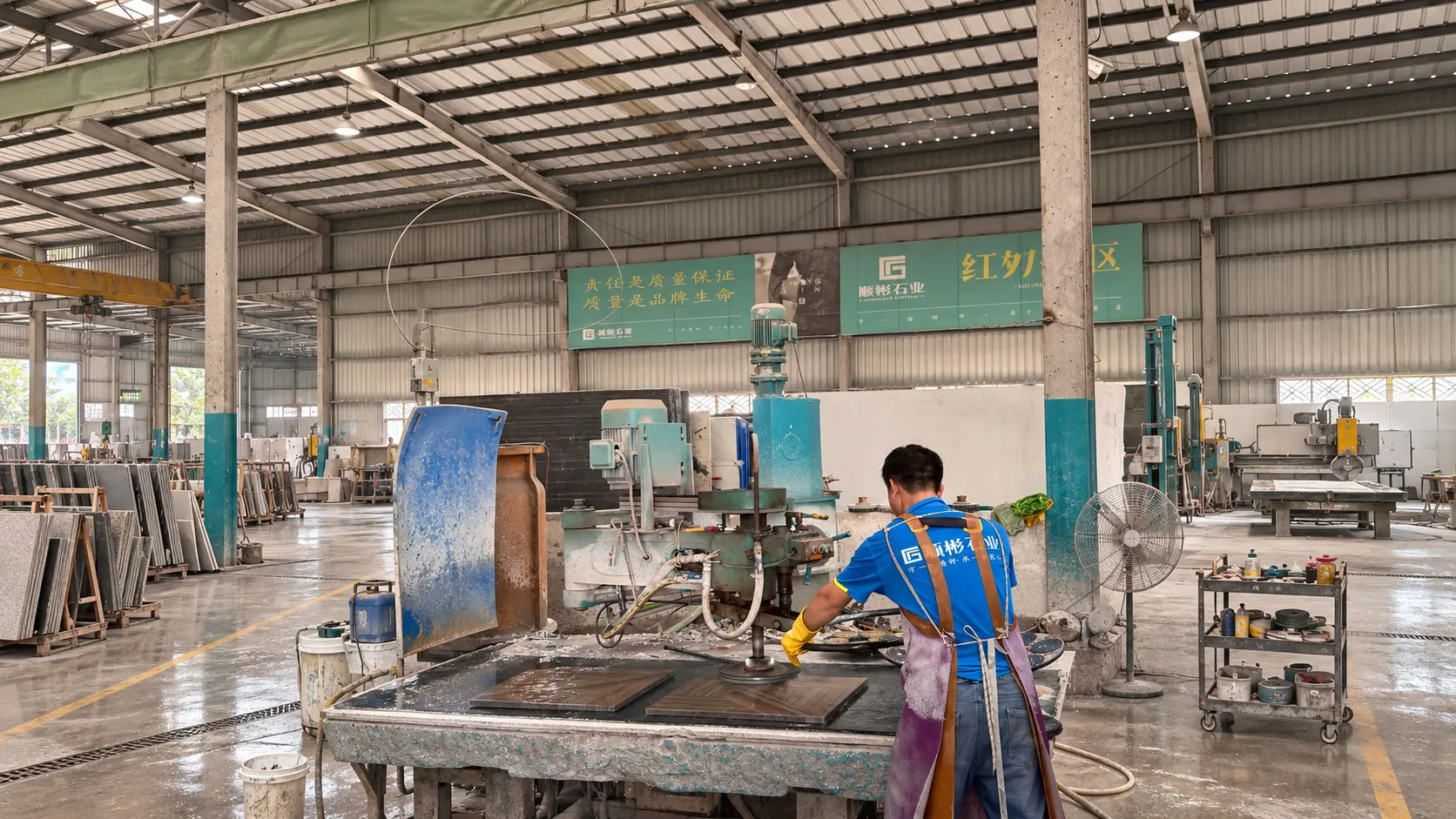
How Modern Stone Cutting Equipment Helps Reduce Waste
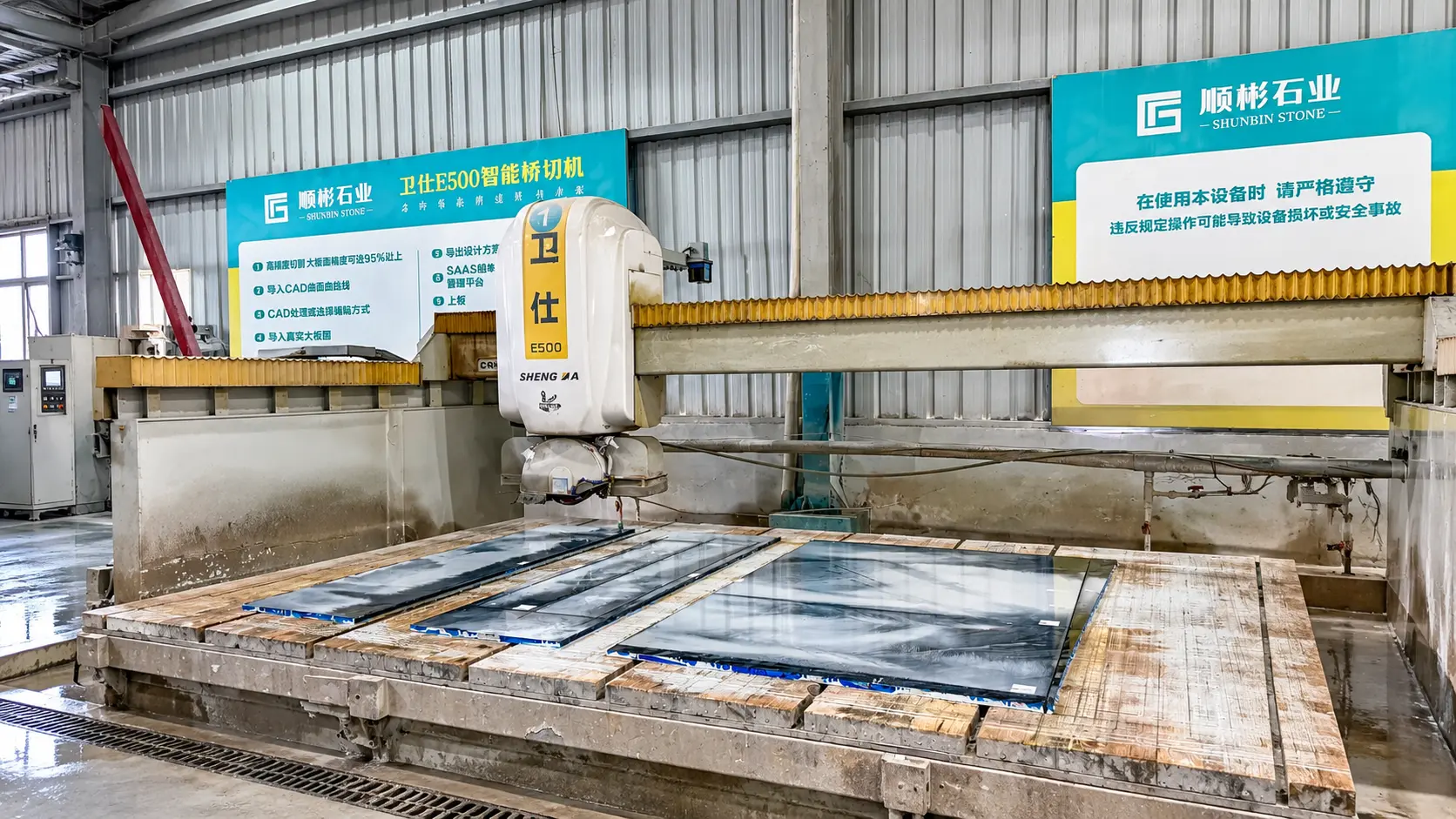
Modern stone fabrication equipment can improve cutting precision and reduce avoidable processing errors.
Different machines serve different production requirements.
Bridge Cutting Machines
Bridge cutting machines are commonly used for straight cutting and dimensioning of stone slabs and other flat components.
Accurate cutting helps maintain specified dimensions and reduces unnecessary material removal caused by repeated adjustments.
Waterjet Cutting Machines
Waterjet technology is suitable for selected complex shapes, curved components and decorative patterns.
Its flexibility allows manufacturers to produce customized stone components that may be difficult to achieve using conventional straight cutting alone.
CNC Stone Processing
CNC equipment supports shaped edges, grooves, profiles and other customized processing operations.
When combined with approved digital drawings, CNC processing can improve repeatability across multiple components.
Integrated Production Planning
The best results come from coordinating digital cutting plans, machine capabilities, slab inspection and quality control rather than relying on a single machine to reduce waste.
How Different Natural Stone Materials Affect Cutting Allowance
Different stone materials require different approaches to slab selection, cutting and material planning.
Quartzite
Quartzite projects often place strong emphasis on natural colour distribution and vein movement.
For materials such as Rosalia Quartzite and Taj Mahal Quartzite, buyers should review actual slab appearance and dimensions before determining the final cutting arrangement.
Where multiple slabs are used together, colour and pattern coordination may influence the final material yield.
Marble
Marble offers a wide range of natural veining and colour characteristics.
Materials such as Arabescato Marble, Breccia Pontificia Marble and Pinkura Marble may require selective slab allocation when the project design includes prominent feature areas.
For bookmatched or highly coordinated layouts, the cutting sequence should be reviewed against the actual slab pattern.
Travertine
Roma Classico Travertine may contain natural pores, filled areas and characteristic linear patterns depending on the material selection and processing.
Cutting direction, vein orientation and the intended surface finish should be considered when calculating usable material.
For all these materials, the final allowance should be determined by the actual slab characteristics and project requirements rather than by stone category alone.
Cutting Waste vs Reusable Stone Offcuts
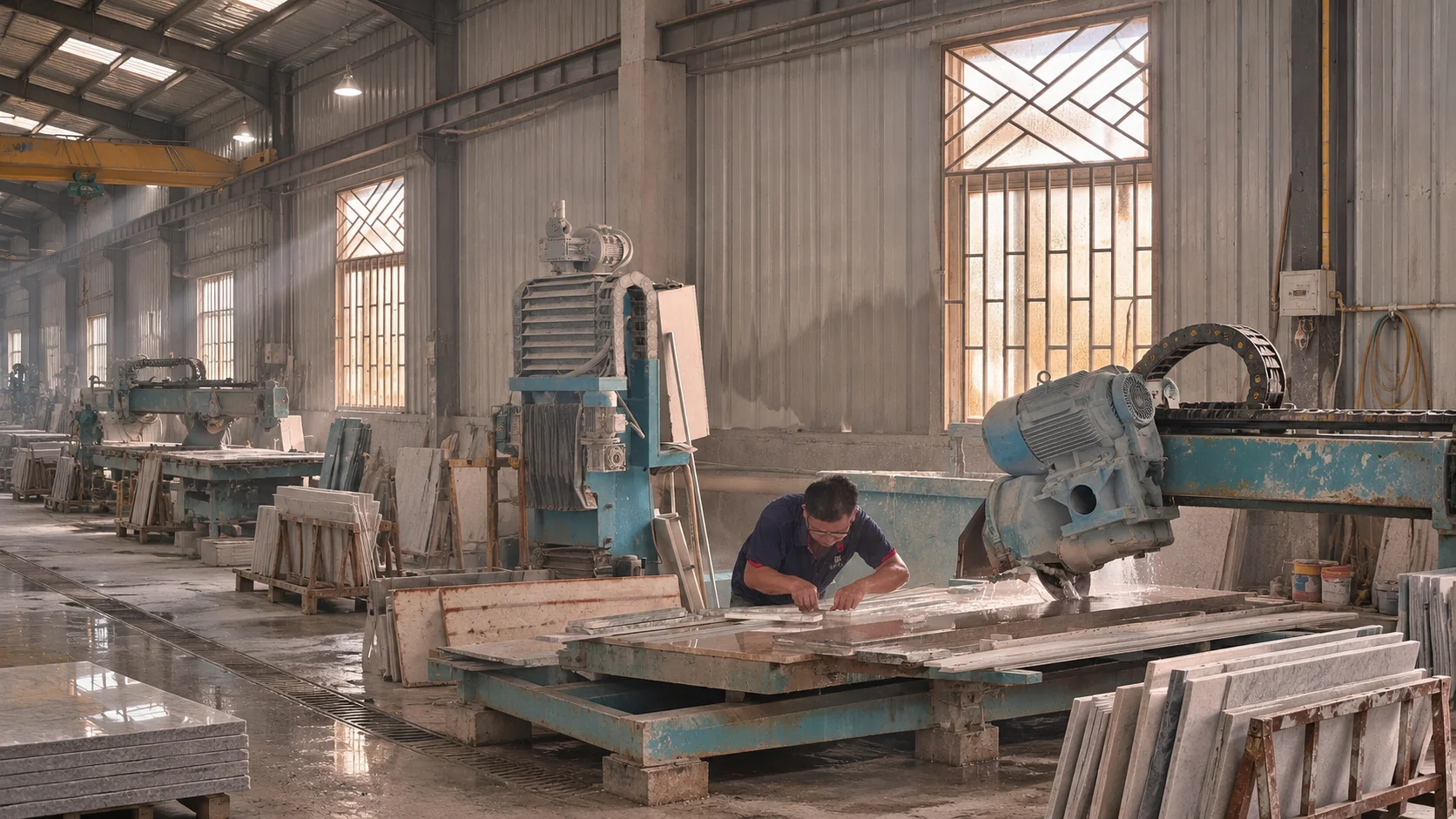
Not all material left after cutting should automatically be classified as waste.
Some offcuts can be reused for smaller components, provided they meet the required dimensions, thickness, appearance and quality specifications.
Potential reuse applications include:
- Small wall panels.
- Decorative borders.
- Thresholds and transitions.
- Small countertop components.
- Window sills.
- Custom trim pieces.
- Other compatible architectural details.
However, offcuts should only be reused when they are suitable for the intended application. A small leftover piece with a different colour or vein direction may not be acceptable for a highly visible area.
Effective offcut management should record dimensions, material type, thickness, finish and original slab identification where practical.
Why Spare Natural Stone Should Be Ordered from the Same Batch
Future replacement material is an important consideration for hotels, commercial buildings and luxury retail developments.
Natural stone is subject to variations in colour, veining and geological characteristics. A replacement slab purchased months or years after the original order may not match the installed material.
For this reason, buyers should consider retaining a reasonable quantity of approved spare material from the original production batch.
Spare material planning should consider:
- The total installed area.
- The number of individual components.
- The complexity of the installation.
- The likelihood of future repairs.
- The availability of the same quarry material.
- Storage conditions and identification requirements.
For hotel projects, spare materials can be organized by floor, room type and component identification. This makes future replacement work easier to manage.
It is also important to distinguish spare stock from cutting allowance. Cutting allowance covers production and installation requirements, while spare stock is retained for future use.
A practical natural stone waste allowance separates production cutting losses from installation adjustments and retained spare stock.
How Show Stone Helps Control Material Waste
For international stone projects, material utilization begins before production. It requires coordination between material selection, fabrication drawings, cutting layouts, machine processing and quality inspection.
Show Stone supports this process through integrated natural stone supply and fabrication services.
Material Selection and Slab Inspection
Actual slab selection helps buyers review colour, veining, dimensions and material characteristics before production.
For projects requiring coordinated appearances, selected slabs can be reviewed together to support the intended design direction.
Digital Cutting and Production Planning
Cutting layouts can be coordinated with approved project dimensions to improve slab utilization and identify potential production conflicts before cutting begins.
Precision Fabrication
Bridge cutting, waterjet processing and CNC equipment support customized stone components and detailed fabrication requirements.
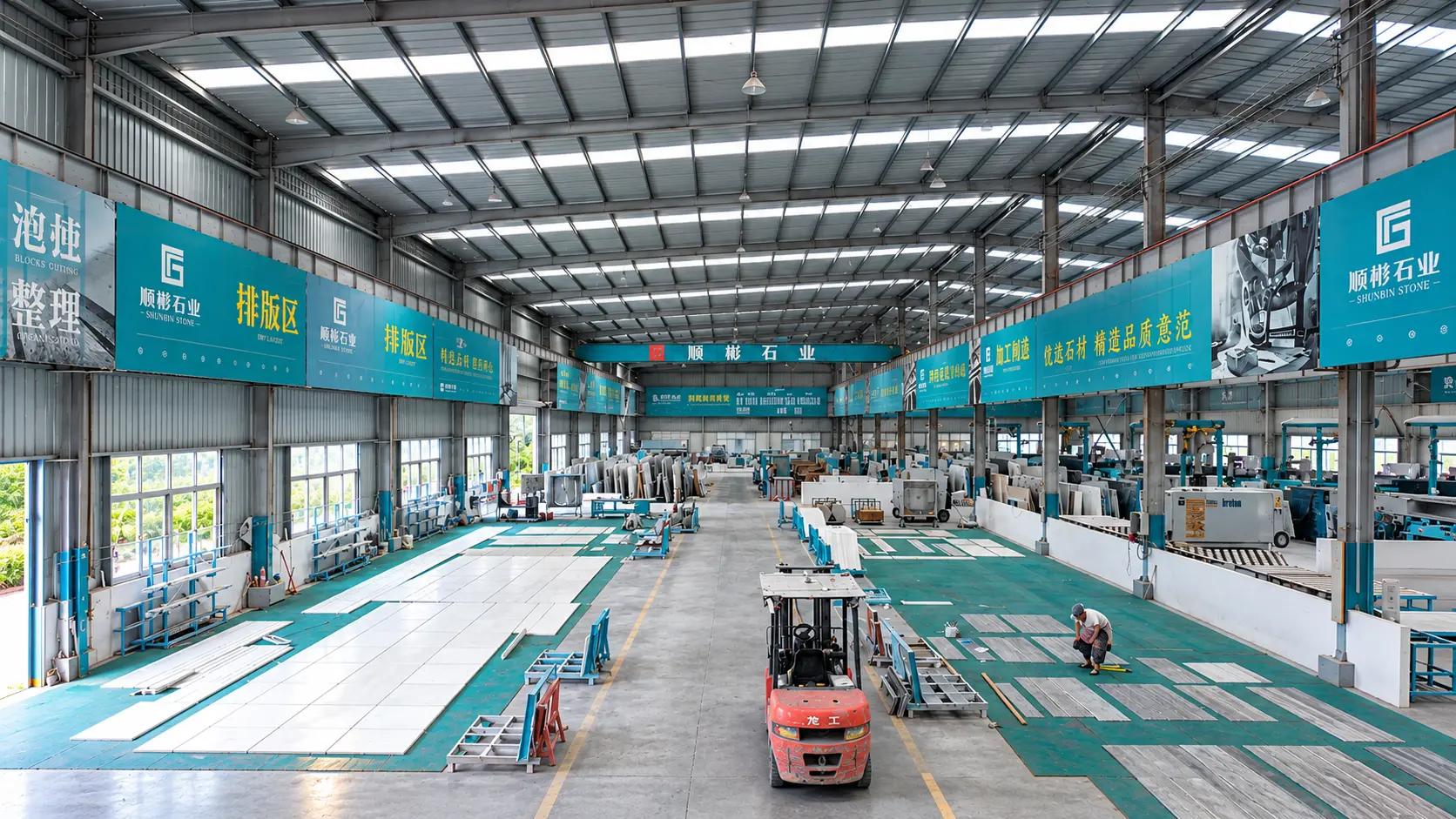
Dry Lay and Quality Control
Dry lay inspection can help review component relationships, dimensions, colour distribution and vein alignment where required.
Finished components are checked against the approved specifications before packing.
Piece Numbering and Export Packing
For large projects, stone components can be identified according to project references, floor numbers, room numbers and installation sequences.
Protective export wooden crates can be coordinated to support international transportation and receiving procedures.
Show Stone’s role focuses on material supply, fabrication, production quality control and installation coordination. On-site installation and structural engineering remain the responsibility of the appointed project professionals.
Show Stone helps buyers evaluate natural stone waste allowance through coordinated slab selection, digital cutting layouts and fabrication planning.
Common Mistakes When Calculating Natural Stone Waste
1. Using the Same Waste Percentage for Every Project. Different materials, layouts and fabrication requirements create different levels of material consumption.
2. Calculating Only from Net Square Metres. Total area does not reveal whether individual components can be arranged efficiently within the available slabs.
3. Ignoring Natural Vein Direction. Cutting without reviewing the intended pattern can create unnecessary visual mismatches or require additional slabs.
4. Waiting Until Production to Confirm the Layout. Late changes to dimensions and cutting arrangements can increase material consumption and create delays.
5. Forgetting Cut-Outs and Edge Details. Sink openings, grooves, mitred edges and custom profiles all influence fabrication planning.
6. Treating Every Offcut as Usable Material. Reusable offcuts must meet the required dimensions, appearance and application specifications.
7. Ordering Replacement Material Too Late. Material from a different batch may not match the original installation.
8. Mixing Cutting Allowance with Spare Stock. Production waste and future replacement requirements should be calculated separately to avoid confusion.
Buyer Checklist: What to Confirm Before Ordering Natural Stone
- Project Drawings: Confirm approved dimensions and finished component quantities.
- Material Selection: Approve the actual stone type, colour, finish and slab appearance.
- Slab Dimensions: Confirm available slab sizes and usable areas.
- Cutting Layout: Review the component arrangement and expected material yield.
- Vein Matching: Identify any bookmatching or continuous pattern requirements.
- Fabrication Details: Confirm cut-outs, edge profiles, grooves and custom shapes.
- Allowance Calculation: Separate cutting allowance, installation allowance and spare material.
- Offcut Management: Identify reusable remnants and their intended applications.
- Quality Control: Establish inspection requirements before production.
- Piece Numbering: Coordinate identification for large projects.
- Export Packing: Confirm protective packing and delivery arrangements.
- Future Maintenance: Decide whether original-batch spare material should be retained.
Frequently Asked Questions
How much extra natural stone should I order for a project?
The additional quantity depends on the stone type, layout, slab dimensions, cutting complexity and installation conditions. Simple rectangular layouts may require approximately 5–10% additional material, while complex patterns and selective slab matching may require considerably more. These are preliminary planning references rather than fixed industry standards.
Is 10% waste allowance enough for natural stone flooring?
It may be sufficient for some straightforward rectangular flooring layouts with limited cutting. However, diagonal patterns, irregular room shapes, decorative borders and selective material matching can increase the requirement. The final quantity should be checked against the actual floor layout.
Does bookmatching increase natural stone waste?
Yes. Bookmatching requires coordinated slab selection, cutting direction and pattern continuity. Some areas that could otherwise be used may need to be excluded to preserve the intended mirrored appearance.
How is natural stone material yield calculated?
Material yield is calculated by dividing the finished usable stone area by the total raw material area and multiplying by 100. The result indicates how efficiently the purchased material is converted into finished components.
Can digital cutting layouts reduce stone waste?
Yes. Digital cutting layouts help arrange individual components within available slabs, review dimensions, coordinate cutting directions and identify opportunities to improve material utilization before production.
Can leftover natural stone pieces be reused?
Yes, provided the offcuts meet the required dimensions, thickness, colour, finish and quality requirements. Suitable remnants may be used for smaller panels, thresholds, decorative details and other compatible components.
Should I order spare natural stone from the same batch?
For large hotel, commercial and luxury residential projects, retaining approved spare material from the original batch is recommended where future replacement or repair is important. This helps reduce the risk of visible colour and veining differences.
Does the type of natural stone affect the waste allowance?
Yes. Different materials have different natural characteristics, slab dimensions, vein patterns and fabrication requirements. However, the actual cutting layout and project specifications are more important than applying a fixed percentage based only on the material category.
Can Show Stone help calculate the required slab quantity?
Yes. Show Stone can support material selection, slab inspection, cutting layout coordination and fabrication planning based on project drawings and component requirements. The final quantity is confirmed according to the approved material selection and production layout.
What information should buyers provide for an accurate stone quantity calculation?
Buyers should provide architectural drawings, finished dimensions, stone specifications, preferred slab sizes, finish requirements, pattern matching instructions and fabrication details. For custom components, shop drawings and individual piece dimensions are particularly useful.
Does Show Stone provide on-site installation?
No. Show Stone provides natural stone supply, fabrication, quality control, dry lay where required, piece numbering, export packing and installation coordination. Final on-site installation is carried out by the client’s appointed contractor.
Why Global Buyers Choose Show Stone
Show Stone supports international architects, interior designers, contractors, developers and hotel groups with natural stone supply and customized fabrication for commercial and hospitality projects.
Our production capabilities connect material selection, cutting optimization and quality control to help buyers manage project quantities more effectively.
- Natural marble, granite, quartzite, travertine and onyx selection.
- Slab inspection and material coordination.
- Digital cutting layout and production planning.
- Bridge cutting, CNC and waterjet fabrication.
- Custom dimensions and architectural stone components.
- Vein matching and bookmatching coordination.
- Dry lay and dimensional quality inspection.
- Piece numbering and project identification.
- Protective export wooden crate packing.
- International project supply and delivery coordination.
By coordinating material selection and fabrication requirements before production, Show Stone helps international buyers make more informed purchasing decisions and reduce avoidable material losses.
Final Recommendation
Natural stone waste allowance should never be treated as a universal percentage that applies to every project.
The correct quantity depends on actual slab dimensions, stone characteristics, cutting layouts, vein matching requirements, fabrication complexity and future maintenance needs.
For straightforward projects, preliminary percentage-based estimating can provide a useful starting point. For high-value slabs, bookmatched walls, custom architectural components and large hospitality developments, actual slab layouts should be reviewed before confirming the final purchase quantity.
The most effective approach is to coordinate material selection, shop drawings, digital cutting plans, fabrication and quality inspection from the beginning of the project.
For your next hotel, commercial or luxury interior project, contact Show Stone with your drawings, material specifications and estimated quantities. Our team can help coordinate stone selection, fabrication planning and export requirements.
Further Technical References
- Natural Stone Institute: Industry resources and technical information for natural stone selection, fabrication and project specifications.
- Natural Stone Institute Technical Resource Library: Technical references for stone fabrication, installation and material specifications.