How to Specify Natural Stone for Luxury Retail Interiors
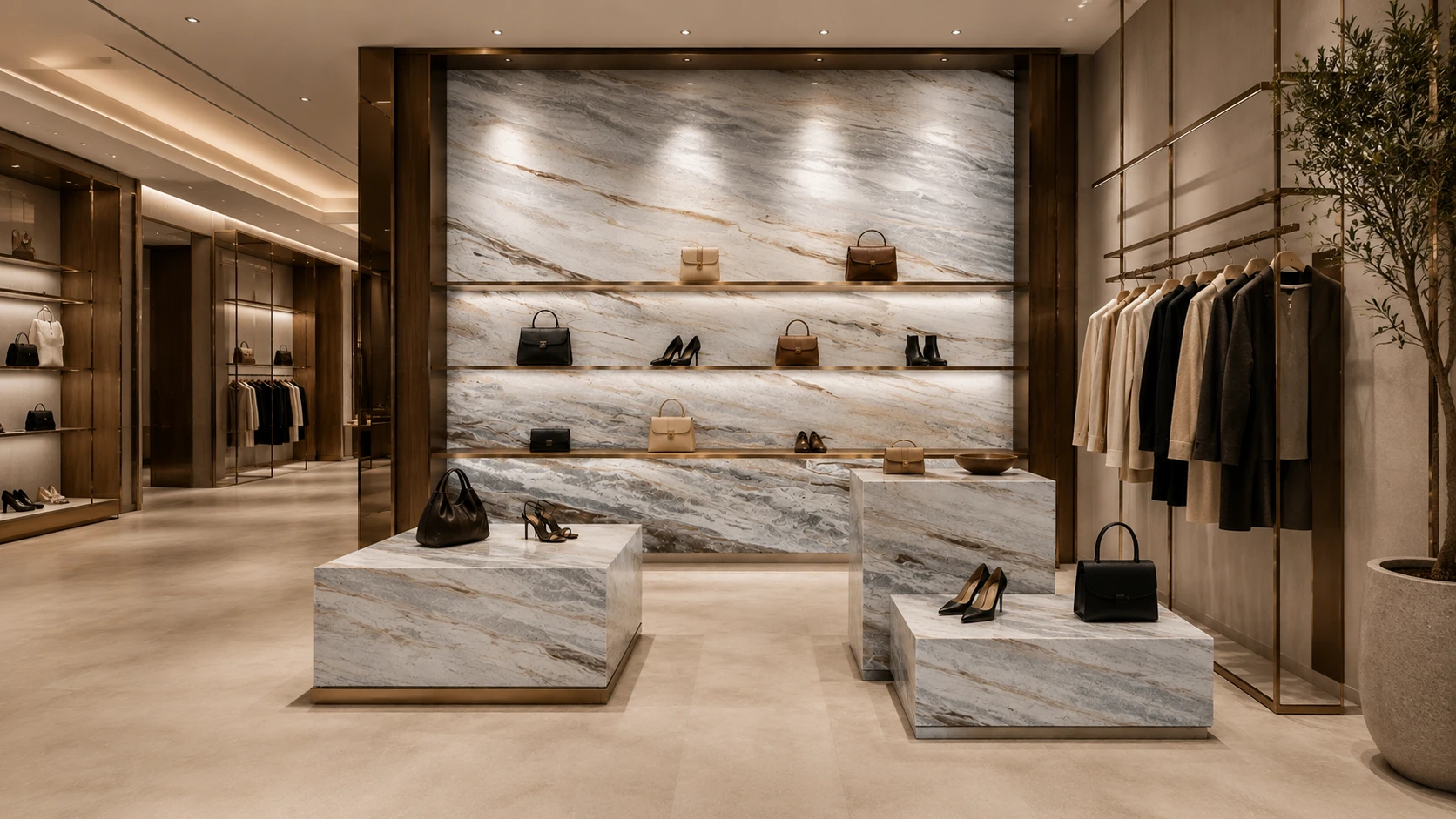
Natural stone for luxury retail interiors is often selected for more than durability or surface decoration. In a premium store, stone can define the entrance, create a visual backdrop for products, form display plinths, wrap cashier counters, establish the fitting-room atmosphere and reinforce the overall material identity of the brand.
Because luxury retail projects are highly visual and often closely coordinated with joinery, metalwork, lighting and display systems, stone specification needs to begin early. A material may look impressive as a slab but still require careful planning before it can become a wall panel, display table, plinth or counter.
The most successful projects connect the actual stone with the drawings before cutting begins. Full-slab approval, digital scanning, colour coordination, mock-ups, cutting layouts, dry-lay inspection and clear numbering can help reduce uncertainty between design approval and site installation.
This guide explains how to specify natural stone for luxury retail interiors from material selection through fabrication, inspection, packing and installation coordination. Buyers can also explore Show Stone’s natural stone collection, marble collection, quartzite collection and Onyx & Semi-Precious Stones collection.
Buyer Decision Check
- Best applications: Store entrances, feature walls, flooring, display tables, plinths, cashier counters, reception points, fitting rooms, stairs and illuminated stone features.
- Main material decision: Match the stone colour, pattern and finish to the brand concept and actual retail zone.
- Main visual-control requirement: Approve actual slabs, colour range, vein direction and major visible surfaces before production.
- Main fabrication requirement: Coordinate custom dimensions, mitres, edges, openings and digital layouts with approved drawings.
- Main delivery requirement: Number and pack finished pieces by store, zone, elevation and installation sequence where required.
Why Natural Stone Works in Luxury Retail Interiors
Luxury retail design often depends on a small number of high-impact materials used with precision. Natural stone can support this approach because every slab has genuine colour variation, movement and mineral character.
Natural stone for luxury retail interiors can help create:
- Strong visual identity
- Premium tactile quality
- Distinctive display backgrounds
- Architectural continuity between floors, walls and counters
- Custom furniture and plinth elements
- Memorable illuminated features with translucent onyx
- A sense of permanence compared with temporary decorative finishes
The key is to use the stone intentionally. A bold exotic slab may be suitable for one central statement wall, while calmer marble or travertine may work better across repeated surfaces.
How to Specify Natural Stone for Luxury Retail Interiors: 12 Key Decisions
Specifying natural stone for luxury retail interiors is easier when the project is divided into a clear sequence. The following twelve decisions cover the main stages from design intent to export delivery.
1. Define Where the Stone Will Be Used
The first step is to identify the exact retail application. A stone chosen for a feature wall may not be fabricated or finished in the same way as a display table or floor.
Common luxury retail applications include:
- Store entrance walls
- Feature walls
- Flooring
- Display tables
- Product plinths
- Cashier counters
- Reception or service counters
- Staircases
- Fitting-room features
- Backlit onyx walls
- Custom stone furniture
Each area should be identified on the drawings before the material and fabrication requirements are finalised.
2. Choose the Stone According to the Brand Direction
Natural stone for luxury retail interiors can communicate very different visual messages depending on the material selected.
Calacatta Monet Marble
Calacatta Monet Marble can create a high-impact decorative surface where strong natural movement is part of the design concept. It can suit statement walls, counters and selected display features.
Arabescato Marble
Arabescato Marble provides a classic white-and-grey marble direction that can work across wall panels, display plinths and refined retail interiors.
Verde Prato Marble
Verde Prato Marble can introduce a deep green natural-stone accent to interiors that need a richer and more distinctive colour identity.
Taj Mahal Quartzite
Taj Mahal Quartzite offers warm neutral movement that can coordinate well with timber, bronze, brushed metal and soft beige retail palettes.
Pink Patagonia
Pink Patagonia can be used where the stone is intended to function as a strong visual statement rather than a neutral architectural background.
Juliet Crystal Quartzite
Juliet Crystal Quartzite is another option for projects seeking a more exotic and decorative slab character.
Travertino Classico
Travertino Classico can support softer, warmer and more architectural retail interiors where designers want natural texture without dramatic high-contrast veining.
Afghan Green Onyx
Afghan Green Onyx is particularly suitable for illuminated features where translucency and colour become part of the store atmosphere.
3. Review the Actual Slabs Before Approval
A sample may confirm general colour, but natural stone for luxury retail interiors should normally be reviewed from the actual slabs when visual appearance is important.
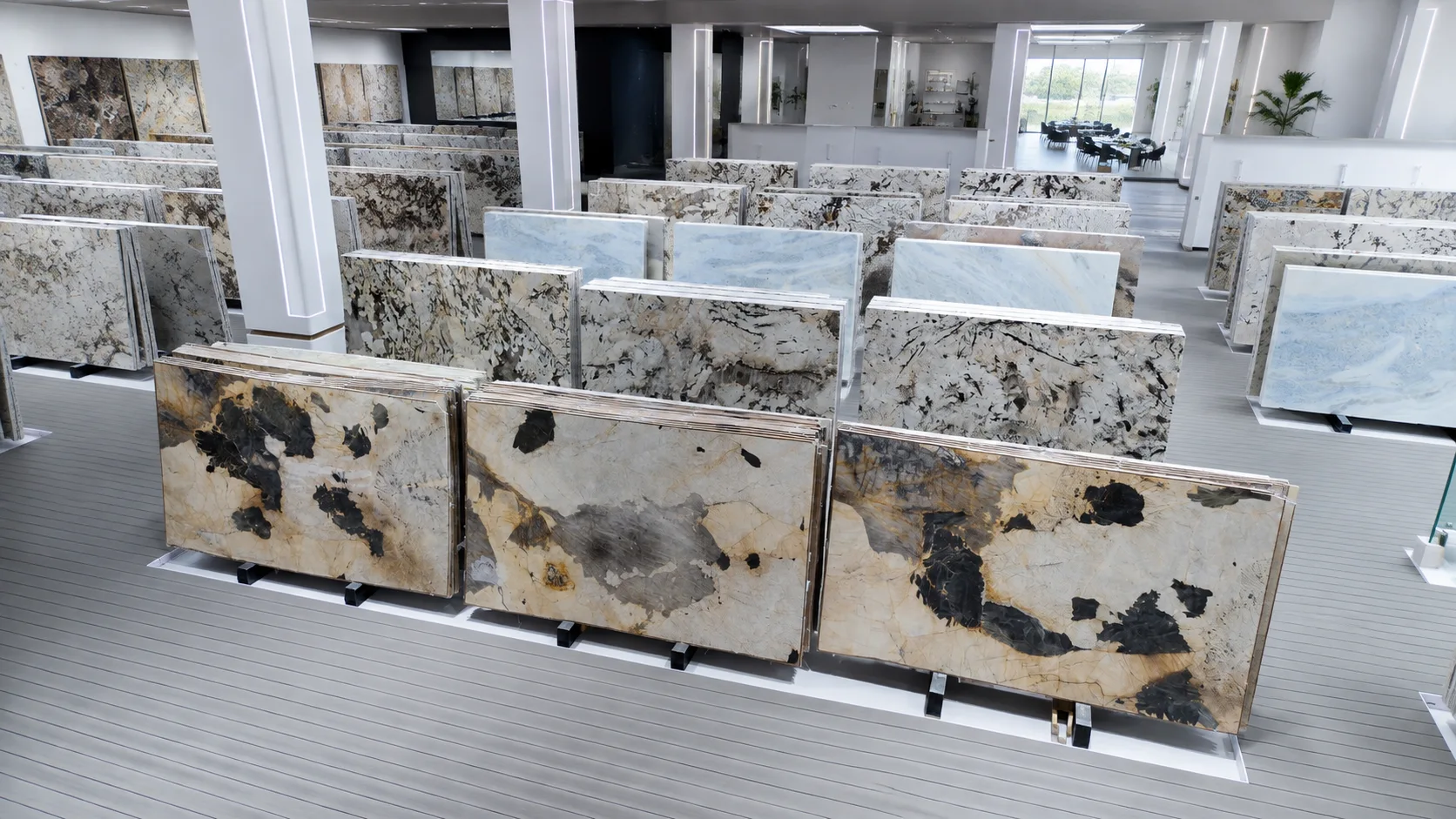
During slab approval, buyers should check:
- Background tone
- Pattern distribution
- Vein direction
- Natural variation
- Visible fissures or repairs
- Slab dimensions
- Available quantity
- Compatibility between slabs for connected areas
Full-slab photography and video can support remote approval when the design team is located in another country.
4. Coordinate Batch and Colour Range
Luxury stores often contain several repeated stone elements. For example, the same marble may appear on a feature wall, a cashier counter and a series of display plinths.
These pieces should not be treated as independent orders if they need to look visually related.
Batch and colour coordination can help organise:
- Connected wall panels
- Repeated display plinths
- Counter fronts
- Floor and wall relationships
- Multiple store zones
The aim is not to remove natural variation, but to control and distribute it intentionally.
5. Use Digital Slab Scanning and Cutting Layouts
Digital slab scanning allows the actual natural-stone pattern to become part of the fabrication-planning process.
Once the slabs are scanned, finished pieces can be positioned digitally before cutting. This helps designers review:
- Feature-wall composition
- Vein direction
- Book-match relationships
- Countertop positions
- Mitred side panels
- Cut-outs and openings
- Material yield
Digital layouts are especially valuable for exotic stones where one section of the slab may look very different from another.
6. Plan Feature Walls as Complete Elevations
Feature walls are one of the most visible uses of natural stone for luxury retail interiors. They should be planned as complete elevations rather than as unrelated panels.
The layout should consider:
- Overall wall dimensions
- Panel joints
- Architectural centre lines
- Display niches
- Product shelves
- Lighting
- Doors
- Metal trims
- Book matching or vein matching
For more detail on this workflow, see Large Format Natural Stone Wall Panels: Specification, Vein Matching & Installation.
7. Use Backlit Onyx for Selected Statement Features
Backlit onyx can turn a wall, counter or display surface into both a stone feature and a lighting element.
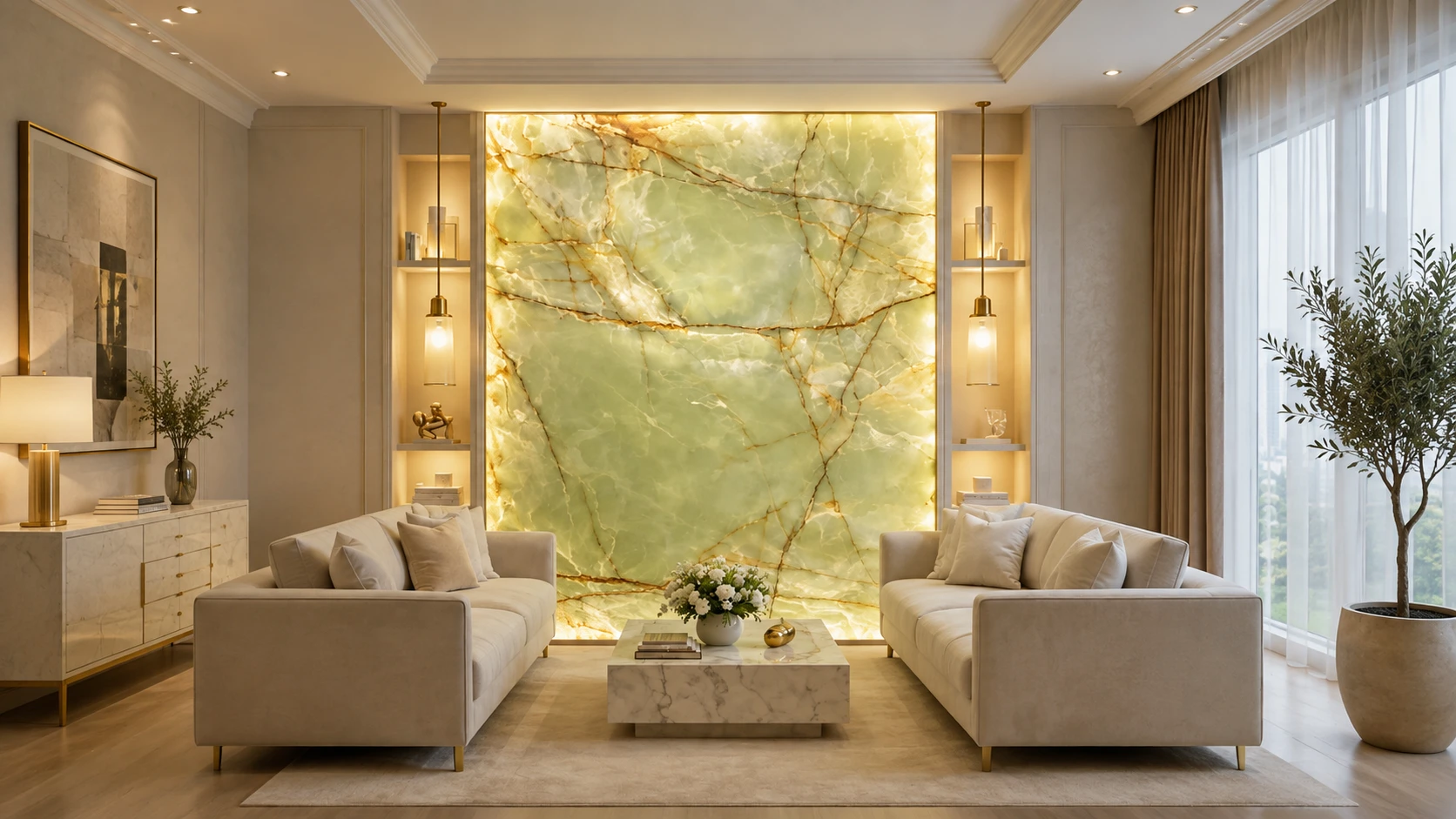
The image above shows a residential application, but the same backlighting principle can be adapted to luxury retail interiors.
Potential retail applications include:
- Cashier counters
- Feature walls
- Display backdrops
- Product niches
- Reception desks
Onyx is commonly supplied at 16mm for many custom projects, with polished or honed finishes available. Reinforcement, backing and lighting-system requirements should be coordinated before fabrication.
For green translucent applications, buyers can review Afghan Green Onyx.
8. Design Custom Display Tables, Plinths and Counters
Natural stone for luxury retail interiors is increasingly used in three-dimensional custom elements rather than only walls and floors.
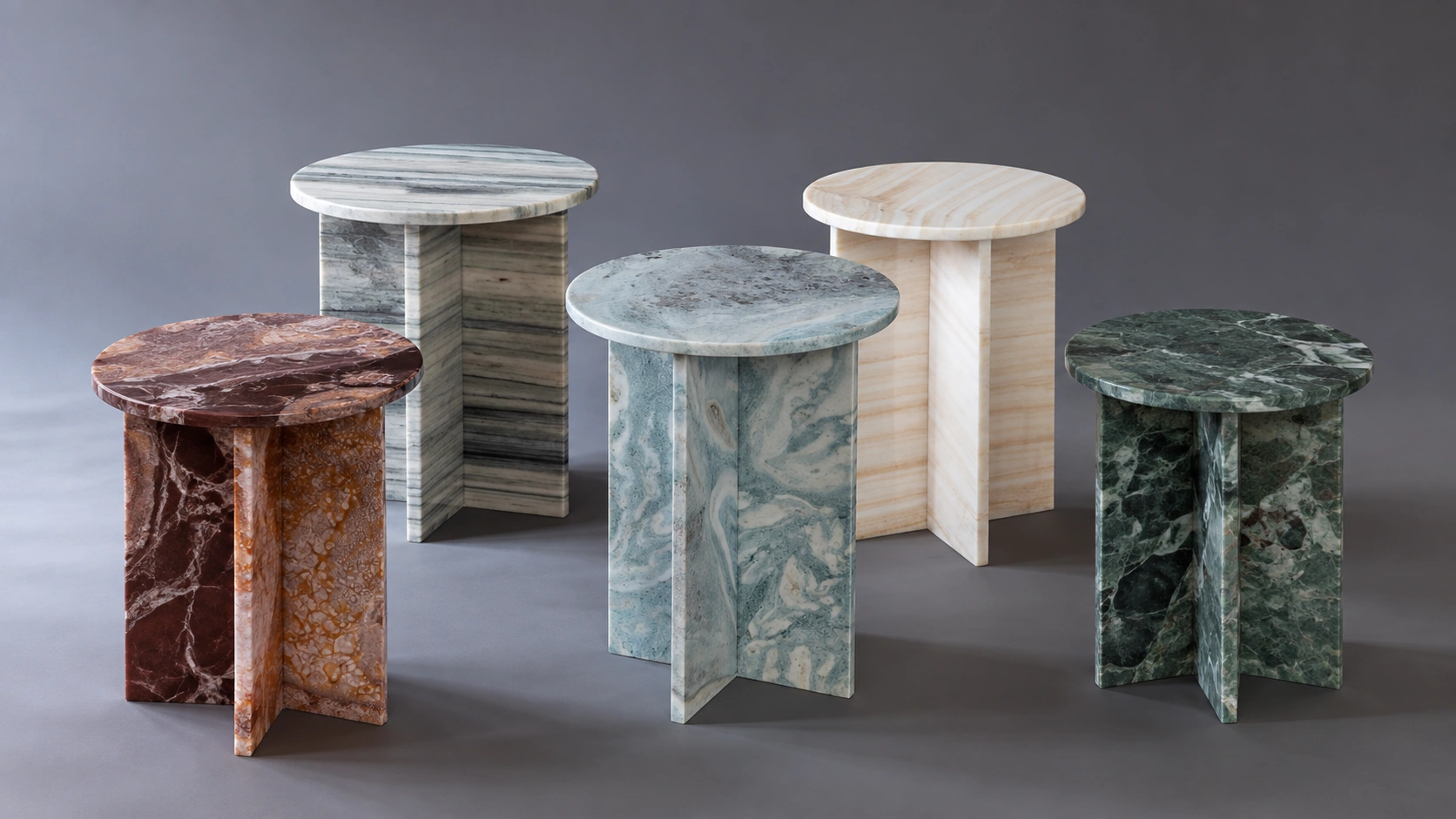
Custom retail fabrication may include:
- Round or rectangular display tables
- Stone plinths
- Cashier counters
- Reception desks
- Pedestals
- Shelving components
- Stone-clad furniture
Fabrication can involve mitred edges, custom edge profiles, waterjet cutting, CNC processing, openings and cut-outs according to approved drawings.
For display surfaces, materials such as Taj Mahal Quartzite, Calacatta Monet Marble and Juliet Crystal Quartzite can support different visual directions.
9. Confirm Thickness, Finish and Edge Details
Common project thicknesses for natural stone for luxury retail interiors are 18mm and 20mm, while other thicknesses can be produced by custom order. Onyx is commonly supplied at 16mm for many illuminated applications.
Available finishes include:
- Polished
- Honed
- Other project-specific finishes according to the selected material
Edge details should also be confirmed early, especially for counters and furniture.
Common fabrication details include:
- Mitred edges
- Built-up edges
- Custom profiles
- Visible polished edges
- Cut-outs
- Openings
10. Produce a Mock-Up or Sample Panel Before Production
Mock-ups are especially useful in luxury retail because several materials may meet in a small area and the design team may need to approve the relationship between stone, metal, lighting and joinery.
A mock-up or sample panel can help review:
- Stone colour
- Surface finish
- Joint appearance
- Mitred edge quality
- Relationship with metal trims
- Lighting effect
- Adhesive or fixing-related fabrication details
Approval before full production can reduce the risk of repeating an unwanted detail across multiple store components.
11. Use Dry Lay and Piece Numbering Before Packing
Dry-lay inspection allows finished stone pieces to be reviewed together before export.
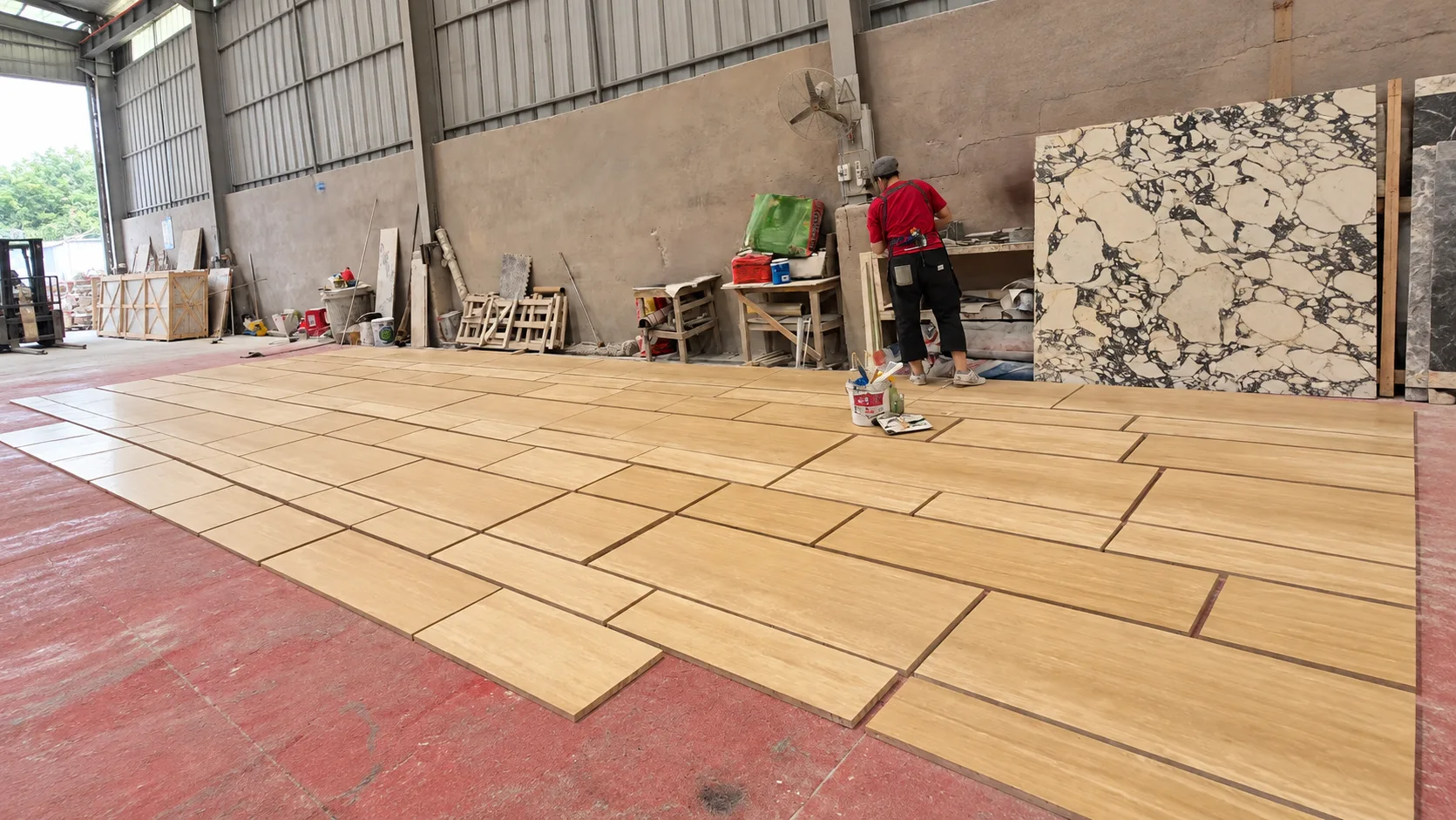
The image above shows flooring pieces, but the same inspection principle can be used for wall panels, counters, plinths and other multi-piece retail components.
Dry lay can help check:
- Colour coordination
- Pattern continuity
- Dimensions
- Mitred relationships
- Panel sequence
- Piece numbers
Piece numbers can then connect the finished stone with the approved shop drawings and packing lists.
12. Pack by Store, Zone, Elevation and Installation Sequence
Luxury retail projects can become difficult to manage when finished components for several areas are mixed together during packing.
Where required, Show Stone can organise finished stone using a sequence such as:
Store → Zone → Elevation → Piece Number → Crate
This can be particularly useful for:
- Stores with multiple interior zones
- Repeated display areas
- Floor and wall packages
- Multi-elevation feature walls
- Projects with tight installation programmes
Foam protection and export wooden crates can be coordinated with piece and crate references so the appointed site team can identify the required components more efficiently.
Store Entrance and Flooring
The entrance establishes the first material impression of the store. Natural stone may be used on the floor, walls, thresholds or display surfaces immediately inside the entrance.
The design team should coordinate:
- Stone colour
- Finish
- Floor module
- Door thresholds
- Adjacent façade materials
- Lighting
- Local project requirements
Where natural stone flooring is used, finish and slip-resistance requirements should be confirmed according to the project area, local code and approved test data.
Feature Walls and Display Backdrops
Feature walls are one of the highest-value applications of natural stone for luxury retail interiors because they frequently sit directly behind key products or brand focal points.
Strong materials such as Pink Patagonia, Calacatta Monet Marble or Verde Prato Marble can create different levels of visual intensity.
For a quieter background, Arabescato Marble or Travertino Classico may support a more restrained architectural direction.
Cashier Counters and Service Desks
Cashier counters are frequently touched and viewed from close range, which means both surface quality and edge fabrication matter.
Specification should confirm:
- Top dimensions
- Front-panel dimensions
- Mitred corners
- Edge profiles
- Equipment cut-outs
- Cable openings
- Support conditions
- Piece numbering
If translucent onyx is used, lighting, backing and reinforcement must also be coordinated.
Fitting Rooms and Private Client Areas
Fitting rooms and VIP client areas may use stone more subtly than the public sales floor. Here the material often supports a calm and refined atmosphere rather than acting as the strongest visual feature.
Travertine, warm quartzite and softer marble can work well in these spaces, particularly when combined with timber, bronze, fabric and indirect lighting.
Digital Fabrication for Custom Retail Components
Custom retail stone often includes shapes that cannot be produced efficiently using basic straight cutting alone.
Show Stone’s fabrication workflow can support:
- Digital slab scanning
- Digital cutting layouts
- Five-axis bridge cutting
- Waterjet fabrication
- CNC processing
- Mitred edges
- Custom profiles
- Openings and cut-outs
This is particularly useful for curved display tables, complex plinths, patterned flooring and custom counter components.
Installation Coordination
Natural stone for luxury retail interiors should be fabricated with the approved installation method in mind.
Show Stone can coordinate:
- Mechanical fixing-related fabrication details
- Adhesive installation requirements
- Panel dimensions
- Piece numbering
- Elevation references
- Installation sequence information
Show Stone does not undertake on-site installation. Site installation is carried out by the client, contractor or appointed installation team. Our role is to provide fabrication, numbering, drawing coordination and installation support before shipment and during project coordination where required.
Technical Specification Guidelines
| Specification | Typical Project Option | Project Notes |
|---|---|---|
| Materials | Marble / Quartzite / Onyx / Travertine / Limestone / Granite | Select according to brand concept, application and project requirements. |
| Size | Custom cut-to-size | Produced according to approved drawings. |
| Common Thickness | 18mm / 20mm | Other thicknesses available by custom order. |
| Onyx Thickness | 16mm common | Final thickness depends on application and backing requirements. |
| Finish | Polished / Honed / Other project finishes | Finish suitability depends on the selected stone and application. |
| Slab Approval | Full-slab photo / video | Supports remote material and batch review. |
| Digital Planning | Digital scanning / Cutting layout | Used for vein control, component position and material yield. |
| Matching | Book matching / Vein matching | Recommended for visually important connected surfaces. |
| Fabrication | Cut-to-size / Mitres / Custom edges / Waterjet / CNC / Openings | According to approved drawings and shop details. |
| Pre-Production Review | Mock-up / Sample panel | Useful for detail approval before repeat production. |
| Quality Control | Dry lay / Piece numbering / Area numbering | Supports layout review and site identification. |
| Packing Sequence | Store / Zone / Elevation / Installation sequence | Can be coordinated with project drawings and piece numbers. |
| Installation Support | Mechanical / Adhesive coordination | Show Stone does not undertake on-site installation. |
| MOQ | 1 pc | Suitable for mock-ups, custom pieces and larger projects. |
| Lead Time | Approximately 4 weeks | Depends on material approval, quantity and fabrication scope. |
| Packing | Foam + export wooden crates | Crates can follow store and installation-zone references. |
Common Mistakes When Specifying Luxury Retail Stone
Choosing Stone Only From a Small Sample
A small sample cannot represent the complete slab pattern or explain how the finished feature wall or counter will look.
Selecting Stone Before Defining the Application
The same material may need different thickness, finish, backing or fabrication depending on whether it becomes flooring, a wall panel or a display table.
Ignoring Batch and Colour Coordination
Repeated plinths and connected surfaces can look inconsistent if natural variation is not organised before production.
Cutting Exotic Slabs Without a Digital Layout
Strong-veined or highly varied slabs benefit from digital positioning before irreversible cutting begins.
Skipping the Mock-Up Stage
Repeated details should ideally be approved once before they are produced across multiple components.
Packing All Store Areas Together
Clear store, zone, elevation and piece references can make site sorting and installation significantly easier.
Assuming the Stone Supplier Is the Site Installer
The supplier can coordinate stone fabrication and installation-related details, but the appointed contractor or project team remains responsible for on-site installation.
Buyer Checklist Before Ordering
- Application: Define entrance, floor, wall, display, counter, plinth, stair or illuminated feature.
- Material: Confirm the exact marble, quartzite, onyx, travertine, limestone or granite.
- Actual Slabs: Review full-slab photographs, videos and available quantities.
- Colour Range: Approve acceptable natural variation and batch relationships.
- Size: Provide finished custom dimensions and shop drawings where available.
- Thickness: Confirm 18mm, 20mm, 16mm onyx or another approved custom thickness.
- Finish: Confirm polished, honed or another material-specific finish.
- Digital Layout: Approve vein direction and component position before cutting.
- Edges: Confirm mitres, custom profiles and visible finished edges.
- Openings: Provide equipment, cable, lighting and fixing-related cut-outs.
- Mock-Up: Approve representative sample details before repeated production where required.
- Dry Lay: Review connected surfaces and repeated components before packing.
- Numbering: Connect every finished piece with its store, zone or elevation.
- Packing: Confirm packing by store, zone and installation sequence where needed.
- Installer: Coordinate mechanical or adhesive requirements with the appointed site team.
- Lead Time: Allow time for slab approval, mock-up, fabrication, inspection and shipment.
Frequently Asked Questions
What natural stones are suitable for luxury retail interiors?
Marble, quartzite, onyx, travertine, limestone and granite can all be suitable depending on the brand concept, application, finish, fabrication requirements and project conditions.
Where can natural stone be used in a luxury retail store?
Natural stone can be used for entrances, flooring, feature walls, display tables, plinths, cashier counters, service desks, staircases, fitting-room features and illuminated stone applications.
Why should actual slabs be approved before fabrication?
Actual slabs show full colour, pattern, vein direction, natural variation and usable dimensions that cannot be evaluated accurately from a small sample alone.
Can natural stone display tables and plinths be custom fabricated?
Yes. Custom cut-to-size fabrication can include mitred edges, custom profiles, waterjet processing, CNC fabrication, openings and other project-specific details according to approved drawings.
Can backlit onyx be used in luxury retail interiors?
Yes. Backlit onyx can be used for feature walls, cashier counters, display backdrops, niches and reception features where the stone and lighting system are coordinated together.
What thickness is commonly used for luxury retail stone?
18mm and 20mm are common project thicknesses for many natural stones, while 16mm is commonly used for many onyx applications. Other thicknesses can be produced by custom order.
Can a mock-up or sample panel be produced before full production?
Yes. Mock-ups or sample panels can be prepared where required to review material, finish, edge details, joints and relationships with other project elements before repeated production.
Why is dry-lay inspection useful for retail projects?
Dry lay allows finished pieces to be reviewed for colour, pattern relationships, dimensions, mitres and sequence before numbering and export packing.
Can stone be packed by store or installation zone?
Yes. Finished pieces and crates can be organised by store, zone, elevation and installation sequence where required, helping the appointed site team identify materials more efficiently.
Does Show Stone provide on-site installation?
No. Show Stone provides fabrication support, piece numbering, drawing coordination and mechanical or adhesive installation coordination, while on-site installation is carried out by the client, contractor or appointed project installation team.
Why Luxury Retail Project Buyers Work With Show Stone
Show Stone supports architects, designers, contractors, developers, retailers and importers sourcing natural stone for luxury retail interiors through a workflow that connects slab selection, digital planning, precision fabrication, inspection, packing and international project coordination.
Our support can include:
- Natural stone sourcing
- Full-slab photography and video approval
- Consecutive slab and batch coordination
- Digital slab scanning
- Digital cutting layouts
- Book matching and vein matching
- Custom cut-to-size production
- Mitred and custom edge fabrication
- Waterjet processing
- CNC fabrication
- Openings and cut-outs
- Mock-ups and sample panels
- Factory dry-lay inspection
- Piece, area and elevation numbering
- Packing by store, zone and installation sequence
- Mechanical fixing coordination
- Adhesive installation coordination
- Foam protection and export wooden-crate packing
- International shipment coordination
Show Stone does not undertake on-site installation. The finished stone is prepared, numbered and documented to support the client’s appointed contractor or installation team.
Project buyers can compare materials such as Calacatta Monet Marble, Travertino Classico, Afghan Green Onyx, Taj Mahal Quartzite, Pink Patagonia, Arabescato Marble, Verde Prato Marble and Juliet Crystal Quartzite.
For related wall-panel planning, see Large Format Natural Stone Wall Panels: Specification, Vein Matching & Installation.
For independent technical information on natural stone design and specification, project teams can also review the Natural Stone Institute resources for design professionals.
More information about Show Stone’s project capabilities is available through our natural stone solutions, About Show Stone and the Show Stone blog.
Final Recommendation
Natural stone for luxury retail interiors should be specified as part of the complete store-design and delivery workflow. The strongest projects connect the actual slab, colour range, digital layout, fabrication details, mock-up, dry lay, numbering and packing sequence before production is completed.
For feature walls, display furniture, counters, flooring and illuminated stone elements, early coordination helps preserve the design intent while making fabrication and site identification more manageable.
To discuss natural stone for a luxury retail project, please contact Show Stone with your preferred materials, store drawings, application areas, dimensions, thickness, finish, fabrication details, approximate quantity and delivery destination.